In the rolling green valleys of the Appalachian Mountains, where mist gathers at dawn and settles softly over cornfields and pastures, lived a farm boy named Jack. Like many poor folk in those hills, Jack’s family had more heart than money. Their cabin was small, their fields rough, but Jack’s mother always said, “A sharp mind plows straighter than a rich man’s mule.”
Jack took those words to heart. He worked hard but dreamed harder, of earning his own way, of having a farm where no one could cheat him out of what was rightfully his. One spring morning, his mother told him, “Jack, the old cow’s calved again. Take the young steer to market. See what price you can fetch.”
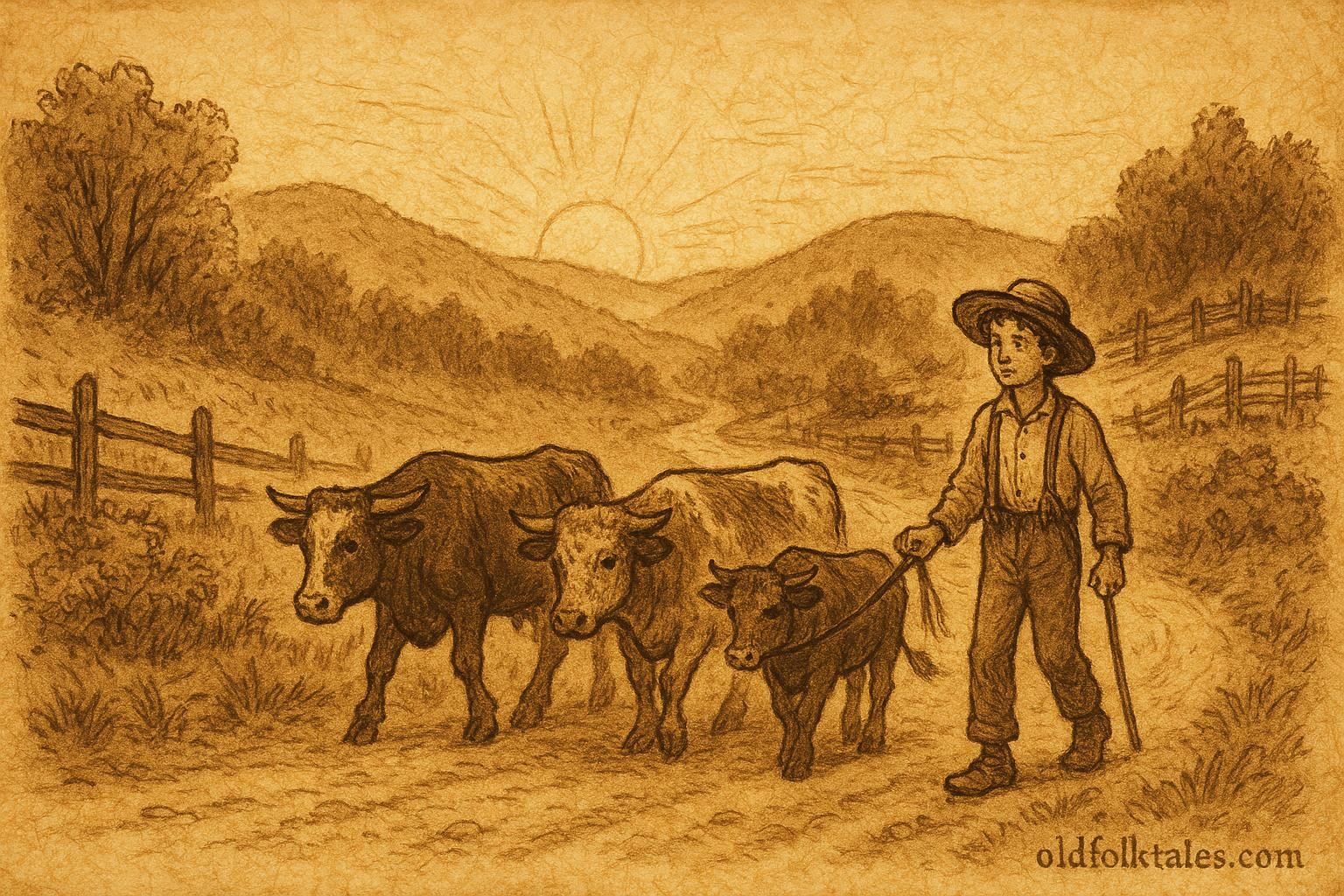
So, with a stick in hand and his lunch tied in a rag, Jack set out down the mountain road. The steer was a fine little creature, red-coated, with bright eyes and a stubborn streak that matched Jack’s own. Along the way, the sun burned bright over the ridges, and the scent of new clover filled the air.
Discover ancient tales passed down by the Indigenous peoples of the Americas.
Before long, Jack met a neighbor, Old Man Griggs, leaning on his fence. Griggs was known for his silver tongue and tricky trades. “Morning, Jack,” he said, squinting. “Fine steer you’ve got there. Where’re you bound?”
“Off to market,” said Jack.
Griggs smiled slyly. “No need to go that far, boy. I’ll give you two steers in trade, see, they’re yonder in my field. Yours is scrawny; mine are well-fed. Fair bargain, eh?”
Jack looked over the fence. Sure enough, there stood two glossy steers, broad and fat. But something in Griggs’s grin didn’t sit right. Jack tipped his hat and said, “I reckon I’ll hold to the road, sir. Ma says count your herd before you trade.”
“Suit yourself,” Griggs muttered, but his eyes gleamed like river stones.
As Jack turned away, Griggs called, “Then I’ll buy him for gold, if you can prove that steer’ll follow you without a rope!”
Jack smiled. He gave a low whistle, and the little steer trotted right after him, as faithful as a hound. Griggs scowled, and Jack walked on, whistling a tune his mother had taught him.
Further down the road, Jack met a farmer driving three steers of his own. The man stopped and said, “Boy, I’ve lost count of mine. I was meant to have three, but my eyes aren’t what they used to be. If you can tell me how many beasts stand here, I’ll give you a bag of corn.”
Jack looked closely. Two of the farmer’s steers stood side by side—but in the shadows behind them, his own red steer had wandered to graze. “There’s three, sir,” Jack said quickly.
The farmer laughed. “So there are! You’ve a keen eye, boy. Take the corn, and good fortune to you.”
Jack thanked him kindly and went on his way, his little herd now numbering three, the red steer, and two more that had somehow followed along. It was said by some that the farmer’s beasts just liked the company, and by others that fortune smiled on honest hearts.
By the time Jack reached the market town, the day was half-spent. Dust rose from the road as traders called out prices. A man in fine clothes looked over Jack’s steers and said, “I’ll buy the lot, but only if you can tell me which one is purebred.”
Jack scratched his head, then looked each steer in the eye. “That one,” he said, pointing to his red calf. “He was born to our cow, and I raised him myself. The others joined me on the road, they chose me, but they’re not mine to sell.”
The merchant, struck by the boy’s honesty, smiled. “You’ve got more sense than half the men in this market. Keep your red steer, and take this silver for your corn. You’ll need it come planting season.”
Jack thanked him and made his way home as the sun dipped low behind the ridges. When he reached the cabin, his mother came running. “Jack! You left with one steer, how do you come home with three?”
Jack grinned. “By keeping my eyes open and my word good.”
That night, as they shared cornbread and stew, the firelight flickered across their faces. Outside, the night wind whispered through the pines, carrying the promise of better days.
Moral Lesson
The story of Jack and the Three Steers teaches that honesty, wit, and fairness can outshine greed and deceit. True success comes not from taking what isn’t yours but from knowing your worth, standing your ground, and trusting good sense over easy gain.
Knowledge Check
1. Who is Jack in Appalachian folklore?
Jack is a clever and humble farm boy who represents resourcefulness and rural wisdom in Appalachian folktales.
2. What is the main conflict in “Jack and the Three Steers”?
Jack faces challenges from deceitful or greedy men as he tries to make an honest living with his single steer.
3. What moral does “Jack and the Three Steers” teach?
It teaches that cleverness and honesty are stronger tools for survival than wealth or trickery.
4. How does the Appalachian setting shape the story?
The farm roads, mountain markets, and rural life reflect the Appalachian culture’s respect for hard work and integrity.
5. What do the steers symbolize in the story?
The steers symbolize opportunity and reward earned through diligence, truth, and wisdom.
6. Why is “Jack and the Three Steers” an important American folktale?
It preserves Appalachian farm values, showing how folk wisdom and character define success in rural America.
Source: Adapted from Appalachian Jack Tales (oral tradition), collected in the American Folklife Center, Library of Congress.
Cultural Origin: Appalachian Mountains, United States.