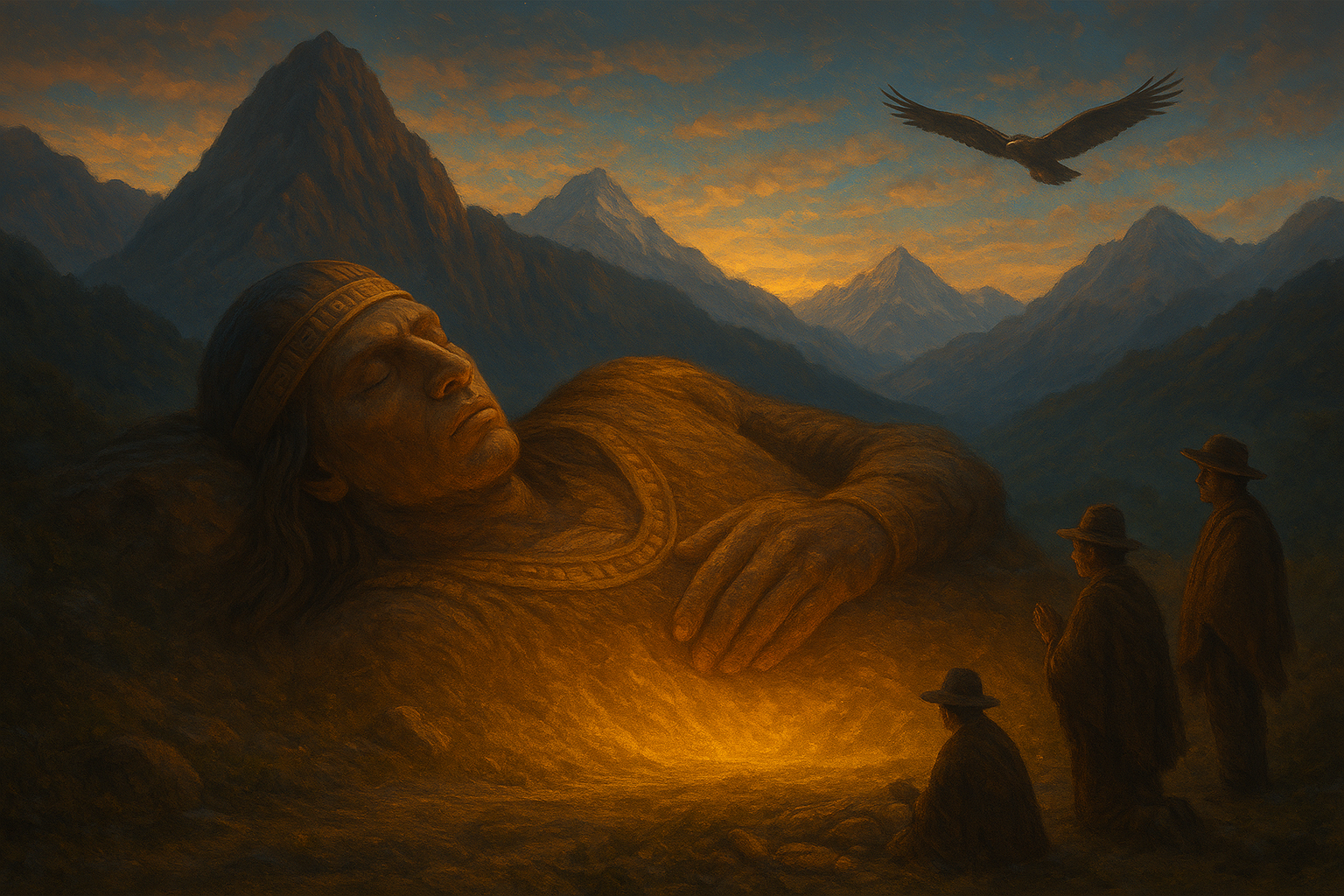
In the age when the empire of the Inca stood tall and proud, stretching across mountains and valleys like a vast condor spreading its wings over the Andes, there lived a leader whose name still echoes through the highland winds, Inkarri. His name itself carried power, a fusion of “Inca” and “rey,” the Spanish word for king, as though even language recognized that he embodied both the ancient ways and the new reality that had crashed upon his people like an avalanche.
Inkarri was no ordinary ruler. His heart burned with an intensity that rivaled the sun his ancestors had worshipped, a fierce and unwavering flame fueled by love for his people and devotion to their freedom. In his veins flowed the blood of emperors, of those who had built Cusco into the navel of the world, who had carved terraces into impossible mountainsides and constructed cities of stone so perfectly fitted that not even a blade of grass could slip between the blocks.
Click to read all South American Folktales — timeless stories from the Andes to the Amazon.
But the world was changing in ways that no divination could have foreseen, no oracle could have prevented. From across the great waters came the colonizers strangers with pale skin and strange weapons, riding animals the highland people had never seen, wielding thunder and lightning in metal tubes, speaking of a different god and claiming dominion over lands that had belonged to the children of the sun since time beyond memory.
The mighty Inca Empire, which had seemed as eternal as the mountains themselves, began to crumble. Cities fell. Sacred temples were violated and destroyed, their gold stripped away and melted down, their wisdom scattered like seeds on barren ground. The people who had once ruled from the jungle to the sea found themselves conquered, subjugated, their ways forbidden, their beliefs suppressed.
Inkarri fought with everything he possessed. While others surrendered or fled into the high mountains, he rallied those who still remembered what freedom tasted like, who refused to bow before foreign masters. His resistance became legendary a thorn in the side of the conquerors, a flame of hope that refused to be extinguished no matter how fierce the winds of oppression blew.
But legends, no matter how bright they burn, cannot stand forever against overwhelming force. The colonizers, threatened by what Inkarri represented, hunted him relentlessly. They could not allow such a symbol of resistance to continue inspiring rebellion. They could not permit the old ways to survive in his living form.
When they finally captured him, they knew that simply killing him would not be enough. A martyr’s death might make him more powerful in memory than he had been in life. The people might gather at his tomb, turn it into a shrine, keep his spirit alive through their devotion. No, they needed to do something more complete, more devastating, something that would scatter his power to the winds and prevent his memory from coalescing into dangerous hope.
So they struck him down with brutal efficiency. They beheaded him, separating his head from his body in a final act of domination. But even that was not sufficient for their purposes. They took his dismembered body his head, his arms, his legs, his torso and scattered the pieces across the vast expanse of the Andes. His head they buried deep beneath the earth of Cusco itself, that sacred city that had been the heart of his empire. His limbs they distributed to distant corners of the mountains, hidden in places known only to those who had performed this grim task.
They believed they had won. They believed that by fragmenting his body and burying the pieces in secret, they had destroyed not just the man but everything he represented. They believed the story was over.
They were wrong.
For even as Inkarri’s body lay scattered and buried, something extraordinary began to happen in the darkness beneath the mountains. The earth, which had nurtured the Inca people for countless generations, did not allow their greatest defender to simply decay into dust. The stones of Cusco, which had been laid by hands that loved them, did not forget whose blood had spilled upon them. The mountains themselves, ancient beyond human understanding, began a work of secret magic.
Deep underground, where no light penetrates and time moves differently than it does in the world above, Inkarri’s body began to regenerate. Slowly, impossibly, his scattered pieces started to rebuild themselves. Bone knitted back to bone with patient, inexorable determination. Flesh reformed, cell by cell, molecule by molecule. His heart, though pierced and buried, began to beat again with a rhythm as steady as the drums of ancient ceremonies.
The process is slow agonizingly, frustratingly slow by the measure of human lifetimes. But the earth measures time in epochs, not years. What seems eternal to those who live and die in the span of decades is merely a moment to the mountains that have stood since the world was young.
The villagers of the highlands know this secret. They have always known it, passing the knowledge down through generations like a precious seed saved from harvest to planting. In the darkest hours of night, when the world grows quiet and even the wind holds its breath, those who press their ears to the ground swear they can hear faint murmurs rising from below the sound of bones shifting, of joints reconnecting, of a body slowly, patiently rebuilding itself into wholeness.
These are not ghost stories told to frighten children or entertain visitors. This is living faith, burning hope that sustains a people who have endured centuries of oppression and cultural erasure. The legend of Inkarri is a promise whispered in the shadows: one day he will rise. One day his body will be whole again. One day he will push aside the earth that covers him, stand tall beneath the Andean sky, and restore the empire that was stolen. One day he will cast out the oppressors and return the land to those whose ancestors shaped it with their hands and blessed it with their prayers.
At mountain shrines throughout the highlands, people leave humble offerings that serve dual purposes, they honor the memory of what was, and they prepare for what will be. Bundles of coca leaves, those sacred plants that connect earth to sky, human to divine. Ears of maize in colors that span the rainbow, representing the bounty and diversity of their land. Chicha, the fermented corn drink that has blessed celebrations and ceremonies since before the Spanish came. These offerings are not relics of a dead past but seeds of a living future.
The people wait with hearts that hold both sorrow and expectation in careful balance. They mourn what was lost the libraries burned, the knowledge destroyed, the languages suppressed, the children torn from their culture. But they also watch for signs of the return, reading the landscape and the weather like a sacred text.
When the rivers swell unexpectedly, rushing down from the mountains with unusual force, some believe it is Inkarri’s blood beginning to flow again through the land’s veins. When condors cry at dusk, their haunting calls echoing across valleys, people pause and wonder if the great birds are announcing the stirring of the king beneath the earth. When earthquakes shake the highlands and they shake often in this land of ancient geological forces there are those who whisper that it is Inkarri shifting in his underground chamber, testing his regenerated limbs, preparing for the day when he will finally rise.
The Spanish conquerors are long gone, but their legacy of colonization remains embedded in the structures of power and the patterns of inequality. Yet Inkarri’s legend persists, stubborn as mountain stone, vital as spring water. Though his empire was shattered into fragments, though the great buildings of Cusco were torn down or built over, though the language and customs were suppressed and nearly extinguished, the story remains alive.
It lives in the stones of ruined temples that tourists photograph without understanding their significance. It lives in the mountains that tower over the cities, indifferent to the comings and goings of empires. It lives in the songs sung in Quechua when the outsiders aren’t listening, in the ceremonies performed at dawn before the modern world awakens, in the dreams of children who still hear the old stories whispered by grandparents who remember.
Inkarri sleeps, but his sleep is not death. It is preparation. It is transformation. It is the long, patient work of resurrection that cannot be rushed but cannot be stopped. And as long as the people remember him, as long as they leave their offerings and whisper their hopes, as long as they teach their children that what was broken can be made whole again, the legend lives.
The empire may have fallen, but the spirit endures. And one day perhaps tomorrow, perhaps in a hundred generations Inkarri will rise.
Explore myths and legends from Brazil, Peru, and Argentina rooted in spirit and survival.
The Moral Lesson
The legend of Inkarri teaches that the spirit of a people cannot be destroyed, no matter how completely their political structures are dismantled or how thoroughly their oppressors try to erase them. It demonstrates that true resistance lives not just in armies and battles, but in stories, memories, and cultural continuity passed down through generations. The tale emphasizes that hope itself is a form of rebellion, that patience can be a revolutionary act, and that what appears defeated may simply be regenerating in the darkness, waiting for its moment to return. Most profoundly, it shows that a people’s identity and dignity survive beyond conquest, living in their stories, ceremonies, and unshakeable belief in eventual restoration and justice.
Knowledge Check
Q1: Who was Inkarri and what does his name represent in this Andean folktale? A: Inkarri was a legendary Inca leader whose name combines “Inca” with “rey” (Spanish for king), symbolizing the fusion of indigenous and colonial realities. He represents the spirit of resistance and freedom for the Andean people, fighting against Spanish colonizers to preserve his people’s way of life. His story embodies the undying hope for the restoration of indigenous sovereignty and cultural identity in the Andes.
Q2: What happened to Inkarri’s body after the colonizers captured him? A: The colonizers beheaded Inkarri and deliberately scattered his dismembered body parts across the Andes Mountains to prevent him from becoming a martyr. His head was buried deep beneath Cusco, the sacred capital, while his limbs were hidden in distant corners of the mountains. This scattering was intended to destroy both the man and the symbol of resistance he represented.
Q3: What is happening to Inkarri beneath the earth according to Andean belief? A: According to this Andean folktale, Inkarri’s scattered body is slowly regenerating and rebuilding itself deep underground. His bones are knitting back together, his flesh is reforming, and his heart beats again with patient determination. Villagers who listen closely at night claim to hear faint murmurs from below the sound of his body reassembling itself in preparation for his prophesied return.
Q4: What offerings do Andean highland people leave for Inkarri and why? A: People leave offerings of coca leaves, maize, and chicha (fermented corn drink) at mountain shrines throughout the Andean highlands. These offerings serve both to honor Inkarri’s memory and to prepare for his prophesied return. They represent living faith rather than mere historical remembrance, symbolizing the people’s continued hope for restoration of their sovereignty and cultural autonomy.
Q5: What natural signs do Andean people interpret as evidence of Inkarri’s stirring? A: The highland people interpret several natural phenomena as signs of Inkarri’s awakening: rivers swelling unexpectedly suggest his blood beginning to flow through the land again; condors crying at dusk are seen as announcements of his stirring; and earthquakes are believed to be Inkarri shifting underground, testing his regenerated limbs in preparation for rising.
Q6: What deeper cultural meaning does the Inkarri folktale hold for indigenous Andean peoples? A: The Inkarri legend represents the indomitable spirit of indigenous Andean resistance and cultural survival despite centuries of colonization and oppression. It symbolizes the belief that what was broken can be made whole again, that indigenous sovereignty and dignity persist beyond conquest, and that patient hope itself is a form of rebellion. The folktale keeps alive the promise that justice will eventually be restored and that indigenous ways, though suppressed, continue regenerating through cultural memory, ceremony, and storytelling passed through generations.
Source: Adapted from “The myth of Inkarri”
Cultural Origin: Indigenous Quechua and other peoples of the southern Andes highlands, particularly around Cusco, Peru (post-conquest Andean oral tradition)