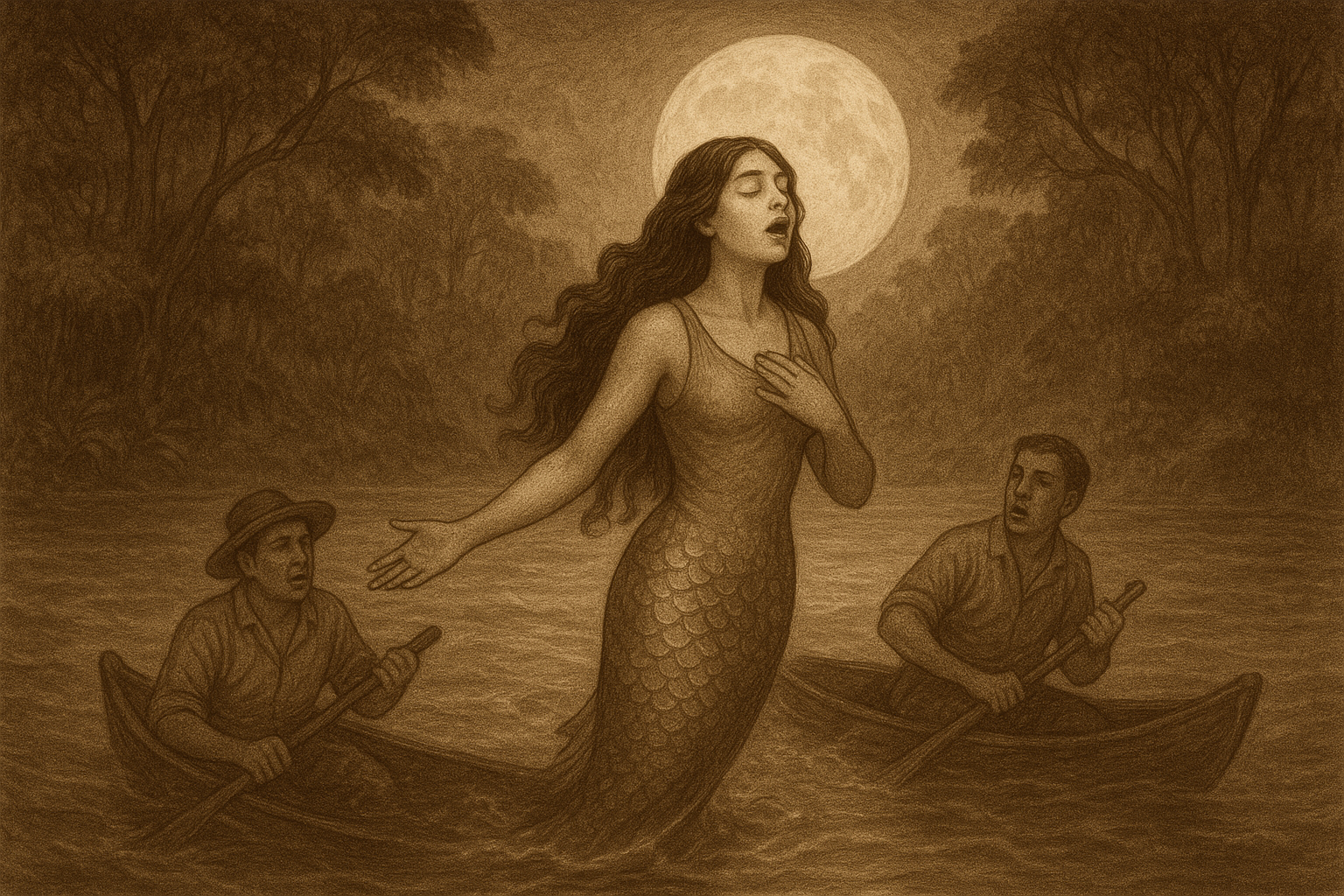
In the time before memory fades into mist, along the great rivers of the Amazon where the dense jungle pressed close to the water’s edge, there lived a young woman named Iara. She was no ordinary daughter of the tribe; she was the child of the powerful shaman himself, a man whose wisdom guided their people through seasons of plenty and hardship alike.
But Iara possessed gifts that set her apart even from her father’s mystical calling. Where other young women learned the arts of weaving and gathering, Iara excelled in the ways of the warrior. Her aim with bow and spear was truer than any hunter’s. Her footfall in the forest was as silent as a shadow. In times of conflict with neighboring tribes, it was Iara who led the defenses, her strategies clever and bold, her courage unshakeable as the ancient trees.
Click to read all South American Folktales — timeless stories from the Andes to the Amazon.
The tribe celebrated her prowess, singing songs of her victories around the fire. The elders nodded with approval. Her father swelled with pride. But in the hearts of her brothers, a darker seed took root and flourished the bitter vine of envy.
They were warriors too, strong and capable, yet they always lived in their sister’s shadow. At every gathering, it was Iara’s name on everyone’s lips. Every hunt, every battle, every test of skill, she surpassed them. The jealousy gnawed at them like termites through wood, hollowing out whatever love had once dwelt there, replacing it with resentment and rage.
Under the cover of darkness, when the jungle hummed with night creatures and the river whispered secrets to the moon, the brothers made their terrible decision. They would end this humiliation. They would reclaim their honor. They laid their ambush carefully, hiding along the path their sister walked each evening to bathe in the river.
But Iara had not earned her reputation through strength alone her instincts were as sharp as her weapons. She sensed the disturbance in the forest’s rhythm, the unnatural tension in the air. When her brothers sprang from the shadows with murder in their eyes, she was ready.
The fight was swift and terrible. Iara, fighting for her very life against those who should have protected her, defended herself with all her considerable skill. When the struggle ended beneath the indifferent stars, it was her brothers who lay still upon the forest floor, and Iara who stood trembling, her hands stained with kindred blood.
Horror and grief crashed over her like rapids over stone. She had killed her own brothers. What choice had she possessed? But would anyone believe her? Would her father, powerful shaman though he was, see past the death of his sons to understand his daughter’s desperate self-defense?
Terror seized her heart. Iara fled deep into the forest, running through the night, branches tearing at her skin, her breath ragged with sobs. She ran until exhaustion claimed her, until the jungle swallowed her completely.
But a shaman’s power runs deep, and a father’s determination deeper still. Through magic and tracking, through divination and persistence, he found her. When his eyes fell upon his daughter his gifted, warrior daughter they held no understanding, no mercy. He saw only the killer of his sons.
The punishment was swift and merciless. He dragged her to the meeting of two great rivers, where the dark waters of the Rio Negro flowed alongside the sandy-brown Solimões, the two currents running side by side without mixing, as though the rivers themselves could not reconcile. There, he cast his own daughter into the depths.
The waters closed over Iara’s head, dark and cold. She sank down, down into the river’s embrace, lungs burning, light fading above. But the river had witnessed everything the betrayal, the self-defense, the injustice. The fish, those ancient children of the waters, came to her rescue.
They surrounded her sinking form, their scales glinting in the filtered light. They carried her deeper still, to a place where the river’s magic ran strongest. And there, on a night when the full moon’s light penetrated even to the river bottom, turning the water silver and strange, Iara was transformed.
Her legs fused and reshaped, becoming a powerful tail covered in shimmering scales that caught every color of the rainbow. Her beauty, already remarkable, became otherworldly, hypnotic. Her voice, once strong with warrior’s commands, became hauntingly melodious the sound of water over stones, of wind through reeds, of ancient longing given sound.
Now Iara dwells in the Amazonian rivers, the Lady of the Waters, neither fully human nor fish, belonging completely to neither world. At dusk, when the light turns golden and the river catches fire with the setting sun, she appears near the water’s edge. Her beauty is dazzling, impossible to describe and more impossible to resist. Her voice rises in wordless song, enchanting, irresistible.
Fishermen hear her singing and feel themselves drawn forward, their boats drifting toward the sound despite their better judgment. Young men walking the riverbanks find their feet carrying them toward the water’s edge, their minds clouded with desire and longing. Some disappear beneath the waves forever, pulled down into Iara’s aquatic realm. Others escape, but return to their villages haunted, forever changed, speaking of beauty and terror so intertwined they cannot separate one from the other.
The elders warn their children: the river is alive. The river remembers. The river demands respect. In Iara’s story lives a warning the waters of the Amazon are beautiful but dangerous, alluring but deadly. To venture carelessly near them, to take them for granted, is to risk the same enchantment that dooms the unwary.
And so Iara remains, the Lady of the Waters, both victim and avenger, tragic figure and dangerous seductress, a reminder that injustice transforms those it touches, and that the natural world possesses powers beyond human understanding or control.
Explore myths and legends from Brazil, Peru, and Argentina rooted in spirit and survival.
The Moral Lesson
The legend of Iara teaches us that jealousy and injustice create lasting consequences that ripple outward like stones thrown into water. It reminds us to respect the power of nature particularly water which can be both life-giving and deadly. The story also warns against letting envy poison familial bonds and demonstrates how quick judgment without understanding can transform tragedy into something far darker. Most importantly, it shows that the natural world is alive with forces that demand our respect and caution.
Knowledge Check
Q1: Who was Iara before her transformation into the river mermaid? A: Iara was a skilled warrior and the daughter of a tribal shaman in indigenous Brazil. She was renowned for her exceptional bravery, hunting skills, and strategic abilities that surpassed even her brothers, making her a celebrated defender of her people.
Q2: Why did Iara’s brothers attack her? A: Her brothers attacked Iara out of intense jealousy and envy. They resented living in her shadow, as she consistently outperformed them in warfare, hunting, and other skills, earning the tribe’s praise and admiration while they felt diminished and humiliated.
Q3: What happened at the meeting of the Rio Negro and Solimões rivers? A: This is where Iara’s father, the shaman, threw her into the water as punishment for killing her brothers in self-defense. The fish rescued her drowning body and, during a full moon, magically transformed her into a half-woman, half-fish being, the Lady of the Waters.
Q4: What powers does Iara possess as the river mermaid? A: As the transformed Lady of the Waters, Iara possesses dazzling, hypnotic beauty and an enchanting voice that irresistibly lures fishermen and men to the water’s edge. Some victims are pulled beneath the waves forever, while others escape but remain haunted by the encounter.
Q5: What is the cultural significance of Iara in Amazon folklore? A: Iara represents the power and danger of the Amazon’s rivers, teaching respect for water and nature. Her legend fuses indigenous river myths with later European mermaid tales, becoming a syncretic figure that warns of the consequences of jealousy, injustice, and careless disregard for nature’s forces.
Q6: What does Iara’s story teach about nature and consequences? A: The legend teaches that nature especially rivers must be respected as powerful, living forces. It also demonstrates how jealousy and injustice create lasting, transformative consequences, and warns that the natural world possesses dangers that can enchant and destroy those who approach it carelessly or disrespectfully.
Source: Adapted from Brazilian folklore as documented in “Iara (mythology)”
Cultural Origin: Tupi-Guarani Indigenous Peoples with syncretic influences, Amazon River Basin