In the ancient days when the world was still young and the land had not yet settled into its final form, the Mi’kmaq people tell that the great spirit hero Glooscap walked the shores of what is now called the Bay of Fundy. He was a being of immense wisdom and power, born of the Great Spirit to protect and guide the people and to keep the harmony between the earth, the sky, and the waters. His footprints shaped valleys, and his voice could calm the winds.
One morning, as Glooscap journeyed along the coast, he noticed something strange. The once-deep waters of the bay were growing still and shallow. The fish were gasping in the mud, the canoes lay stranded on the shore, and the people cried out that the sea had abandoned them. The rivers that once flowed into the bay trickled weakly through narrow channels.
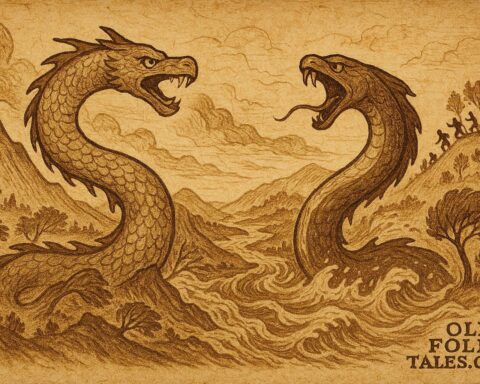
Glooscap stood upon a high cliff and looked far into the distance. There, near the mouth of the great bay, he saw a huge dam blocking the waters. Behind it, the sea roared and swelled, trapped and furious. Perched beside this dam was an enormous beaver, larger than a house, gnawing at tree trunks and piling more branches to strengthen his wall. His tail slapped the surface of the water with a thunderous crack that echoed through the valleys.
Explore the ancestral legends of Canada, Mesoamerica, and South America’s Indigenous tribes.
Glooscap understood that this was no ordinary creature but a giant beaver spirit who had grown greedy. The beaver had once been given dominion over the rivers, but in his pride, he wanted to control the sea as well. By building his dam, he had trapped the tides, hoarding the waters for himself.
Glooscap descended from the cliffs and walked along the shore until he stood near the dam. The beaver, seeing him, gave a loud growl that sent ripples through the bay.
“Why have you done this, brother?” Glooscap called. “The rivers no longer flow, and the people cannot fish. The creatures of the sea are dying without the tides. You have disturbed the balance of the world.”
The beaver only laughed, showing long white teeth. “These waters are mine now. I will make my own kingdom and let the world come to me if it thirsts.”
Glooscap’s eyes flashed with sorrow and power. “You have forgotten your place in the order of things. The waters must move, for they are the veins of the earth. When they are still, the world itself begins to die.”
But the beaver would not listen. He slapped his tail and dove beneath the surface, vanishing into his great dam of mud and logs.
For three days, Glooscap waited and watched, thinking of how to restore the flow without destroying all that lived nearby. At last, he took his great paddle, carved from the heart of an ancient pine, and waded into the bay. With one mighty swing, he struck the dam. The blow shook the earth, splitting the dam and sending waves crashing in all directions.
The beaver emerged in fury, his eyes glowing like embers. He tried to rebuild the wall, but Glooscap struck again. The dam burst completely, and the imprisoned sea roared back into the bay. The water surged so high that it covered the cliffs and flooded the valleys. The people fled to the hills, watching in awe as the ocean thundered and churned.
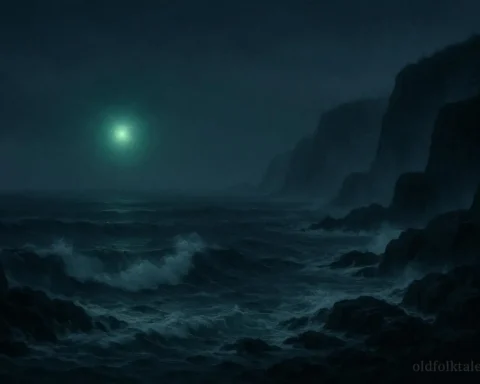
When the waves finally calmed, the bay had been forever changed. The water now moved in powerful rhythms, rushing in and out as if the sea itself were breathing. These became the great tides of the Bay of Fundy, the highest and most dramatic in the world.
The beaver, realizing he had been defeated, tried to escape. He swam northward through the rivers, but Glooscap followed him, striking the earth with his paddle wherever the creature passed. The mountains and lakes of New Brunswick and Nova Scotia formed where the beaver fled. At last, when he reached the northern waters, the giant beaver turned to stone, his great body becoming part of the land. To this day, people say that his shape can still be seen among the cliffs and islands near the bay.
Glooscap stood upon the shore, his paddle resting at his side. He looked upon the swirling tides, pleased that the balance had been restored. He spoke to the wind and said, “Let the waters rise and fall forever, that the world may remember what happens when greed disturbs the order of creation.” The wind carried his words, and the sea answered in rhythm.
From that day forward, the Mi’kmaq people told their children that the tides were Glooscap’s work. When the water rushes in and out twice each day, it is his reminder that all things must move and change. Even the strongest forces of nature must serve harmony, not pride.
Generations later, fishermen and travelers still speak of Glooscap. They say that when the tides grow especially high and the winds roar through the bay, it is the echo of Glooscap’s paddle striking the waters, keeping the rhythm of life steady and strong.
Moral Lesson
The legend of Glooscap and the tides teaches that all creation must remain in balance. When pride or greed seeks to control nature, disaster follows. True strength lies not in domination but in harmony and respect for the world’s living order.
Knowledge Check
1. Who was Glooscap in Mi’kmaq tradition?
He was a great spirit hero and protector who maintained balance between people, nature, and the spiritual world.
2. What caused the stillness of the waters in the Bay of Fundy?
A giant beaver had built a massive dam that trapped the tides and stopped the sea from flowing.
3. How did Glooscap restore the balance of the waters?
He used his great paddle to break the dam, releasing the trapped sea and creating the tides.
4. What happened to the giant beaver after the dam was destroyed?
The beaver fled north, and when he could no longer escape, he turned into stone, becoming part of the landscape.
5. What natural phenomenon does this story explain?
It explains the powerful tides of the Bay of Fundy.
6. What moral lesson does the story teach?
It teaches that harmony and balance in nature are sacred and that greed or pride can destroy the world’s order.
Source: Adapted from The Story Begins: Mi’kmaq Legends (The Confederacy of Mainland Mi’kmaq, 1996).
Cultural Origin: Canada, Nova Scotia, Mi’kmaq Maritime Folklore