In the great cities of Brazil and Mexico, traffic never truly sleeps. Even late at night, engines hum, headlights sweep across pavement, and red lights pause streams of hurried lives. It is at these intersections, where cars wait impatiently and drivers glance at their phones, that people speak of El Niño del Semáforo.
Those who encounter him say the moment feels ordinary at first. A red light stretches longer than expected. The street is quiet except for distant horns and the whisper of tires. Then a small shape appears beside the car.
Discover the vibrant legends of Guatemala, Honduras, and Costa Rica in our folktale collection.
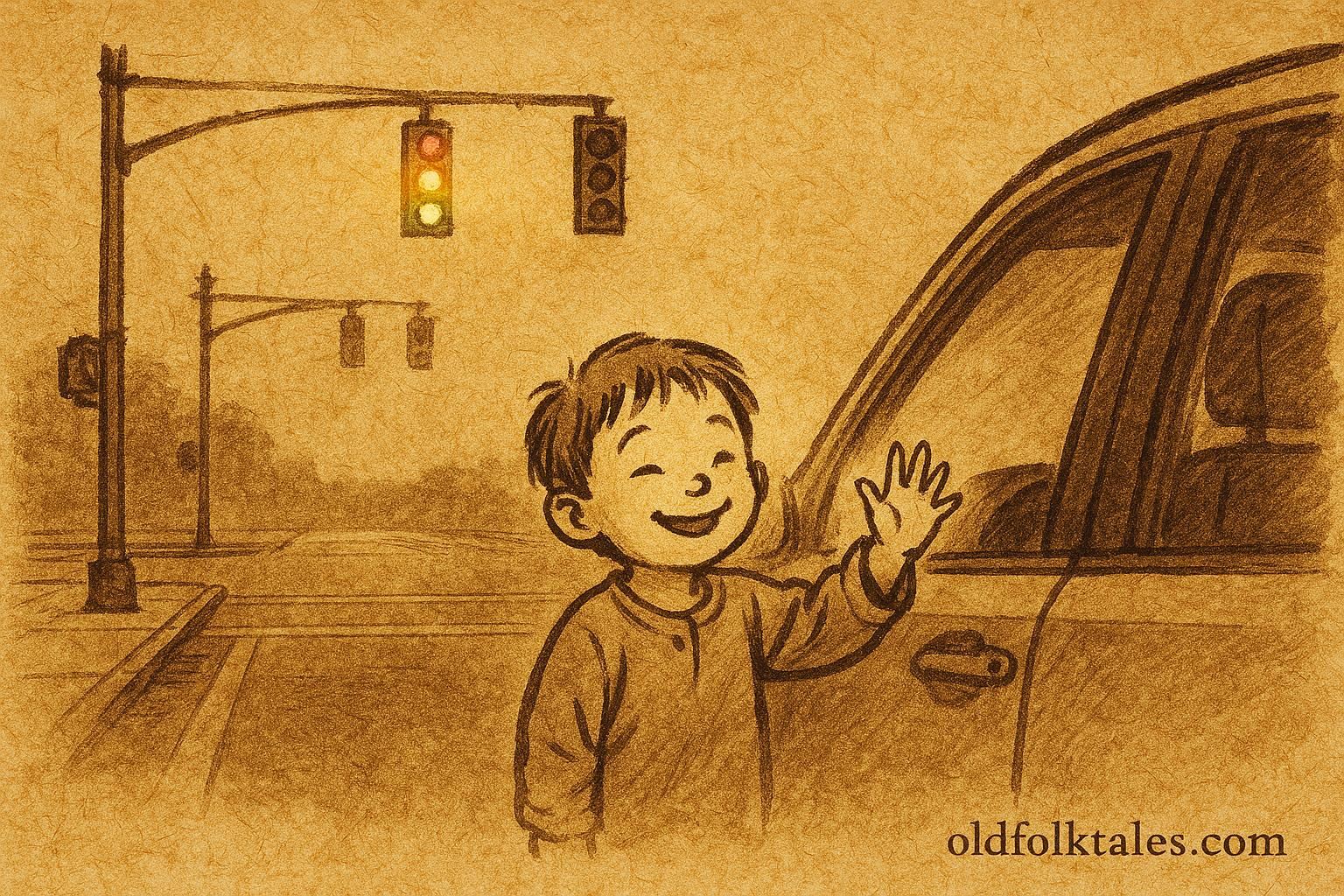
A child stands at the window.
He is young, no more than seven or eight. His clothes are simple, worn, and slightly too large. He smiles, gently and silently, and taps on the glass with small fingers. He does not beg. He does not speak. He simply waits, eyes bright and steady.
Drivers describe an unease they cannot explain. Some reach instinctively for their wallets. Others freeze, unsure whether to look away or respond. When they blink, when they glance down or check their mirrors, the child is gone.
The light turns green. Traffic moves. The moment passes.
But it does not leave them.
Across different cities and neighborhoods, the details remain the same. The child only appears during red lights, most often late at night. He never runs between cars. He never steps into traffic. He does not approach aggressively. He simply exists, briefly, at the edge of attention.
Some drivers report seeing him more than once. Others say they feel watched long after the encounter, as though unseen eyes follow them through the city. A few claim that ignoring him brings restless sleep and lingering guilt, while acknowledging him, meeting his gaze, offering a nod or a coin—leaves a quiet heaviness instead of fear.
Stories spread, whispered at taxi stands and roadside stops. People begin to interpret what they have seen.
Some say El Niño del Semáforo is the spirit of a child lost to poverty and neglect, trapped forever between lanes of moving traffic and human indifference. Others believe he is not a ghost at all, but a symbol made visible, a reminder of the children society learns not to see.
What unites the stories is not terror, but discomfort. The child does not threaten. He does not harm. He exposes.
In cities where speed matters more than pauses, where red lights feel like interruptions, the child appears only when movement stops. He exists in the brief moment when drivers are forced to wait and look forward. And when the light changes, he disappears, just as easily as innocence is forgotten.
Those who have seen him speak differently afterward. Some say they notice children at intersections more. Others find themselves slowing down, offering help, or feeling a persistent sense of responsibility. The legend does not accuse; it asks.
In Brazil and Mexico, El Niño del Semáforo endures as a quiet presence in a loud world. He stands where attention falters, reminding the living that what is ignored does not vanish, it lingers.
Moral Lesson
This folktale teaches that when society ignores its children, innocence is lost and suffering becomes invisible. Forgotten lives return as reminders, asking the living to see and care.
Knowledge Check
1. Who is El Niño del Semáforo?
A silent child who appears at red lights late at night.
2. Where does this urban folktale originate?
In cities across Brazil and Mexico.
3. What does the child do when he appears?
He taps gently on car windows and smiles without speaking.
4. When does he disappear?
As soon as drivers blink or the light changes.
5. What does the child represent to many people?
Children lost to poverty, neglect, and social indifference.
6. What lesson does the story teach?
Ignoring vulnerable children creates lasting harm for society.
Source: Contemporary urban oral tradition
Cultural Origin: Brazil & Mexico (Urban Latin American folklore)