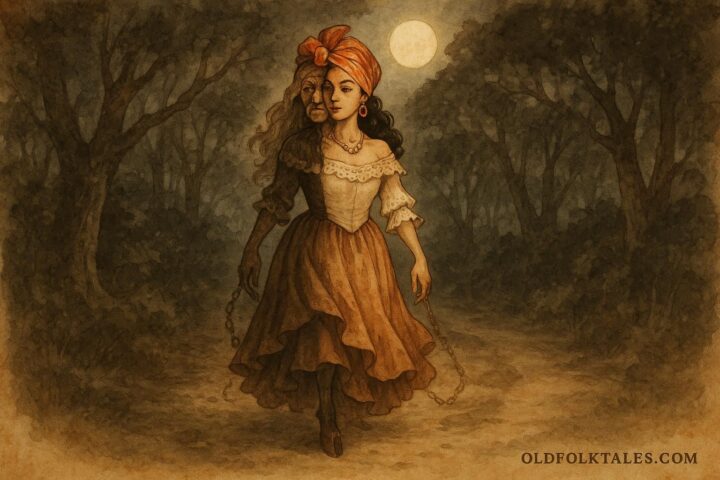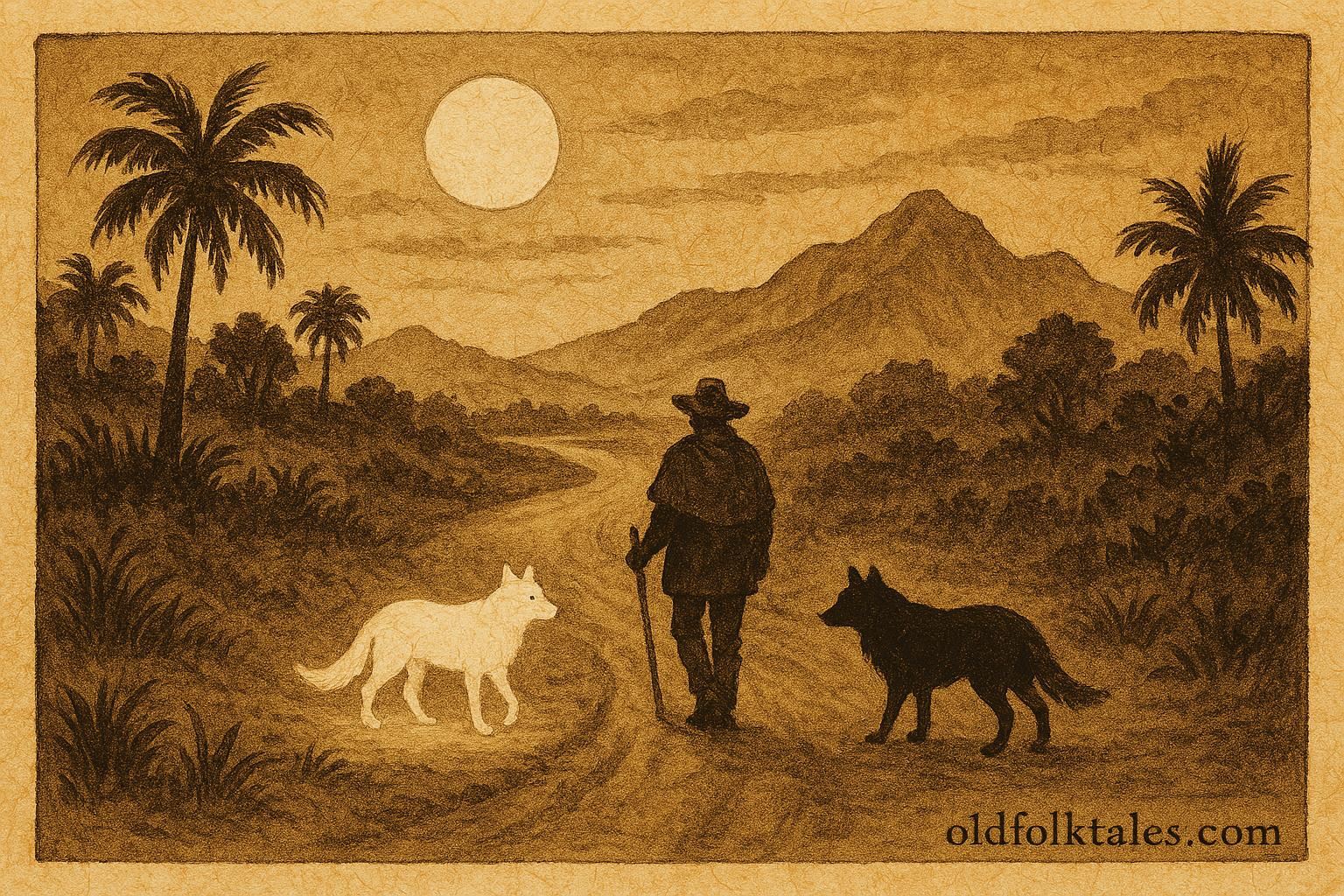
On quiet nights across the winding roads of Central America, travelers tell of strange footsteps behind them, soft, deliberate, and heavy, like a dog’s paws pressing against the dirt. Those who dare to look back may see glowing eyes in the dark and know that they have encountered El Cadejo.
The legend of El Cadejo is one of the oldest and most enduring tales across El Salvador, Guatemala, Honduras, Nicaragua, and parts of Mexico. Passed down through generations, it speaks of two spirit dogs who walk the earth at night, one good, one evil, guarding or punishing those who wander after dark.
The White Cadejo: The Spirit of Protection
The white Cadejo is said to shine with a faint, silvery glow beneath the moonlight. Its fur gleams like mist, and its eyes are gentle but piercing, reflecting both wisdom and sorrow. Those who see the white Cadejo say it moves silently, almost floating, as though its paws never truly touch the earth.
Travelers who lose their way in the darkness often tell of being guided home by this benevolent spirit. Some claim it appeared beside them just as they were about to stumble over a cliff or into a river. Others say it sat patiently on a roadside, its eyes glimmering softly, until dawn broke and safety returned.
In many stories, the white Cadejo guards innocent wanderers, lonely children, and weary laborers walking home late from distant fields. It protects those who have strayed but whose hearts remain pure. Elders say the white Cadejo’s presence is a blessing, a reminder that goodness and mercy walk beside even the humblest soul.
The Black Cadejo: The Spirit of Darkness
But not all footsteps in the night bring comfort.
Some belong to the black Cadejo, a towering hound with fur as dark as pitch and eyes that burn like embers. Its breath reeks of sulfur, its growl rumbles from the depths of the earth, and its shadow seems to stretch beyond the trees.
The black Cadejo hunts those who live in sin: drunkards who stagger through alleys after midnight, faithless lovers sneaking home from betrayal, and those who mock the sacred or harm the innocent. To meet its gaze is to feel one’s heart freeze with dread.
Some say the black Cadejo is not merely a spirit, but a demon, sent to collect corrupted souls. Others believe it was once a man, a sinner cursed to walk the world forever as a beast of darkness. Its chains (from the Spanish cadena) drag along the ground, clinking faintly, warning of its arrival. When its howl pierces the night, people lock their doors and whisper prayers, for they know the creature is near.
The Traveler’s Tale
One old tale tells of Tomás, a young man from the hills of Honduras. He was known for his reckless habits, drinking, gambling, and quarreling deep into the night. One evening, after losing every coin at a tavern, he stumbled home along the dusty road. The moon was bright, but the world around him swayed with the weight of his drunkenness.
Suddenly, he heard footsteps behind him, steady, rhythmic, and too close. Turning around, he saw two glowing eyes watching him from the shadows. A great black dog emerged, its fur bristling and its chains scraping against the stones.
Terrified, Tomás crossed himself and whispered prayers, but his trembling legs gave way. The creature crept closer, growling low and deep. Then, from the opposite side of the road, another figure appeared, a white hound glowing faintly like starlight. The black Cadejo halted, snarling. The two beasts faced each other, silent and still, until the black one turned and vanished into the darkness.
When Tomás awoke at dawn, he found himself safely at the gates of his home. He never drank again. From that day, he devoted himself to honest work, grateful to the white Cadejo who had spared him from the shadow.
The Lesson of the Two Cadejos
The story of El Cadejo is more than a tale of fear, it is a lesson about choices. Each Cadejo represents the spirits that follow every person: one urging toward goodness and redemption, the other tempting toward sin and ruin. Travelers in Central America still whisper prayers before venturing out at night, asking the white Cadejo to walk beside them and keep the black one away.
In some villages, parents warn their children, “Behave well, or the black Cadejo will find you.” But the wise elders add, “Walk with a clean heart, and the white Cadejo will never leave your side.”
Moral Lesson
This folktale teaches that every action carries a consequence. The white Cadejo symbolizes conscience, protection, and hope, while the black Cadejo reflects temptation and punishment. Through the choices we make, kindness or cruelty, humility or pride, we summon the spirit that will follow us through the night.
Knowledge Check
1. Who are the main supernatural figures in the tale of El Cadejo?
The white Cadejo (good spirit dog) and the black Cadejo (evil spirit dog).
2. What does the white Cadejo represent in Central American folklore?
It symbolizes protection, purity, and moral guidance for those who live righteously.
3. What lesson does the black Cadejo teach travelers and villagers?
That immoral behavior, drunkenness, and sin lead to danger and spiritual ruin.
4. What sound is often associated with the Cadejo’s approach?
The dragging of chains (cadena), especially linked to the black Cadejo’s curse.
5. What is the cultural origin of El Cadejo?
It originates from Central American folklore, especially El Salvador, Guatemala, and Honduras, with Indigenous and Spanish influences.
6. What moral theme connects both versions of the Cadejo?
The eternal struggle between good and evil within every human heart.
Source: Adapted from Central American folktale traditions (El Salvador, Guatemala, Honduras, and Nicaragua).
Collected from regional folklore archives and oral traditions.
Cultural Origin: Central America (Indigenous and Spanish colonial folklore)