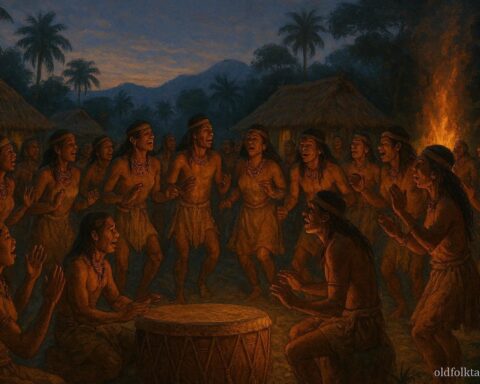
In an era when gods and humans walked closer together, when the boundary between the sacred and mundane was as thin as morning mist over a river, a goddess existed whose power shaped the very fabric of life in the Andean world. Her name was Chaupi Ñamca, and she ruled over domains that touched every aspect of existence fertility that made crops grow and women conceive, the flowing rivers that brought life to the valleys, the intricate art of weaving that transformed raw wool into clothing and meaning, and the sacred force of sexuality that bound people together and created new generations.
Chaupi Ñamca was not a simple deity to be easily understood or safely approached. Her nature was dual, reflecting the complexity of the forces she commanded. She could be nurturing as a mother, bringing abundance to fields and blessing households with prosperity. Her touch could make the sterile fertile, the dry streams flow with water, and the tangled threads resolve into patterns of breathtaking beauty. Those who honored her properly, who understood the delicate balance she represented, found their lives enriched beyond measure.
Click to read all South American Folktales — timeless stories from the Andes to the Amazon.
But Chaupi Ñamca was also dangerous, as all truly powerful forces must be. Like the river that could both water crops and sweep away villages, like fertility that could overwhelm as easily as bless, like desire that could create or destroy, the goddess embodied the truth that power without balance becomes destruction. She rewarded devotion, but she punished disrespect with a swift and terrible finality that left no room for appeals or second chances.
The goddess dwelt in sacred places at the confluence of rivers where waters mingled, in caves adorned with ancient markings, on mountainsides where springs bubbled from the earth. Her presence could be felt in the rhythm of the loom, in the coursing of water through irrigation channels, in the quickening of life in the womb. She was everywhere and nowhere, immanent in the world yet impossible to fully grasp or control.
Many men, drawn by her power and beauty, sought Chaupi Ñamca’s favor. They came with offerings and declarations, their arms strong and their confidence high. They believed that their strength, their status, or their eloquence would win the goddess’s approval. They thought they understood what she desired, that they could approach her as they would approach a mortal woman, with gifts and persuasion and the assumption of their own worthiness.
But Chaupi Ñamca saw through all pretense to the truth of a person’s heart. She cared nothing for outward displays of strength or wealth. What she sought what she demanded was something far more difficult to offer: genuine humility and the willingness to labor without expectation of immediate reward. She tested every suitor who came before her, and her tests were designed to reveal character rather than confirm capability.
To one proud warrior who approached her with gifts of gold and fine cloth, she appeared not in divine radiance but as an old woman struggling to carry water from a distant spring. The warrior, intent on finding the goddess, walked past the old woman without a glance, leaving her to struggle alone with her burden. He never found Chaupi Ñamca that day, though he searched until sunset. When he returned to the village, boasting of his quest, an elder woman laughed and told him: “You passed the goddess on the path. She was the one you ignored.”
The warrior, embarrassed but still prideful, returned to seek the goddess again. This time, when he saw the old woman with her water jars, he recognized her or thought he did. He rushed forward to help, but his assistance was rough and impatient, motivated by his desire to pass the test rather than genuine compassion. The water spilled, the jars cracked, and Chaupi Ñamca revealed herself in her true form, her eyes blazing with divine anger.
“You help not from kindness but from calculation,” she said, her voice carrying the weight of rushing water and rumbling earth. “You seek to use me as you would use any tool a means to increase your own glory.”
Before the warrior could protest or plead, transformation came upon him. His body hardened, his limbs growing rigid, his protests dying in a throat that could no longer form words. Stone replaced flesh, and where a proud warrior had stood, a boulder now rested by the roadside a permanent reminder of the cost of approaching the sacred with selfish intent.
Another man came, a farmer known throughout his village for his hard work and practical nature. He sought the goddess because his fields had been struck by blight and his wife had not conceived in their years of marriage. He came not with gold but with humble offerings the best ears of corn he had managed to grow despite the failing crop, wool he had carefully cleaned and prepared himself, coca leaves arranged with reverence.
Chaupi Ñamca appeared to him not as an old woman but as herself, radiant and terrifying in her power. She looked into his heart and saw sincerity mixed with desperation, devotion tangled with the natural human desire for results. She decided to test him further.
“You wish for fertility in your fields and in your home,” she said, her voice like water moving over stones. “But fertility requires more than asking. It requires reciprocity ayni. You must give before you receive, labor before you rest, demonstrate humility before you can be elevated. Will you work for me, expecting nothing, trusting that balance will be restored when the time is right?”
The farmer, though desperate for immediate relief, recognized truth when he heard it. He bowed low before the goddess. “I will labor as you require,” he said. “Not because I expect reward, but because it is right to give back to the forces that sustain us.”
Chaupi Ñamca set him to work. She tasked him with cleaning the springs that fed the community’s water supply, with repairing the ancient irrigation channels that had fallen into disrepair, with teaching the children of the village the proper songs to sing during planting season. The work was hard and endless. Days became weeks, weeks became months, and still no relief came to the farmer’s blighted fields or barren household.
Others in the village mocked him. “You waste your time serving a goddess who gives you nothing in return,” they said. “Work your own fields. Seek other remedies. This devotion is foolishness.”
But the farmer continued, not because he was certain of reward but because he had learned something profound in his labors. He had discovered that the work itself the act of maintaining the channels that watered everyone’s fields, the care of the sacred springs, the teaching of traditions to the young had value independent of personal benefit. He was participating in ayni, the reciprocal exchange that sustained the entire community and maintained balance between humans and the sacred forces of nature.
Chaupi Ñamca watched, her eyes seeing not just his actions but the transformation of his heart. When the proper time arrived not when the farmer demanded but when true balance had been achieved, she blessed him. His fields erupted in abundance, producing crops more bountiful than he had ever imagined. His wife conceived, and she bore healthy children. But more than this, the farmer had gained something that could not be taken away: understanding of how the world truly worked, of the principle of reciprocity that governed all relationships between men and women, between labor and rest, between humans and nature, between the mortal and the divine.
The goddess’s teachings spread through her interactions with countless seekers. Some learned and were blessed. Others failed her tests and were transformed turned to stone like the proud warrior, changed into animals that wandered the hills as living reminders of arrogance punished, or simply denied her presence, left to struggle alone without the balance she could provide.
The people came to understand that Chaupi Ñamca was not merely a goddess to be petitioned for favors but a living embodiment of the principle that sustained creation itself. Life required balance. Power needed humility. Fertility demanded labor. Receiving required giving. The masculine and feminine, the human and natural, the sacred and mundane all existed in reciprocal relationship, and Chaupi Ñamca was the guardian of that essential balance.
Her shrines were maintained with care, her offerings given with sincerity rather than calculation. Women came to her for blessing in their weaving, in their pregnancies, in their relationships. Men came to learn humility and the true nature of power. And everyone came to understand that the goddess taught the same lesson in countless ways: that creation is sustained through ayni, through the sacred reciprocity that acknowledges our interdependence and our responsibility to give as well as receive, to labor as well as rest, to approach the powerful forces of existence with reverence rather than presumption.
Click to read all Andean Highland Folktales — echoing from the mountain peaks of Peru, Bolivia, and Ecuador.
The Moral Lesson
The myths of Chaupi Ñamca teach the essential Andean principle of ayni (sacred reciprocity) as the foundation of cosmic and social balance. The goddess embodies the truth that power requires responsibility, that receiving demands giving, and that approaching the sacred with selfish calculation rather than genuine humility leads to transformation or destruction. Her dual nature (both nurturing and dangerous) reflects the reality that the same forces that sustain life can also overwhelm or destroy when balance is disrupted. The story emphasizes that true devotion manifests not in grand gestures or material offerings but in patient labor, sincere humility, and willingness to participate in reciprocal exchange without demanding immediate reward.
Knowledge Check
Q1: What domains did Chaupi Ñamca rule over in Andean mythology?
A: Chaupi Ñamca was a powerful female deity who ruled over fertility (of crops and women), weaving (the transformation of wool into cloth and meaning), rivers (the life giving waters), and sexuality (the sacred force that bound people together and created new generations). She controlled aspects of existence that touched every part of Andean life.
Q2: What was Chaupi Ñamca’s dual nature and why was it significant?
A: Chaupi Ñamca was both nurturing and dangerous, reflecting the complexity of the forces she commanded. She could bring abundance, bless households, and make the sterile fertile, but she also punished disrespect swiftly and terribly. Her dual nature embodied the truth that powerful forces like rivers, fertility, and desire can both sustain and destroy depending on how they are approached and balanced.
Q3: How did Chaupi Ñamca test those who sought her favor?
A: The goddess tested suitors through trials designed to reveal character rather than confirm capability. She often appeared in humble forms (like an old woman carrying water) to see if people would help without recognition or reward. She demanded genuine humility and willingness to labor without expectation of immediate benefit, rejecting those who approached her with calculation or selfish intent.
Q4: What happened to those who failed Chaupi Ñamca’s tests?
A: Those who failed the goddess’s tests faced severe consequences. Some were transformed into stone (like the proud warrior who became a boulder), others were changed into animals that wandered the hills as living reminders of punished arrogance, and some were simply denied her presence and left to struggle alone without the balance and blessing she could provide.
Q5: What is ayni and how does it relate to Chaupi Ñamca’s teachings?
A: Ayni is the Quechua principle of sacred reciprocity, the understanding that creation is sustained through balanced giving and receiving, labor and rest, human effort and natural blessing. Chaupi Ñamca embodied this principle, teaching that relationships between men and women, humans and nature, mortals and the divine thrive only when both parties honor reciprocal exchange. Her myths demonstrate that receiving requires giving, and that approaching sacred forces with humility and willingness to participate in ayni brings genuine blessing.
Q6: What is the cultural significance of Chaupi Ñamca in Andean cosmology?
A: Chaupi Ñamca represents the Andean understanding that powerful female deities control essential life forces and that balance (between masculine and feminine, human and natural, sacred and mundane) is fundamental to cosmic and social order. Her myths teach that creation requires reciprocity, that power demands responsibility, and that humility and patient labor are more valuable than grand gestures or material wealth. She embodies the principle that sustains Andean society: ayni, the sacred reciprocity that acknowledges interdependence and mutual obligation.
Source: Adapted from the Huarochirí Manuscript (Quechua: Manuscrito de Huarochirí), particularly chapters detailing female deities and their relationships with human devotees. English translations by Frank Salomon and George L. Urioste, “The Huarochirí Manuscript: A Testament of Ancient and Colonial Andean Religion”
Cultural Origin: Ancient Andean peoples, particularly Quechua speaking communities of the Central Peruvian Highlands