In the time when the stars still visited the earth and the boundary between heaven and the mortal world was as thin as morning mist, a young shepherd tended his flocks high in the puna grasslands of the Andes. His life was simple and solitary, marked by the bleating of llamas, the whisper of wind through the ichu grass, and the vast silence of the mountains that surrounded him like ancient guardians.
Each night, after settling his animals and building a small fire to ward off the highland cold, the shepherd would lie upon his woven blanket and gaze upward at the glittering heavens. The sky above the Andes was unlike any other so clear and infinite that it seemed he could reach up and touch the stars themselves. The elders of his village had told him stories since childhood of the beautiful maidens who lived among those distant lights, dancing eternally in garments woven from starlight and singing songs that only the wind could carry to earth.
Click to read all Andean Highland Folktales — echoing from the mountain peaks of Peru, Bolivia, and Ecuador.
The shepherd often dreamed of these celestial beings, wondering if the stories were true or merely the imaginings of old men remembering their youth. But he cherished the tales nonetheless, for they made the loneliness of the high grasslands feel less empty.
One night, when the moon hung full and bright like a silver drum in the sky, the shepherd heard something that made his heart stop, the sound of laughter, clear and melodious, carried on the wind. At first he thought it was his imagination, but then he heard it again, accompanied by music so ethereal it seemed to shimmer in the air itself.
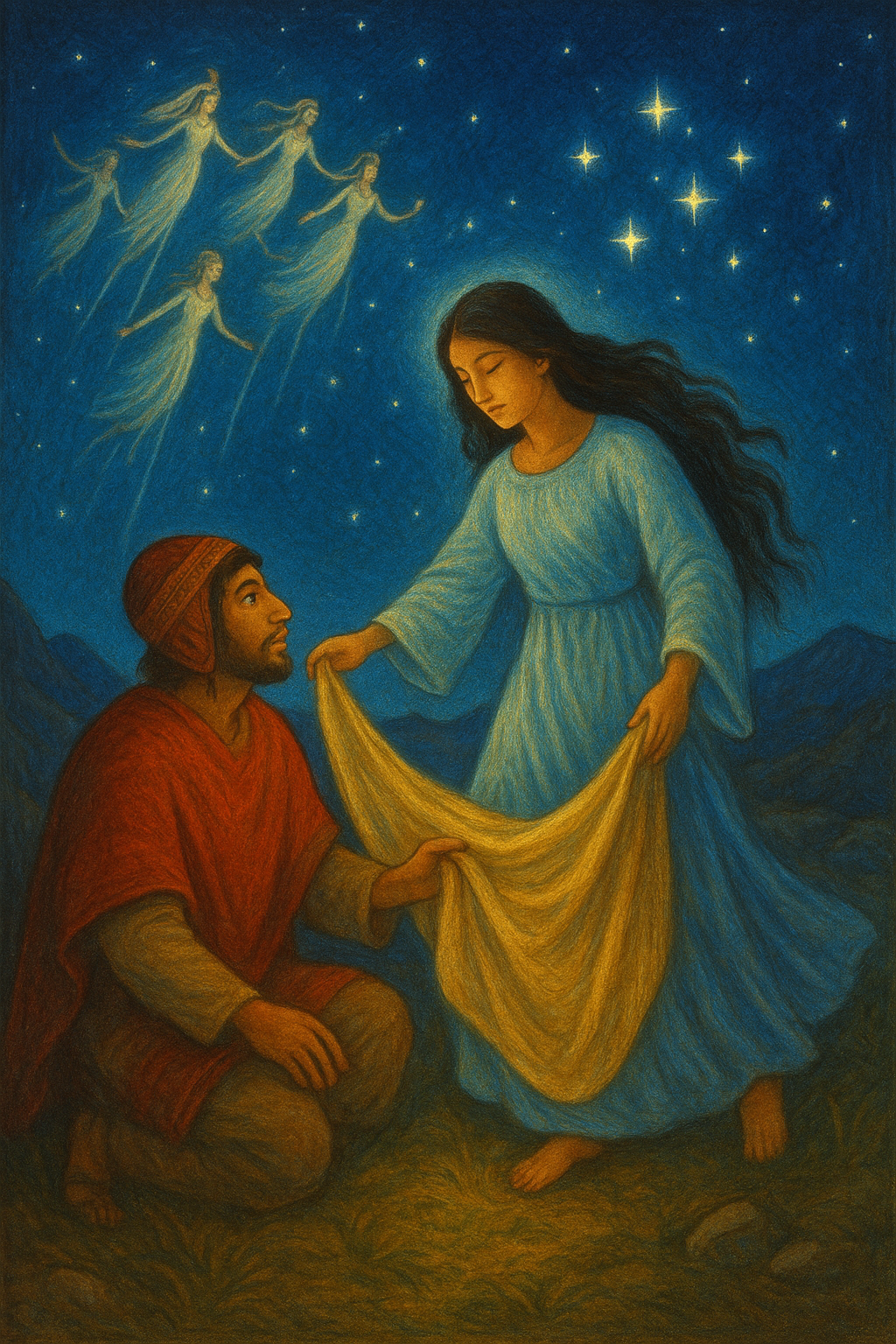
Looking up, the shepherd gasped in wonder. Descending from the heavens on threads of pure light came seven radiant maidens, their forms glowing with a luminescence that put the moon to shame. They wore garments that rippled like water made of stars, and their long dark hair flowed behind them like rivers of night. As their feet touched the meadow, they began to dance, moving with such grace that the grass beneath them barely bent, as if they weighed no more than moonbeams.
The shepherd’s breath caught in his throat. He crouched behind a large rock, afraid that any movement or sound might break the spell and send the maidens fleeing back to their celestial home. For what felt like hours, he watched them dance and sing, their voices blending in harmonies that spoke of distant worlds and ancient mysteries he could never hope to understand.
But even as he watched, enchanted, the shepherd’s heart was captured by the youngest of the seven maidens. She was smaller than her sisters, with eyes that sparkled like the morning star and a smile that seemed to hold all the joy of creation. When she laughed, it was like the tinkling of silver bells, and when she danced, she moved with such innocent delight that the shepherd felt his soul stirring with an emotion he had never known, a love so profound and sudden that it frightened him.
As the night deepened and the sky began to pale with the first hints of dawn, the maidens gathered together, preparing to return to their home among the stars. One by one, they wrapped themselves in their shimmering cloaks, the magical garments that allowed them to fly between heaven and earth. The shepherd watched in growing desperation, knowing that in moments they would be gone forever, leaving him alone once more in the empty grasslands.
Without thinking, driven by a love that overwhelmed all reason, the shepherd rushed from his hiding place. The maidens cried out in surprise and alarm, but before they could take flight, he reached out and seized the cloak of the youngest maiden, pulling it from her shoulders.
Immediately, her sisters rose into the air like birds startled from their roost, their forms dissolving into streams of light that shot back toward the heavens. But the youngest maiden remained earthbound, trapped without her magical garment. She fell to her knees and wept, her tears falling like drops of liquid starlight upon the grass.
“Please,” she cried, her voice breaking with sorrow, “return my cloak! Without it, I cannot fly. I cannot return to my home, to my sisters, to the sky where I belong!”
The shepherd’s heart broke at her anguish, but his love had made him selfish and desperate. “Forgive me,” he whispered, kneeling before her. “I know I have done a terrible thing, but I cannot let you go. Stay with me. Let me care for you. I will cherish you always, I swear it by all the mountains and stars.”
The maiden wept throughout that first day and the next, but the shepherd was true to his word. He built her a shelter, brought her the finest foods he could find, and spoke to her with such tenderness that gradually, slowly, her heart began to soften. Seasons passed, and what had begun as captivity transformed into something deeper. She learned to love the shepherd for his gentle nature, his devotion, and the honest simplicity of his life.
In time, they married in the way of his people, and she bore him a son a beautiful child who had his father’s strength and his mother’s luminous eyes. They lived happily in the shepherd’s small stone hut, tending the flocks together and raising their child beneath the vast Andean sky. To the outside world, they seemed like any other family of the highlands.
Yet every night, when darkness fell and the stars emerged like old friends, the maiden would stand outside and gaze upward with longing in her eyes. She would search the heavens for her sisters, for the celestial home she had lost, and her heart would ache with a homesickness that no earthly love could fully heal.
The shepherd saw this and understood, though it pained him. He had hidden her cloak in a secret place, wrapped carefully and concealed where she would never find it. But one day, while he was away with the flocks, the maiden was cleaning their small home when she discovered a strange bundle tucked beneath the earthen floor. Her hands trembled as she unwrapped it, and there, gleaming as bright as the day he had taken it, was her star cloak.
Tears streamed down her face, tears of joy and sorrow mingled together. She looked at her sleeping son, at the simple home she had made, at the life she had grown to love. But the call of the sky was stronger than any earthly bond. With shaking hands, she wrapped the cloak around her shoulders and felt its power surge through her once more.
Before she rose, she lifted her son and held him close, pressing her lips to his forehead. “My beloved child,” she whispered, “when you see the bright cluster of stars that shines before dawn the seven sisters dancing together in the sky know that your mother is there, watching over you always. I have not abandoned you. I am simply returning to where I belong.”
And with that, she rose into the air like smoke, like light, like a dream dissolving at dawn. The shepherd returned to find his home empty save for his crying son and a lingering glow in the air that smelled of starlight and sorrow.
From that day forward, the shepherd and his son would rise before dawn to watch the Pleiades,the seven sister stars climb above the eastern horizon. The Andean peoples came to call these stars Qollqa or Onqoy, and they became sacred markers of time, signaling when to plant crops and when to prepare for the agricultural year. The Incas knew that when the Pleiades appeared in a certain position in the sky, it was the star maiden returning to dance with her sisters and watch over her earthly family below.
Discover the sacred tales of llamas, condors, and gods who guard the Andes
The Moral of the Story
This ancient tale teaches us that love born of selfishness and force can never truly flourish, no matter how genuine the feelings may become. The shepherd’s act of taking the star maiden’s cloak was motivated by love, but it was still a violation of her freedom and her nature. True love requires respect for what someone is and where they belong even when that means letting them go. The story also reminds us that we cannot hold onto what was never meant to be ours, and that some beings, like the stars themselves, can never be fully bound to earth no matter how much we wish it. Yet love, even when it ends, leaves its mark: the child born of their union and the eternal watching presence of the Pleiades remind us that connections made with genuine affection endure beyond separation.
Knowledge Check
Q1: Who were the seven maidens that descended from the sky?
A: The seven maidens were celestial beings star maidens who lived in the heavens and would occasionally descend to earth on threads of light to dance in the meadows, wearing cloaks woven from starlight.
Q2: How did the shepherd trap the youngest star maiden on earth?
A: The shepherd seized and hid the youngest maiden’s magical star cloak while the maidens were preparing to return to the sky. Without her cloak, she was unable to fly back to the heavens and remained trapped on earth.
Q3: What eventually happened to the star maiden?
A: After living happily with the shepherd and bearing his son, the star maiden eventually found her hidden cloak. She wrapped herself in it and returned to the sky to rejoin her sisters, though she left with sorrow for the family she was leaving behind.
Q4: What astronomical feature did the star maiden become associated with?
A: The star maiden became associated with the Pleiades (called Qollqa or Onqoy by Andean peoples) the cluster of seven sister stars that appears before dawn and was used by the Incas as a sacred marker for agricultural timing.
Q5: What does the shepherd’s action of taking the cloak teach about love and freedom?
A: It teaches that love cannot be built on force or captivity, and that truly loving someone means respecting their nature and freedom even when it means letting them go back to where they belong.
Q6: Why were the Pleiades sacred to Andean agricultural peoples?
A: The Pleiades were sacred because their appearance in the sky marked important agricultural times for planting and harvest. The stars also represented the star maiden watching over her earthly family, connecting the celestial realm with human life on earth.
Source: Adapted from oral Quechua tradition recorded in H. B. Alexander, Latin-American Mythology (1916) and M. Arguedas, Mitos, Leyendas y Cuentos del Perú (1949).
Cultural Origin: Inca Empire and Quechua peoples