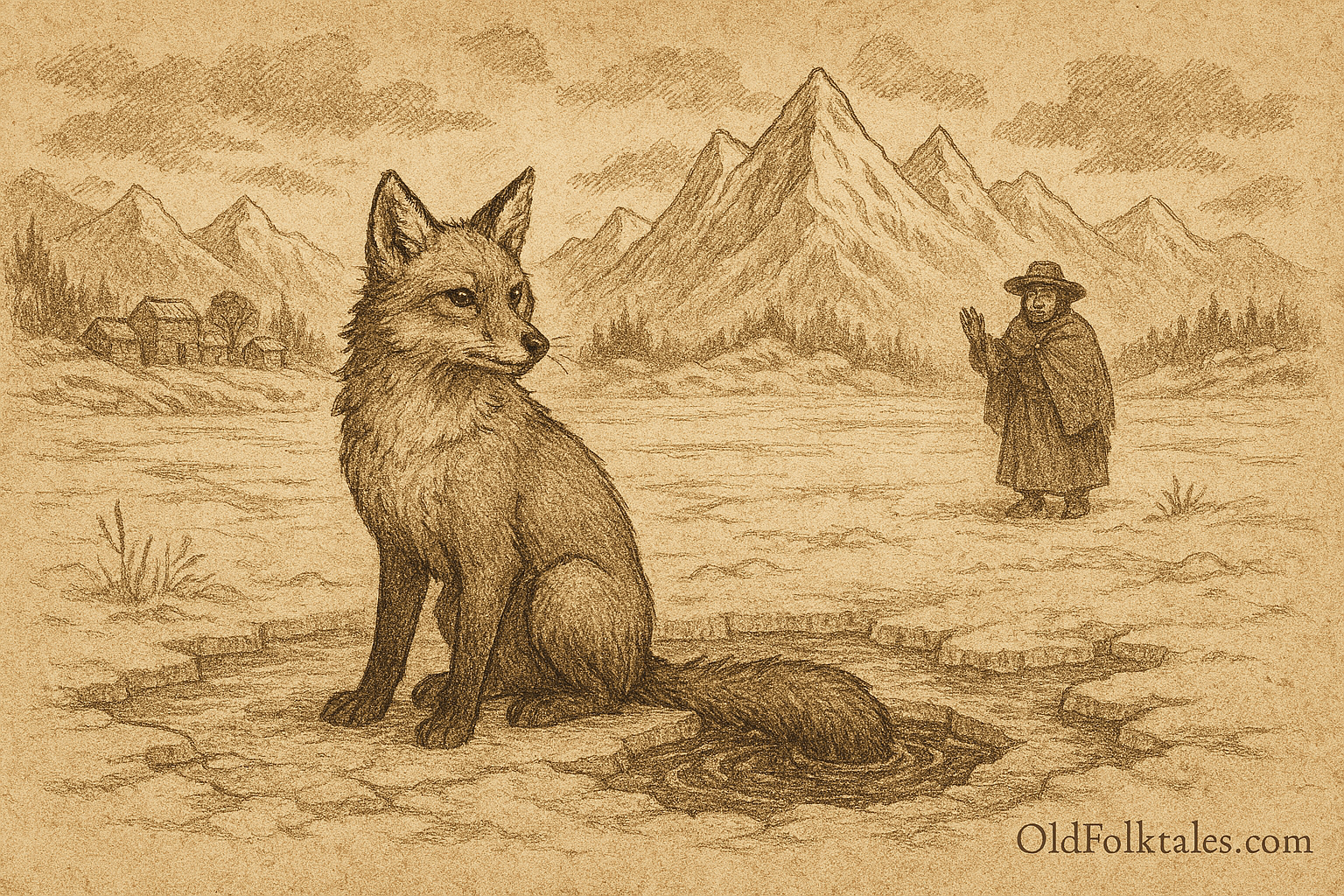
High in the Peruvian Andes, where snow-capped peaks pierce the clouds and cold winds whistle through ancient stone villages, there lived a fox named Atoq. He was not an ordinary fox his tail was his greatest pride, thick and luxurious, flowing behind him like a river of russet fur. Atoq considered himself the cleverest creature in all the mountains, smarter than the llamas that grazed on the hillsides, wiser than the condors that soared overhead, and certainly more cunning than any human.
Winter had settled over the highlands with particular severity that year. The lake near the village had frozen solid, its surface transformed into a sheet of white glass that stretched as far as the eye could see. The Quechua villagers, with their generations of mountain wisdom, knew how to survive these harsh months. They had learned from their ancestors the art of ice fishing cutting careful holes through the frozen surface and lowering nets to catch the fish that swam in the dark waters below.
Click to read all South American Folktales — timeless stories from the Andes to the Amazon.
From his den in the rocks above the village, Atoq watched these activities with growing interest. His stomach growled with hunger, for prey had become scarce in the frozen landscape. The rabbits hid deep in their burrows, and the birds had flown to warmer valleys. But those villagers those simple humans they seemed to have an endless supply of fresh fish. Every evening, they returned to their homes with baskets full of silvery catch, their families gathering around warm fires to share their meals.
“How difficult can it be?” Atoq muttered to himself, his amber eyes gleaming with what he believed was brilliance. “If these humans can catch fish through the ice, surely I, the magnificent Atoq, can do it even better!”
One particularly cold morning, when mist hung over the frozen lake like a ghostly blanket, Atoq crept down from his den. He had watched the villagers carefully and thought he understood their technique perfectly. They made a hole, they put something into the water, they waited, and then they pulled out fish. Simple.
The fox trotted confidently onto the ice, his beautiful tail streaming behind him. He found a thin section where the villagers had been working and managed to widen one of their holes. The black water below looked deep and mysterious, but Atoq felt no fear only the certainty of his own cleverness.
“Now,” he said to himself, “I need something to put in the water to attract the fish.”
He looked at his possessions. He had no nets, no lines, no hooks. But he did have his magnificent tail. Surely, he thought, if he dipped his glorious tail into the water, the fish would be so attracted to its beauty that they would simply attach themselves to his fur. Then he could pull them out one after another.
Just as he was about to lower his tail into the icy water, an old woman from the village appeared on the shore. She was wrapped in layers of brightly colored woven blankets, and she called out to him in warning.
“Atoq! Foolish fox! Do not leave your tail in that water! The ice will claim it!”
But Atoq, certain of his own superiority, merely laughed at her. “Old woman, I am not one of your simple villagers! I know what I’m doing. Go back to your fire and leave the clever ones to their work!”
The woman shook her head sadly and retreated to the village, knowing that pride cannot be taught—only learned through consequence.
Atoq lowered his beautiful tail into the hole, feeling the shock of the freezing water against his fur. It was unpleasant, certainly, but he was determined. He would show everyone how truly clever he was. Minutes passed, and his tail grew numb, but no fish came. The water was so cold it made his bones ache, but Atoq’s pride would not let him give up.
“Just a little longer,” he told himself. “The fish will come. They must come.”
The sun climbed higher in the sky, though it gave little warmth. Atoq’s tail remained in the water, and slowly, silently, something terrible was happening. The water around his fur was beginning to freeze. The cold was working its way up his magnificent tail, turning the wet fur into something stiff and solid.
By the time Atoq realized what was happening, it was too late. He tried to pull his tail free, but it wouldn’t move. He pulled harder, his heart beginning to race with panic. The ice had gripped his tail like a frozen fist, holding it prisoner in the lake’s cruel embrace.
“Help!” he cried out, all his pride evaporating into the cold mountain air. “Someone help me!”
The villagers heard his cries, but they remembered his arrogance and his dismissal of the old woman’s wisdom. They let him struggle, knowing that some lessons must be learned through experience, not words.
Atoq pulled and pulled, terror flooding through him as the sun began its descent toward the horizon. He knew that if he remained trapped through the night, the mountain cold would claim not just his tail but his life. With one final, desperate yank, he tore himself free but at a terrible cost. Most of his magnificent tail remained frozen in the ice, snapped off at the base like a broken branch.
Atoq limped back to his den, his pride shattered along with his tail. Where once a glorious plume had flowed behind him, now only a thin, scraggly stub remained. The other animals of the mountain saw what had happened, and the story spread quickly through the highlands.
From that day forward, all foxes in the Andes have carried thin tails, a reminder of Atoq’s pride and foolishness. And Atoq himself, humbled by his experience, learned to watch and listen before acting, to respect the wisdom of those who knew the land, and to understand that true cleverness lies not in thinking yourself superior to others, but in recognizing that everyone has something valuable to teach.
Click to read all Andean Highland Folktales — echoing from the mountain peaks of Peru, Bolivia, and Ecuador.
The Moral of the Story
This tale teaches us that pride and arrogance blind us to wisdom, even when it’s offered freely. Patience, humility, and respect for local knowledge and experience are more valuable than self-proclaimed cleverness. Those who dismiss the advice of others because they believe themselves superior often pay a heavy price for their hubris. True wisdom comes from listening, observing, and learning from those around us, especially those who have lived and learned before us.
Knowledge Check
Q1: Who is Atoq in Quechua folklore, and what was special about him?
Atoq is the fox in Quechua tales, a character often portrayed as clever or cunning. In this particular story, Atoq’s most distinctive feature was his magnificent, thick tail, which he took great pride in. He considered himself the smartest animal in the Andes mountains.
Q2: What technique were the Quechua villagers using to catch fish in winter?
The Quechua villagers practiced ice fishing, a traditional technique passed down through generations. They cut holes through the frozen lake surface and used nets to catch fish swimming in the waters below, demonstrating their ancestral knowledge of survival in harsh mountain winters.
Q3: Why did Atoq ignore the old woman’s warning about the frozen lake?
Atoq’s pride and arrogance led him to dismiss the old woman’s wisdom. He believed he was cleverer than the villagers and didn’t need their advice. His overconfidence in his own abilities made him deaf to the warning that could have saved his tail.
Q4: What does the fox’s thin tail symbolize in Andean culture?
The fox’s thin tail serves as an origin story explaining a physical characteristic, but more importantly, it symbolizes the permanent consequences of pride and the refusal to learn from others. It’s a visible reminder that appears in nature of the cost of arrogance and the importance of respecting traditional knowledge.
Q5: What cultural values does this Quechua tale teach?
This story emphasizes several important Andean values: respect for elders and their wisdom, humility over pride, the importance of community knowledge passed through generations, patience rather than impulsiveness, and the understanding that experience and local expertise are more valuable than self-proclaimed cleverness.
Q6: How does this story reflect the harsh environment of the Peruvian Andes?
The tale is set in the severe highland winter where survival requires specific knowledge and respect for nature’s power. The frozen lake, the scarcity of food, and the life-threatening cold all reflect the real challenges faced by Andean communities, emphasizing why traditional wisdom and cooperation are essential for survival in such an unforgiving environment.
Source: Adapted from traditional Quechua oral narratives from the Andean highlands, as documented in Quechua folklore collections including those by anthropologists studying Peruvian indigenous storytelling traditions.
Cultural Origin: Quechua people, Peruvian Andes (highland regions of Peru)