Before rivers learned their paths and before rain knew when to fall, the world was dry and uncertain. The land existed, but it did not yet understand how to nourish life. Seeds slept beneath the soil without waking. Women carried children with difficulty. Streams appeared and vanished without warning, leaving villages unsure whether tomorrow would bring abundance or thirst.
In this early age, the Taíno people believed that all life waited for a guardian who could teach water how to behave.
That guardian was Atabey.
Atabey was not born as other beings were. She emerged when the first underground spring broke through stone. Where her feet touched the ground, water flowed and did not retreat. Where her breath moved, rain learned how to fall gently instead of with destruction. She carried within her the cycles of birth, growth, and return. Rivers followed her guidance. Wombs responded to her presence. The people called her Mother of Waters because nothing living could begin without her consent.
Atabey did not rule from above. She lived within rivers, beneath lakes, inside springs, and in the unseen moisture that softened soil. She watched quietly as humans learned to drink, bathe, and farm. At first, they approached water with fear. Then with relief. Eventually, with carelessness.
Journey through Central America’s heartlands and hear its stories of creation, courage, and nature.
Villages grew beside rivers that never seemed to empty. Children played without restraint. Farmers diverted streams without asking. Some poured waste into flowing water, trusting it would carry everything away. They forgot that water listens.
Atabey noticed the change.
She did not act immediately. She believed that understanding must come before correction. She waited through many seasons, watching how people treated what sustained them. When she saw gratitude replaced by entitlement, she decided it was time to teach.
One summer, the rains arrived too early. Rivers swelled and flooded fields planted without care. The people blamed the sky. Another season, the rains came too late. Crops cracked in dry ground. This time, they blamed the rivers.
Confusion spread. Women struggled with childbirth. Fish disappeared. Springs grew shallow.
The elders gathered and spoke of Atabey, whose name had nearly faded from daily words. They remembered the old teachings that said water is alive and that life responds to how it is treated. They decided to return to listening.
At dawn, they approached the river without tools. They brought no demands. They sang softly, not to summon Atabey but to remind themselves of humility. The water slowed. The surface stilled.
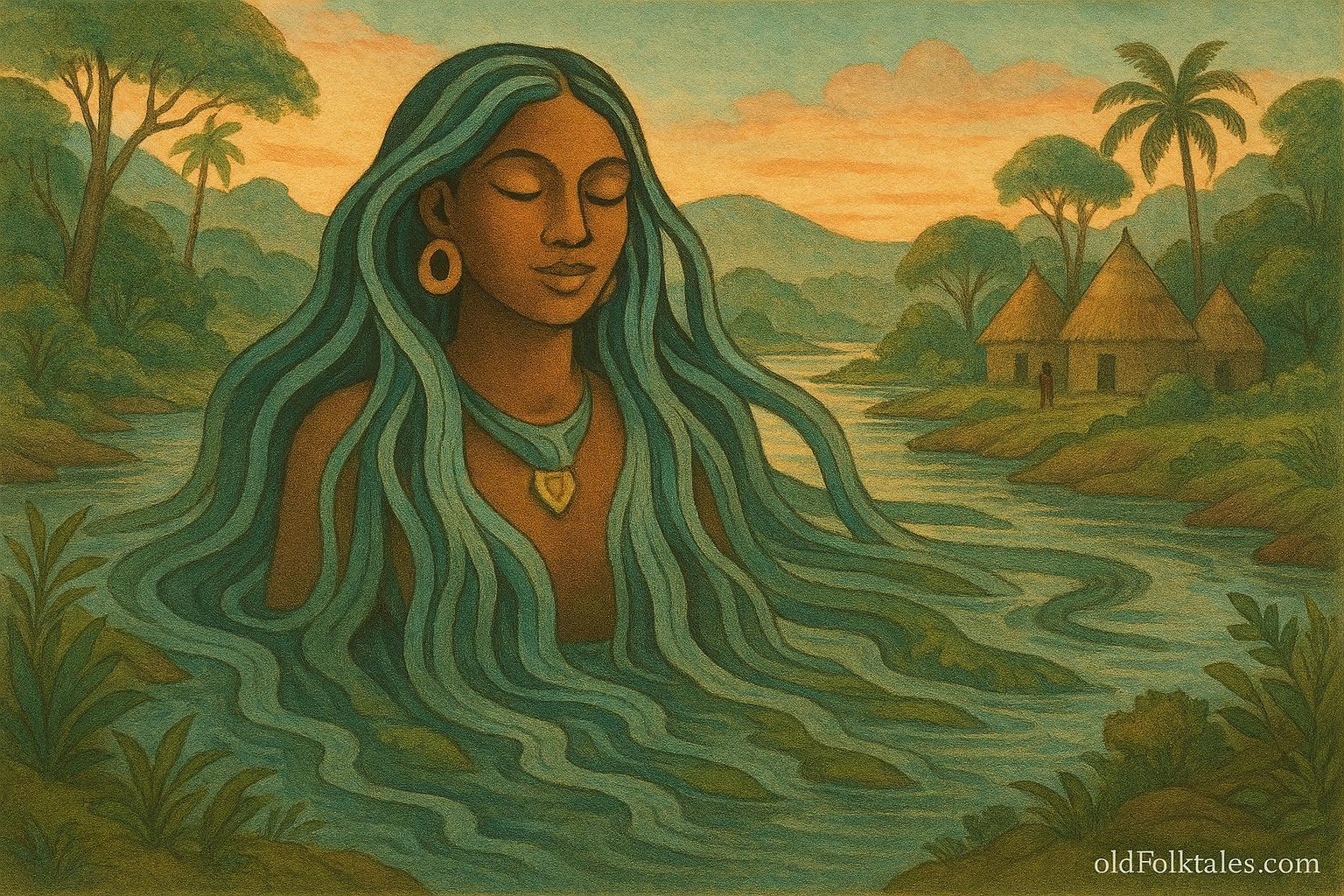
Atabey rose.
She appeared as a woman shaped by flowing lines. Her hair moved like currents. Her eyes reflected depth beyond sight. She did not speak at first. She looked at the people, and they felt the weight of being seen fully.
“You have treated me as endless,” she said at last. “But life is not endless without balance.”
The people bowed. No one argued. They understood that water had not failed them. They had failed water.
Atabey did not punish with destruction. Instead, she imposed limits. Springs flowed only at certain hours. Rivers demanded quiet crossing. Women seeking children were instructed to fast and reflect before bathing in sacred waters. Waste thrown into streams returned to shore.
Through hardship, the people learned discipline. They learned that water must be approached with intention. Slowly, Atabey lifted the restrictions. Births became strong again. Crops stabilized. Fish returned.
From that time on, Atabey remained present but unseen. Mothers whispered her name during childbirth. Farmers thanked her before irrigation. Children were taught that shouting at rivers was disrespectful.
The Taíno understood that Atabey was not only water. She was memory. She carried the past through the present into the future. She reminded humanity that creation continues only when care is maintained.
And so, every flowing stream became a lesson, and every drop carried responsibility.
Explore the ancestral legends of Canada, Mesoamerica, and South America’s Indigenous tribes.
Moral lesson
Life thrives when humans treat natural forces with respect and restraint. Water gives freely only to those who remember it is sacred.
Knowledge check
1 Who is Atabey in the story?
Answer She is the Taíno mother goddess of water, fertility, and life cycles.
2 Why did Atabey become concerned with human behavior?
Answer Humans began wasting and disrespecting water, treating it as endless.
3 How did Atabey correct the people?
Answer She imposed limits on water access to teach discipline and respect.
4 What happened when people relearned gratitude?
Answer Balance returned through healthy crops, safe births, and stable rivers.
5 Why is water described as a listener?
Answer Because it responds to human behavior and intention.
6 What lasting lesson did the people learn?
Answer That survival depends on honoring natural forces, not exploiting them.
Source
Adapted from Caribbean Indigenous cosmology collections at the National Museum of the American Indian
Cultural origin
Taíno peoples, Greater Antilles