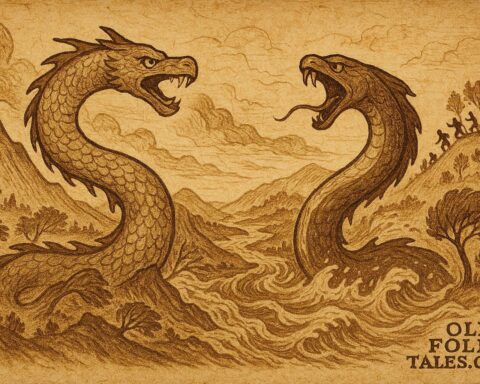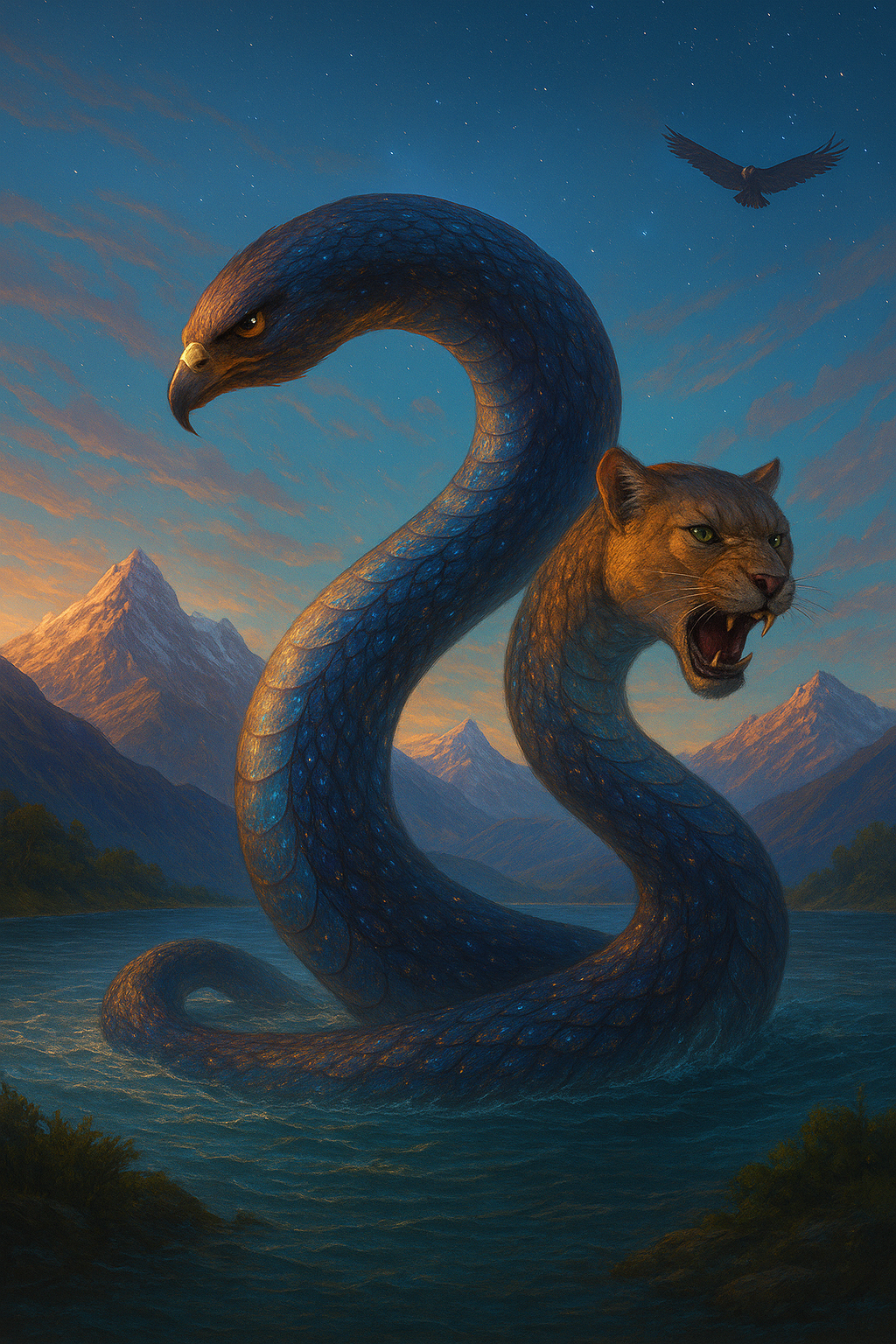
Deep beneath the eternal snows that crown the Andes Mountains, where the peaks pierce the sky like frozen spears and condors circle on currents of invisible air, there exists a realm unknown to most mortals. It is a world of hidden lakes whose waters have never seen sunlight, of underground rivers that carve secret pathways through ancient stone, of caverns so vast that entire villages could disappear within their darkness. And in this concealed domain, coiled within the very bones of the earth itself, dwells Amaru the mighty serpent-dragon whose presence commands both terror and reverence.
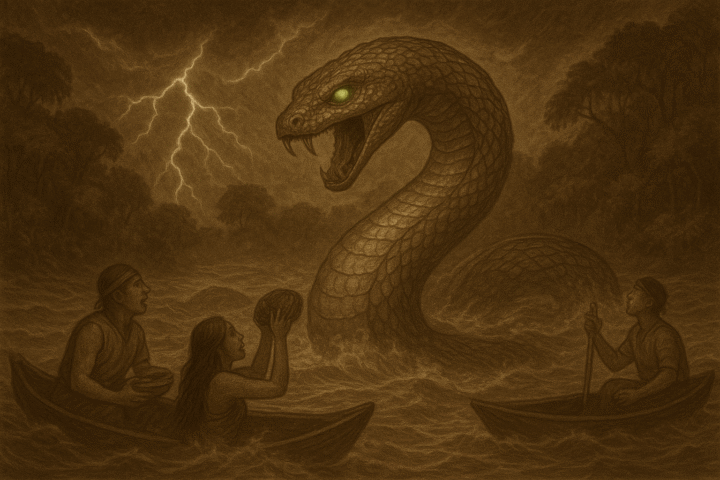
Amaru is no ordinary creature of scale and fang. Its body stretches impossibly long, threading through all three realms of existence: deep within the earth where the ancestors sleep, across the surface where humans toil and dream, and up into the sky where the spirits of the heights make their homes. Its form defies simple description, for it possesses the heads of both birds and pumas those sacred animals that represent the sky and the terrestrial world. Its scales do not merely shimmer; they glow with an otherworldly light, like stars pulled down from the heavens and pressed into living flesh. Its enormous tail disappears into the depths of mountain lakes, connecting the visible world with the mysterious underworld below.
Click to read all South American Folktales — timeless stories from the Andes to the Amazon.
To the Inca and the indigenous peoples of the Andes who came before and after them, Amaru is far more than a monster to be feared. It is a guardian, a keeper of boundaries, a living embodiment of the sacred balance that must be maintained between the worlds and within the natural order itself. Where Amaru dwells, the forces of creation and destruction rest in delicate equilibrium.
The story the elders tell begins in a time not so distant that memory has entirely faded, yet far enough that the details have acquired the weight of legend. Near the sacred waters of Lake Titicaca that vast expanse of blue that sits so high in the mountains it seems to touch the sky there stood a village. Its people were industrious and clever, skilled in the arts of agriculture and weaving, known throughout the region for their terraced fields that climbed the mountainsides like giant staircases to the heavens.
But as the village grew and prospered, ambition began to cloud the people’s judgment. They looked upon a sacred lagoon that fed their fields and saw not a holy place but wasted space. “Why should so much water sit idle,” the young ones argued, “when we could drain it and plant more quinoa, more potatoes, more maize?” The elders protested, reminding everyone of the old ways, the necessary rituals, the offerings that had always been left for Amaru at the water’s edge bundles of coca leaves, ears of golden maize, whispered prayers of gratitude and respect.
But the voices of caution were drowned out by the promises of prosperity. “Those are just old stories,” the villagers said, dismissing centuries of wisdom with a wave of their hands. “Superstition from a more ignorant time. We are modern people now. We understand how the world works.”
And so they began to drain the sacred lagoon.
The work took many days. They dug channels to divert the water, built earthen dams to contain and redirect the flow. Slowly, the lagoon began to recede, revealing a muddy bottom that had been hidden beneath the water since time immemorial. The fish that had lived there for generations gasped and died on the exposed mud, their silver bodies turning dull under the harsh mountain sun. The earth around the lagoon, deprived of its life-giving moisture, began to crack, the fissures spreading like veins of death through once-fertile soil.
The villagers celebrated their achievement, blind to the signs of imbalance all around them. They planted their crops in the reclaimed land and went to sleep that night dreaming of abundant harvests.
But in the darkest hours before dawn, when even the stars seemed to hold their breath, Amaru stirred in the deep places beneath the earth.
The great serpent-dragon rose from its lair in the hidden lakes far below the surface, its massive body undulating through underground passages worn smooth by millennia of passage. It emerged from the drained lagoon’s center, where a deep crack had opened in the exposed earth a doorway between worlds that should never have been revealed. Amaru’s multiple heads broke through into the night air, bird beaks opening to release cries that sounded like condor shrieks mixed with the roar of pumas, its puma heads snarling with indignation at the violation of the sacred space.
The serpent’s scales blazed with starlight in the darkness, casting strange shadows that danced and writhed across the surrounding mountains. It surveyed what the humans had done the dried mud, the dead fish, the absence of water where water had always been meant to flow. Then Amaru hissed, a sound like wind through ice caves, like the earth itself expressing its displeasure. Without further warning, the great guardian retreated, not into the empty lagoon, but deeper still into the bowels of the earth, coiling back through passages that led to the very heart of the mountain, to the realm of the ancestors and the ancient powers that sleep there.
When the villagers awoke, they found themselves in the grip of consequences they had not imagined. A strange sickness had settled over the village during the night not a fever exactly, but a weakness, a draining of vitality that left people listless and hollow-eyed. Children cried without knowing why. Adults felt a heaviness in their chests, as though something essential had been stolen from the very air they breathed.
Worse still, the rains stopped coming. The skies remained clear and pitiless, day after day, week after week. The crops they had planted in the reclaimed land withered before they could sprout. The crops in their traditional terraced fields turned brown and brittle. The streams that had always run down from the mountains slowed to trickles, then stopped altogether. Dust replaced water. Drought settled over the land like a curse.
The elders gathered in the village center, their faces grave with knowing. “Amaru has withdrawn its blessing,” they said quietly. “The guardian has retreated to the deep places, and without its presence to maintain the balance, the waters will not flow. The land will not give life. We have broken the covenant.”
Fear finally penetrated where wisdom had failed. The villagers understood, too late, what their arrogance had cost them. In desperation, they turned to the old ways they had so recently dismissed. They gathered offerings the finest golden maize from their dwindling stores, bundles of precious coca leaves, woven textiles in patterns that honored the sacred. They returned to the dried lagoon and to the shores of Lake Titicaca, laying their gifts at the water’s edge with trembling hands.
But offerings alone were not enough. The people had to change their hearts as well. They sang the old chants their grandparents had taught them, songs in Quechua that spoke directly to the land, to the mountains, to the serpent that dwelt beneath. They spoke with genuine humility now, acknowledging their foolishness, asking forgiveness, promising to respect the boundaries between worlds and to honor the sacred places that had been entrusted to their care.
For many days, nothing changed. Then, one morning, the villagers felt it a trembling in the earth, subtle but unmistakable. Far beneath their feet, Amaru was moving again, uncoiling from its deep retreat. That afternoon, clouds gathered over the mountains for the first time in months. That night, rain fell gentle at first, then stronger, the life-giving water soaking into the parched earth. Springs that had dried began to flow again. The lagoon, left open to receive the water rather than being drained, began to slowly fill.
The sickness lifted from the village like morning mist burned away by the sun. The people recovered their strength. The land began to heal, though it would take time to fully restore what had been damaged. And Amaru, satisfied that the humans had learned their lesson, disappeared once more into its hidden realm, the guardian returning to its eternal vigil.
From that day forward, the people of the Andes tell this story to their children and their children’s children. They say that any time the ground trembles beneath your feet, it is Amaru stirring in the deep places, a reminder that the serpent is always there, always watching. When wind breaks the mirror-smooth surface of a mountain lake, creating ripples where there should be stillness, it is Amaru’s tail moving through the underground waters that feed that lake, a sign of the guardian’s presence.
The great serpent-dragon maintains the boundary between the three worlds: above, where the condors soar and the sky spirits dwell; in the middle, where humans live their brief and bustling lives; and below, in the hidden places where ancestors rest and ancient powers wait. Respect the land, the elders teach. Speak with humility to the forces you cannot see. Remember that you are not masters of the earth but merely guests in a realm far older and more powerful than you can comprehend. Do this, and Amaru will remain at peace, allowing life to continue in balance.
But forget these lessons, take more than you need, violate the sacred places, ignore the offerings and the rituals that maintain the covenant between humans and the natural world do these things, and you risk awakening the serpent’s silent vengeance. For Amaru never forgets, and nature always demands its due.
Explore myths and legends from Brazil, Peru, and Argentina rooted in spirit and survival.
The Moral Lesson
The legend of Amaru teaches profound respect for the sacred balance of nature and the hidden forces that sustain life. It warns against arrogance and the dismissal of ancestral wisdom in favor of short-term material gain. The story emphasizes that humans are not separate from or superior to nature, but part of an interconnected system with sacred boundaries that must be honored. Most importantly, it shows that some places and forces are meant to remain undisturbed, that taking without giving leads to devastating consequences, and that restoring balance requires genuine humility, changed hearts, and renewed commitment to maintaining harmony with the natural and spiritual worlds.
Knowledge Check
Q1: What is Amaru and what makes it unique in Andean mythology? A: Amaru is a powerful serpent-dragon in Inca and Andean mythology that dwells beneath mountains and in hidden lakes. It uniquely possesses both bird heads and puma heads, representing connections to sky and earth, with scales that shimmer like stars. Its body coils through all three realms the underground world of ancestors, the surface world of humans, and the sky world of spirits making it a guardian of boundaries between worlds.
Q2: What sacred boundary did the village near Lake Titicaca violate? A: The village violated the sacred boundary by draining a holy lagoon to create more farmland, ignoring the traditional offerings of golden maize, coca leaves, and prayers that the elders had always left for Amaru. They dismissed ancestral wisdom as superstition and exploited a sacred water source for material gain without respect for its spiritual significance.
Q3: How did Amaru respond to the violation of the sacred lagoon? A: When Amaru discovered the drained lagoon with dead fish and cracked earth, the serpent rose from underground, its multiple heads crying out in indignation with sounds of condors and pumas. After hissing its displeasure, Amaru retreated deeper into the earth’s bowels, withdrawing its protective presence and causing sickness, drought, and crop failure to afflict the village.
Q4: What did the villagers have to do to restore balance and bring Amaru’s blessing back? A: The villagers had to restore the traditional offerings golden maize, coca leaves, woven textiles, and prayers at the water’s edge. More importantly, they had to genuinely change their hearts, sing the old Quechua chants, speak with true humility, acknowledge their foolishness, and promise to respect sacred boundaries and honor the covenant between humans and nature.
Q5: What are the signs that Amaru is present and active according to Andean tradition? A: According to tradition, ground tremors indicate Amaru stirring in the deep places beneath the earth. When wind breaks the smooth surface of mountain lakes creating unexpected ripples, it signals Amaru’s tail moving through the underground waters that feed those lakes, reminding people that the guardian serpent is always present and watching.
Q6: What does Amaru symbolize in terms of humanity’s relationship with nature? A: Amaru symbolizes the sacred balance between worlds and the hidden forces that sustain life. It represents the boundary guardian between the underworld, human world, and sky world, teaching that nature contains powers beyond human understanding that deserve respect. The serpent embodies the principle that humans are not masters but participants in an interconnected system, and that violating sacred boundaries or taking without reciprocal respect brings consequences that affect the entire community.
Source: Adapted from “Amaru (mythology)”20 Peruvian legends of the Andes”
Cultural Origin: Inca and other indigenous groups of the Andes Mountains, primarily Peru, Bolivia, and Ecuador