In the rural heartlands of Paraguay, where rivers wind like silver serpents through dense forests and the boundary between day and night feels like a threshold between worlds, there exists a warning passed down through generations. It is whispered by grandmothers to restless children, shared among travelers before journeys, and remembered by those who venture near water as twilight falls.
They speak of a woman who appears when the sun begins its descent and shadows stretch long across the earth. She wears a shawl the color of fresh blood, so vivid it seems to glow in the fading light. And she comes with a message that no one should ignore.
Click to read all South American Folktales — timeless stories from the Andes to the Amazon.
The people call her the Woman of the Red Shawl, and to see her is to receive a warning that may save your life or mark your doom, depending on whether you have the wisdom to listen.
The story begins, as many such stories do, with those who did not listen.
There was a young man named Ramiro, strong and headstrong in the way of youth, who believed that courage meant never showing caution. He worked as a fisherman, spending his days on the waters of the Paraguay River, casting his nets and hauling in the silver catch that fed his family and filled the markets of nearby towns.
One evening, as the sun painted the sky in shades of amber and rose, Ramiro prepared to make one final trip to check his nets before darkness fell completely. The other fishermen had already returned to shore, their boats pulled up onto the muddy banks, their catches sorted and packed. They called to him as he pushed his small vessel back into the water.
“Ramiro! Leave the nets until morning! The hour grows late!”
But Ramiro laughed, waving away their concerns. “One more hour of light remains. I will not let good fish rot in the nets overnight when I can bring them in fresh.”
The older fishermen exchanged worried glances but said nothing more. They knew the stubbornness of young men, and they knew that some lessons could only be learned through experience.
Ramiro paddled out to where his nets were set, to a place where the river widened and deepened, where the current ran strong and the water turned dark as obsidian even in daylight. The twilight air hung heavy and still, broken only by the splash of his paddle and the distant calls of birds settling into the trees for the night.
As he reached for his nets, movement on the shore caught his eye.
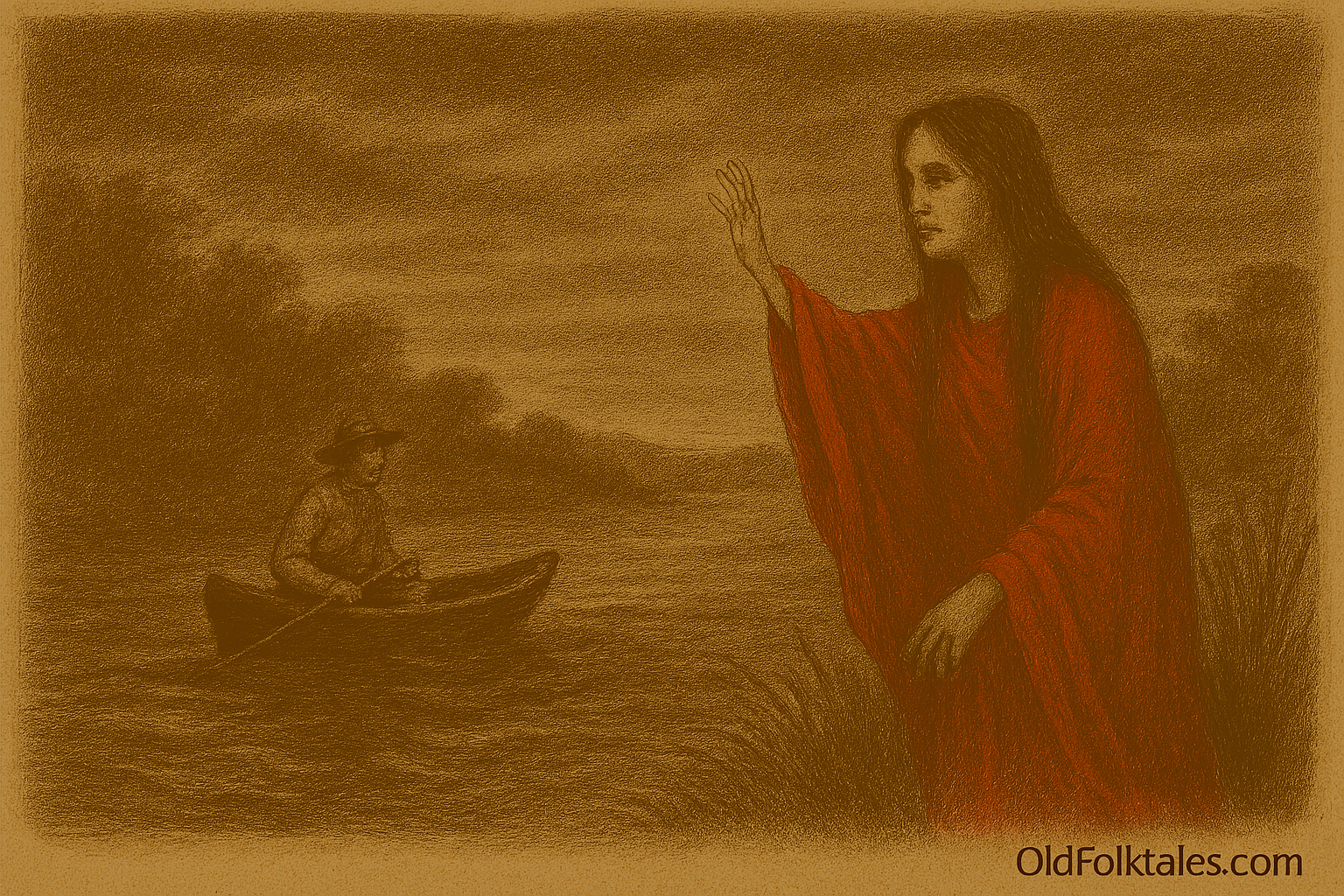
A woman stood at the water’s edge, watching him. She was neither young nor old, her age somehow indefinable in the dimming light. But what arrested Ramiro’s attention, what made his hands freeze on the rope of his net, was the shawl draped across her shoulders a shawl so intensely red it seemed to pulse with its own inner fire.
The woman raised one arm slowly, deliberately, pointing toward the shore. Her gesture was unmistakable: come back. Turn around. Leave this place.
Ramiro felt an inexplicable chill run through his body despite the warm evening air. Something in the woman’s presence felt wrong, unnatural. Her stillness was too perfect, her appearance too sudden. She had not walked to that spot she had simply appeared, as though materialized from the air itself.
For a moment, uncertainty gripped him. His hands trembled slightly on the net rope. But then pride and stubbornness reasserted themselves. He was not a child to be frightened by strange women on the shore. He was not weak-minded to see ghosts in every shadow.
“I am only checking my nets!” he shouted toward her, his voice carrying across the water. “I will return to shore shortly!”
The woman did not respond. She did not move. She simply stood there, her red shawl vivid against the darkening landscape, her arm still extended in warning. Then, as Ramiro watched, she raised her other arm and beckoned more urgently, shaking her head slowly from side to side. The message was clear: danger. Return. Now.
Ramiro’s chest tightened with an emotion he did not want to acknowledge as fear. He turned away from her deliberately, focusing his attention on pulling up his nets. His movements were rough, almost angry, as though by working harder he could dispel the unease that had settled over him like a cold mist.
“Superstitious nonsense,” he muttered to himself. “I will not be frightened by an old woman and a red cloth.”
When he looked back toward the shore, the woman was gone.
Ramiro felt a brief surge of vindication. See? Just an ordinary woman, probably a villager out for an evening walk, now returned home. Nothing supernatural, nothing to fear. He returned to his work, determined to finish quickly and prove to himself that his courage had been justified.
But as he worked, strange things began to happen.
The water around his boat began to ripple in patterns that did not match the current. Circles appeared on the surface, expanding outward as though something large moved beneath. The air grew suddenly cold, so cold that Ramiro could see his breath misting before his face. And from somewhere in the growing darkness came a sound a whisper that seemed to come from the water itself, from the air, from everywhere and nowhere at once.
“Turn back… turn back… turn back…”
Ramiro’s hands fumbled with the nets. His heart hammered against his ribs. The boat rocked beneath him, though the water appeared calm. A wave of dizziness swept over him, so powerful that he had to grip the sides of the boat to keep from falling.
Then he saw her again.
The Woman of the Red Shawl stood impossibly on the water itself, twenty feet from his boat, her feet resting on the surface as though it were solid ground. Her face, which had been shadowed before, was now visible in the strange luminescence that seemed to emanate from her shawl. It was a face of indescribable sadness, of ancient sorrow, of warning given too many times to those who would not listen.
She raised both arms and pointed behind him.
Ramiro spun around, following her gesture, and his blood turned to ice in his veins.
A massive whirlpool was forming in the center of the river, directly between his boat and the safety of the shore. Water spiraled downward into a vortex that seemed to have no bottom, pulling everything toward its hungry center. The current that had been languid moments before now rushed toward the whirlpool with terrifying speed, and Ramiro’s boat had already begun to drift in that direction.
Terror gave him strength. He seized his paddle and drove it into the water, struggling against the current with every ounce of his strength. His muscles screamed in protest. Sweat poured down his face despite the unnatural cold. The boat inched sideways, but the pull of the whirlpool was relentless, drawing him ever closer to that spiraling abyss.
He glanced toward where the woman had stood on the water, a desperate plea for help forming on his lips.
She was still there, but now she moved. With gestures both graceful and commanding, she seemed to be pushing at the air itself, as though fighting against invisible forces. And miraculously, the current around Ramiro’s boat began to shift. A counter-current formed, catching his vessel and pushing it away from the whirlpool, toward the shore, toward safety.
Ramiro paddled with renewed desperation, working with this unexpected aid. Slowly, agonizingly, the boat moved away from the deadly vortex. The roar of the whirlpool faded behind him. The unnatural cold began to lift. Finally, his boat scraped against the muddy bank, and Ramiro half-fell, half-jumped onto solid ground.
He collapsed there, gasping, trembling, alive.
When he could finally breathe normally again and looked back toward the river, both the woman and the whirlpool had vanished. The water flowed peacefully under the now-dark sky, as though nothing extraordinary had happened.
But Ramiro knew the truth. He had been warned, had ignored the warning, and had been saved despite his foolishness but only just barely.
The next day, he told his story to the other fishermen. Some believed him immediately they had heard similar tales before. Others were skeptical until an elder spoke up, his voice carrying the weight of years and wisdom.
“You saw the Woman of the Red Shawl,” the old man said simply. “You are fortunate you lived to tell of it. She appears to those who are in danger, who approach places or times that should be avoided. She is not evil she is a guardian, a warner. But she appears only when the danger is real and terrible.”
“Why does she wear red?” Ramiro asked, his voice still shaky.
“The red is blood,” another elder answered. “Some say it is the blood of all those who ignored her warnings and died. Others say it is her own blood, that she died trying to save someone she loved and now exists between worlds, forever trying to save others from similar fates. No one knows her true story, but everyone knows her purpose: she marks places of danger and times when the boundary between life and death grows thin.”
From that day forward, Ramiro never dismissed warnings or signs of danger. He told his story to anyone who would listen, hoping to spare others the terror he had experienced. And he was not alone in his experience.
Over the years, many others have encountered the Woman of the Red Shawl near the rivers of Paraguay. She appears most often at twilight, that in-between time when the world changes from light to dark, when spirits walk more freely and the veil between worlds grows thin.
Some travelers report seeing her standing at crossroads near rivers, pointing away from a path they had intended to take. Those who heeded her warning later learned that bandits had been waiting on that road, or that a bridge had collapsed, or that floods had washed away the trail.
Others have seen her near swimming holes where children play, appearing when a child ventures too far from shore or toward waters that run deep and dangerous. In these cases, the children often report feeling a sudden urge to return to shallow water, or their parents suddenly call them back, or they simply change their minds about swimming only to learn later that dangerous currents or hidden dangers lurked where they had been heading.
But there are also the darker stories tales of those who saw the Woman of the Red Shawl, recognized her warning, and deliberately ignored it out of pride, disbelief, or recklessness.
These stories rarely have happy endings.
A merchant who saw her blocking his path continued anyway, only to be found days later, his wagon overturned in a ravine, his body broken. A group of young people who saw her near a popular swimming spot laughed at the superstition and dove in anyway; one never resurfaced. A traveler who saw her pointing away from a riverside camp ignored the warning and was found the next morning, alive but delirious with fever, muttering about spirits in the water he never fully recovered his sanity.
The rural people of Paraguay have learned to respect the Woman of the Red Shawl. They teach their children about her, not to frighten them, but to protect them. When she appears, you listen. When she warns, you turn back. When she points away from danger, you follow her guidance without question.
Some say she is a ghost, a spirit trapped between worlds. Others believe she is an angel of mercy, sent by God to protect the innocent and warn the foolish. Still others think she might be an ancient spirit of the rivers themselves, a manifestation of the water’s own consciousness, trying to prevent tragedy.
Whatever her true nature, her purpose is clear: she is a guardian who appears when danger is near, offering one chance, one warning, one opportunity to choose safety over peril.
The crimson shawl she wears has become legendary, a symbol of the thin line between life and death, a banner of warning more valuable than any treasure. In the twilight hours, near the rivers and streams of Paraguay, that splash of red against the gathering darkness is a sign that should never be ignored.
For the Woman of the Red Shawl speaks in a language older than words. She speaks in symbols and signs, in color and gesture, in presence and absence. And her message, delivered century after century to those who venture too close to danger, remains unchanged:
Turn back. This is not your time. This is not your place. Live to see another day.
Those who listen are saved. Those who do not… become part of the reason she continues to appear, her red shawl a memorial to all who did not heed the warning, and a beacon of hope for those who still might.
Discover the sacred tales of llamas, condors, and gods who guard the Andes
The Moral Lesson
The legend of the Woman of the Red Shawl teaches the vital importance of heeding warnings and respecting signs of danger, even when we don’t fully understand them. Pride, stubbornness, and the dismissal of cautionary signs can lead to tragedy, while humility and respect for wisdom whether from elders, intuition, or mysterious guardians can save lives. The story reminds us that supernatural or unexplained warnings should not be dismissed as mere superstition, and that there are forces in the world that seek to protect us if we are wise enough to listen. True courage is not the absence of caution, but the wisdom to recognize real danger and act accordingly.
Knowledge Check
Q1: Who is the Woman of the Red Shawl in Paraguayan folklore? A: The Woman of the Red Shawl is a mysterious guardian spirit who appears near rivers at twilight wearing a vivid crimson shawl. She warns travelers of imminent danger by gesturing for them to turn back. She is considered a protective entity who offers one chance to avoid tragedy, though those who ignore her warnings often face illness, disappearance, or death.
Q2: What happened to Ramiro when he ignored the woman’s warning? A: When Ramiro ignored the Woman of the Red Shawl’s warning and continued checking his fishing nets, he encountered supernatural phenomena including strange water ripples, unnatural cold, and a massive whirlpool that nearly pulled his boat to destruction. He was saved only when the woman used mysterious powers to create a counter-current that pushed him toward shore.
Q3: Why does the Woman of the Red Shawl appear specifically at twilight? A: She appears at twilight because it is considered an “in-between time” when the world transitions from light to dark and the boundary between the physical and spiritual worlds grows thin. This liminal period is when spirits walk more freely and dangers become more prevalent, making it the perfect time for a guardian spirit to warn those at risk.
Q4: What is the symbolic meaning of the red shawl the woman wears? A: The red shawl symbolizes blood and the thin line between life and death. According to different interpretations, it represents either the blood of all those who ignored her warnings and died, or her own blood from dying while trying to save a loved one. The vivid crimson serves as an unmistakable warning signal that cannot be overlooked.
Q5: What happens to people who see the Woman of the Red Shawl and ignore her warnings? A: Those who deliberately ignore her warnings typically face tragic consequences they fall ill with mysterious fevers, disappear without trace, encounter accidents like overturned wagons or drownings, or lose their sanity. The folklore contains numerous cautionary tales of people whose pride or disbelief led them to dismiss her warnings, resulting in death or permanent harm.
Q6: What is the cultural significance of this legend in rural Paraguay? A: In rural Paraguayan culture, the Woman of the Red Shawl serves as an important teaching tool about respecting warnings, listening to intuition, and honoring the spiritual dimensions of nature. Parents teach children about her to instill caution near rivers and respect for supernatural signs. The legend reinforces community values of humility, wisdom, and the understanding that not everything can be explained by rational thought alone.
Source: Adapted from rural Paraguayan oral tradition as documented in Portal Guaraní
Cultural Origin: Guaraní and mestizo communities, rural Paraguay, South America