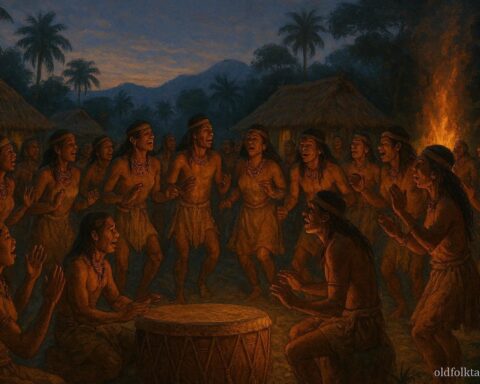
In the early days of the world, before silence learned to linger, laughter moved freely through the Amazon forest. It drifted like birdsong through the trees and rippled across riverbanks. Humans laughed as they harvested crops and shared meals. Animals laughed in their own way, through playful calls, bounding steps, and bright, restless energy. Joy belonged to everyone, and no one thought to claim it.
Among the animals lived a monkey known for his cleverness. He was quick with his hands and quicker with his mind. He watched the way laughter softened faces and drew others close. He noticed how attention gathered around joy, how those who made others laugh were never alone.
The monkey began to think.
“If laughter brings power,” he told himself, “then whoever holds the most laughter will hold the forest.”
At first, his behavior seemed harmless. He mimicked the sounds of others, exaggerated their movements, and pointed out small mistakes. Laughter followed him wherever he went. But slowly, his playfulness sharpened into mockery. He laughed not with others, but at them.
Each time laughter rose, the monkey seized it. He tucked it away inside himself, savoring the sound as if it were a possession. He grew louder, while others grew quieter. Children stopped playing games where they might be laughed at. Animals moved cautiously, fearful of becoming targets of his clever tongue.
Still, the monkey laughed.
As days passed, the forest changed. Gatherings grew silent. Harvests were completed without song. Even the rivers seemed to flow more slowly, as if weighed down by the absence of joy. Laughter no longer traveled through the trees; it stayed trapped inside the monkey.
Yet something was wrong.
Though he possessed all the laughter, the monkey felt restless. His joy echoed hollowly inside him. There was no one left to hear it, no one left to respond. His laughter no longer felt warm. It rattled within him like stones in an empty gourd.
Loneliness crept in where joy once lived.
The spirits of the forest watched silently as balance slipped away. They saw animals withdraw, humans grow weary, and the monkey pacing alone among the branches. At last, they summoned him.
“You have taken what does not belong to one alone,” the spirits said. “Laughter is not power to be stored. It is breath. It must move.”
The monkey tried to laugh in response, but the sound fell flat. His hoarded joy brought him no comfort now.
The spirits commanded him to release the laughter he had stolen.
With trembling limbs, the monkey opened himself and let the laughter go. It burst outward, spilling through the forest like sudden rain. Children laughed again as they ran. Animals resumed their playful calls. Songs returned to harvest fields. The forest breathed freely once more.
The monkey felt lighter, but smaller.
He learned then that laughter only lives when it is shared. When hoarded, it turns empty. When used without care, it wounds. Joy belongs to the community, not to those who seek to control it.
From that time on, laughter returned to the Amazon as it had always been, moving freely, belonging to all, reminding each living being that balance depends on generosity, even with happiness itself.
Discover South America’s folktales filled with magic, transformation, and ancestral wisdom
Moral Lesson
This folktale teaches that joy must be shared to remain meaningful. Hoarding happiness or using it selfishly leads to isolation and imbalance within the community.
Knowledge Check
1. Why did the monkey begin collecting laughter?
He believed laughter gave power and attention.
2. How did the monkey take laughter from others?
By mocking mistakes and laughing at others rather than with them.
3. What effect did the loss of laughter have on the forest?
The forest became quiet, heavy, and joyless.
4. Why did the monkey become unhappy despite holding all the laughter?
Because joy without sharing brings loneliness, not fulfillment.
5. What role did the forest spirits play in the story?
They restored balance by forcing the monkey to release the laughter.
6. What lesson does the story teach about happiness?
Happiness must be shared and practiced with moderation.
Source: Indigenous oral animal folklore; recorded in Central Amazon tale cycles
Cultural Origin: Amazon Basin (Indigenous folklore)