In the dense forests of Paraguay, where ancient trees grew so thick their canopies blocked out the stars, there walked a spirit that made even the bravest travelers quicken their pace. The people called her Mala Visión, the Evil Vision, and her story was one of beauty corrupted by jealousy, love twisted into violence, and a soul condemned to wander forever in the darkness she had created.
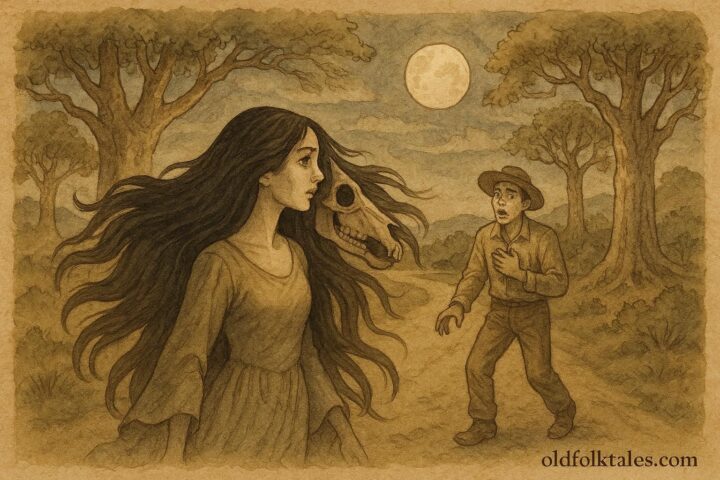
Long ago, in a small settlement carved from the wilderness, there lived a woman named Valentina. She possessed a beauty that turned heads wherever she went: thick black hair that fell like a waterfall down her back, eyes dark as midnight, and features so perfectly formed that poets compared her to angels. But beneath this exquisite exterior lived a heart that harbored seeds of darkness, seeds that would eventually grow into something monstrous.
Valentina was married to Mateo, a kind and gentle man who worked as a woodcutter. He loved his wife deeply, perhaps more deeply than was wise, for he indulged her every whim and overlooked the possessive nature that grew stronger with each passing year. Mateo was handsome in his own right, with strong shoulders and an easy smile that made people feel comfortable in his presence. This warmth, this natural charisma, would become the spark that ignited Valentina’s descent into madness.
Click to read all South American Folktales — timeless stories from the Andes to the Amazon.
For Valentina was consumed by jealousy. She could not bear to see Mateo speak to another woman, even in innocent greeting. When he helped a neighbor carry water or paused to chat with the merchant’s daughter in the marketplace, Valentina’s mind conjured elaborate fantasies of betrayal. Her jealousy was a living thing inside her, feeding on her thoughts, growing larger and more demanding with each imagined slight.
“You were looking at her,” she would hiss at Mateo when they were alone, her beautiful face contorted with rage. “I saw the way you smiled.”
“My love, I was only being polite,” Mateo would reply, his voice patient and confused. “There is no one but you in my heart.”
But his reassurances meant nothing. The jealousy had taken root too deeply, wrapping around her reason like strangling vines. Valentina began to see threats everywhere. Every woman was a potential rival. Every kindness Mateo showed to others was evidence of his faithlessness. She stopped sleeping, spending her nights imagining his betrayals, her mind spinning darker and darker scenarios.
One evening, Mateo returned home later than usual. He had been helping a elderly widow repair her roof, a task that had taken longer than expected. He arrived home tired and hungry, expecting the warmth of his home and his wife’s embrace.
Instead, he found Valentina waiting in their small house, a machete in her trembling hands. Her eyes were wild, her hair disheveled, her beauty transformed into something terrible by the madness that had finally consumed her completely.
“You were with her,” Valentina whispered, her voice like broken glass. “Don’t lie to me. I know. I always know.”
“Valentina, please,” Mateo said, his hands raised in a gesture of peace. “I was helping Doña Rosa with her roof. Ask anyone in the village. There is nothing between us, nothing between me and any woman but you.”
But she could no longer hear reason. The jealousy had devoured everything else inside her. With a scream that shattered the evening calm, Valentina attacked her husband. The machete rose and fell, rose and fell, and Mateo’s blood stained the earthen floor of their home.
When the madness finally receded and Valentina saw what she had done, the horror of it broke something fundamental in her mind. Mateo lay dead at her feet, his eyes still open, still reflecting the love he had held for her even in his final moments. She had destroyed the very thing she claimed to love so desperately.
Valentina fled into the forest, the machete still clutched in her bloodstained hands. She ran blindly through the darkness, branches tearing at her clothes and face, her screams echoing through the trees. But she could not escape what she had done. Everywhere she looked, she saw Mateo’s face. His ghost appeared before her, pale and bleeding, his eyes filled not with anger but with profound sadness.
“Why?” the apparition whispered. “I loved only you.”
The haunting drove what remained of Valentina’s sanity completely away. She wandered deeper into the forest, no longer knowing or caring where she went. Days passed, then weeks. Search parties found no trace of her, though sometimes hunters reported hearing terrible screams in the deepest parts of the woods, cries of anguish and madness that made their blood run cold.
Eventually, Valentina’s body was found at the base of a ravine, her beautiful features barely recognizable, her dead eyes still wide with horror. But death brought her no peace. Her spirit, twisted by jealousy and guilt, could not rest. She was condemned to wander the forests at night, forever seeing the ghost of the husband she had murdered, forever crying out in anguish and rage.
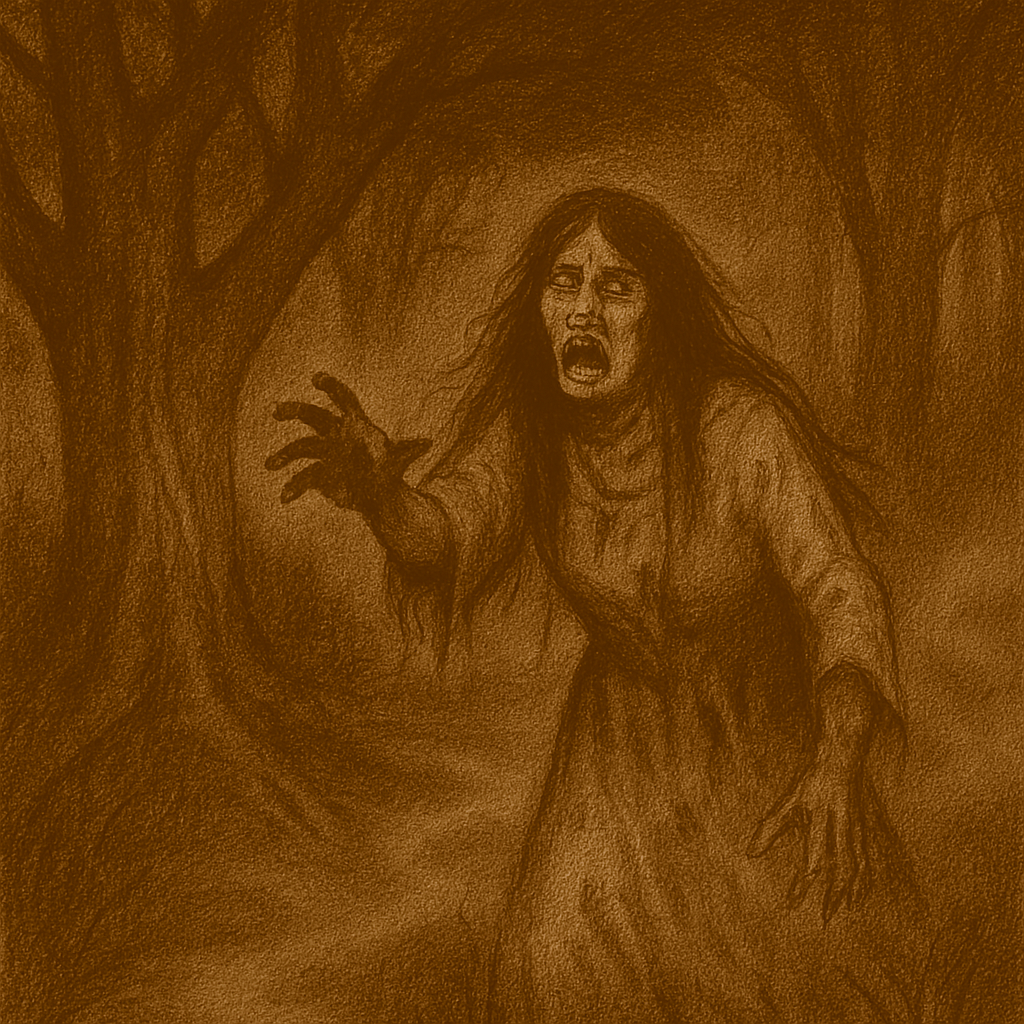
Those who traveled through the Paraguay forests after dark soon learned to recognize the signs of her presence. First came an unnatural chill, even on the warmest nights. Then the sound of sobbing, growing closer and closer. And finally, if one was unlucky enough, a glimpse of her: a beautiful woman in bloodstained clothes, her face a mask of madness, her hands reaching out as if to grab or strangle, her voice raised in terrible screams that spoke of suffering beyond human understanding.
Travelers who encountered Mala Visión rarely escaped unscathed. Some died of fright, their hearts simply stopping from the terror of her appearance. Others fled into the darkness and were found days later, their minds broken, unable to speak of what they had seen. A few returned to tell their tales, but they were forever changed, their eyes holding shadows that never quite went away.
The legend of Mala Visión spread throughout Paraguay, told around fires and used to teach children important lessons. Parents would tell their daughters about the beautiful woman destroyed by jealousy, warning them that unchecked suspicion and possessive love could transform even the purest heart into something monstrous. They told their sons about Mateo, reminding them that sometimes love, no matter how genuine, cannot save someone determined to destroy themselves and others.
To this day, people avoid certain parts of the Paraguayan forests at night. When travelers must pass through these areas, they walk quickly and speak prayers of protection. And sometimes, on particularly dark nights, those prayers are not enough. The screams still echo through the trees, and the spirit of Mala Visión continues her eternal wandering, forever trapped between the world of the living and the dead, forever haunted by the consequences of her jealous rage.
Click to read all Andean Highland Folktales — echoing from the mountain peaks of Peru, Bolivia, and Ecuador.
The Moral of the Story
The legend of Mala Visión teaches us that jealousy, left unchecked, transforms love into something destructive and ultimately self-destroying. When we allow suspicion and possessiveness to control our hearts, we risk destroying not only those we claim to love but also ourselves. True love requires trust, and without trust, even the strongest affection becomes poisonous. The story warns that violence born of jealousy brings no resolution, only eternal suffering and regret.
Knowledge Check
Q1: Who was Valentina before she became the spirit of Mala Visión?
A: Valentina was an exceptionally beautiful woman married to Mateo, a kind woodcutter. Despite her physical beauty, she harbored an extreme and pathological jealousy that eventually consumed her reason and drove her to commit a terrible act of violence against her loving husband.
Q2: What caused Valentina to murder her husband Mateo?
A: Valentina murdered Mateo because her extreme jealousy had driven her to madness. When he returned home late from helping an elderly widow repair her roof, her unfounded suspicions of his infidelity overwhelmed her completely, leading her to attack him with a machete despite his innocence and devotion to her.
Q3: How did Valentina become the wandering spirit known as Mala Visión?
A: After murdering Mateo, Valentina fled into the forest where she was haunted by his ghost and driven completely insane by guilt and horror. She eventually died in a ravine, but her spirit, twisted by jealousy and remorse, was condemned to wander the forests eternally, unable to find peace or rest.
Q4: What happens to travelers who encounter Mala Visión in the forest?
A: Travelers who encounter Mala Visión experience an unnatural chill, hear terrible sobbing and screaming, and may see her bloodstained apparition reaching out with madness in her eyes. Some die of fright, others flee and are found with broken minds, and even survivors are forever changed by the horrifying encounter.
Q5: What cultural lesson does the Mala Visión legend teach about relationships?
A: The legend teaches that jealousy and possessiveness are destructive forces that transform love into something toxic and dangerous. It emphasizes that trust is essential in relationships and warns that suspicion, even when unfounded, can lead to irreversible tragedy and eternal suffering for all involved.
Q6: Why is the Mala Visión story still told in Paraguayan culture?
A: The story continues to be told as a cautionary tale to teach about the dangers of jealousy, possessive love, and violence. Parents use it to warn children about letting negative emotions control their actions, emphasizing that unchecked jealousy can destroy not only others but also oneself, resulting in eternal consequences.
Source: Adapted from Paraguayan oral folklore traditions and cultural legends documented in regional ghost story collections and supernatural folklore archives.
Cultural Origin: Rural forest communities of Paraguay, South America