High in the rugged Andes of Argentina, villagers whispered of a path that came alive only under the veil of night. Known simply as the Night Path, it stretched across high ridges and deep valleys, winding where no ordinary trail dared. Those who traveled it with honesty and humility discovered that it offered a swift, safe journey. But those guided by pride, impatience, or deceit found the path worked against them, erasing their footprints as if they had never walked there.
The Night Path was more than a trail. The elders explained that the mountains themselves observed human intentions, and the path was a sacred extension of the land’s consciousness. It had existed long before the village had homes, before roads had been laid, and even before the tallest peaks were fully formed. The path was a teacher, a silent guardian, and a moral mirror.
Among the villagers was a young woman named Nayra, known for her curiosity and independent spirit. She had grown up hearing stories of travelers who had lost their way or returned humbled from the Night Path. Yet she had never seen it herself. One evening, under a crescent moon, she decided to follow the path. She carried a small bundle of food intended for her grandmother in the next village. In her heart, however, Nayra held a hidden wish: she wanted to prove her courage and find a shortcut that had been warned against for generations.
Explore the ancestral legends of Canada, Mesoamerica, and South America’s Indigenous tribes.
At first, the Night Path appeared inviting. Moonlight spilled over jagged stones, illuminating small shrubs that clung to the mountainside. A gentle breeze carried the scent of distant pines and the faint hum of night insects. Nayra walked briskly, thinking only of her goal, scarcely noticing the beauty around her. Her footprints marked the soft earth as she went, yet something felt unusual.
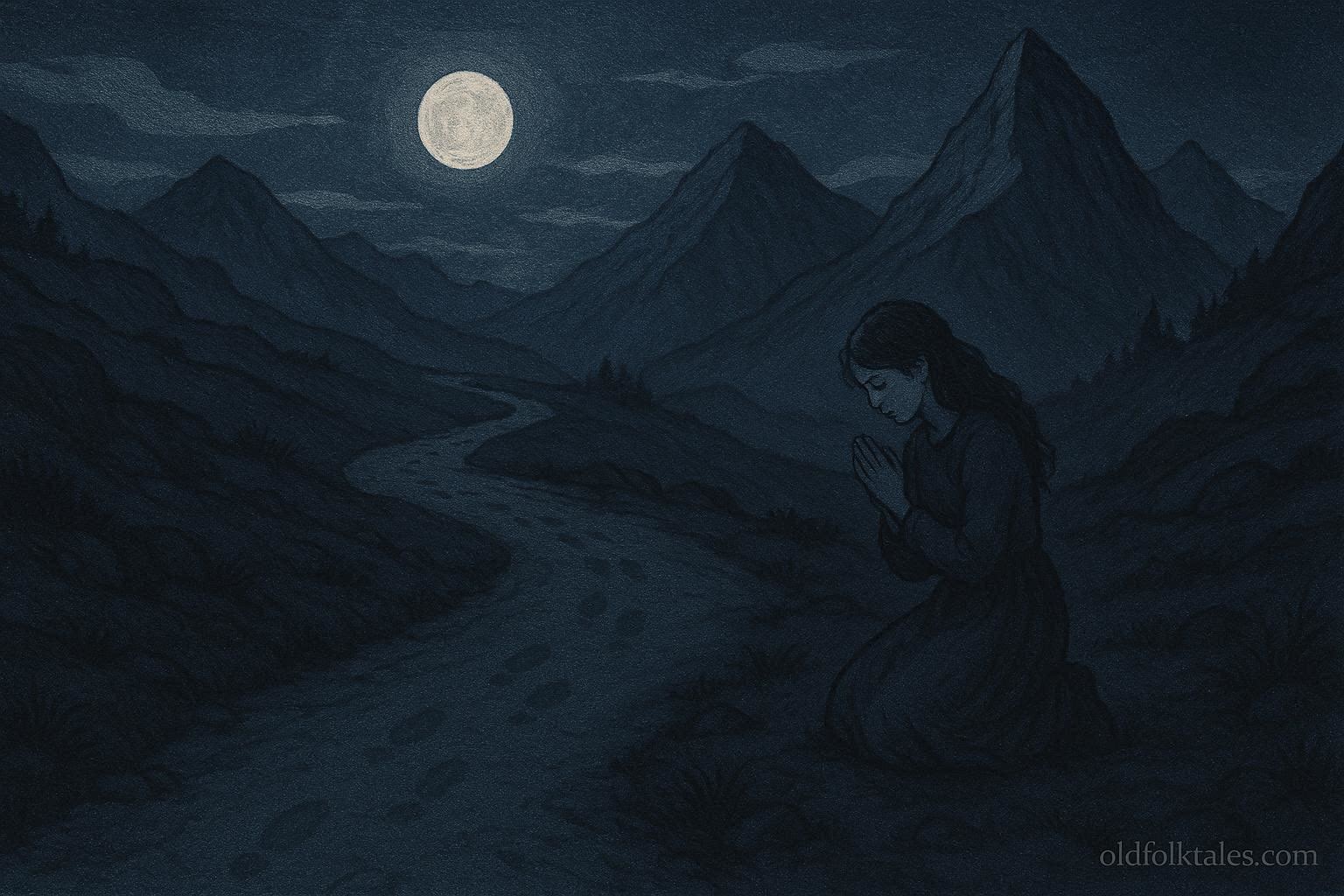
Soon, she realized her tracks were fading. She turned to look behind her, startled to see the earth smooth and untouched. Nayra felt a chill run through her. The elders’ warnings rushed back to her: “The path sees the heart. The path shows what lies within.” Nayra sank to her knees and whispered a quiet apology. She had been impatient, proud, and secretive. She had thought only of herself, not of the journey’s purpose or the respect owed to the land and spirits.
A sudden gust of wind swept across the mountainside. Nayra felt as if the mountains themselves were speaking to her, urging reflection and humility. She stayed on her knees for long moments, bowing her head, listening to the soft rustle of leaves and the distant call of a night bird. She promised to walk honestly, to respect the path, and to honor both her task and the spirits who watched over the trail.
When she rose, her footprints reappeared, faint but steady. Nayra now walked slowly, observing each stone, listening to the whisper of the wind, and feeling the solid presence of the mountains beneath her feet. Every step became a deliberate act of care, humility, and attentiveness. She noticed the path guiding her around hidden crevices and narrow ledges, and she understood that the trail rewarded those who aligned their intentions with truth and responsibility.
Along the way, she encountered other travelers: an elderly man carrying firewood, a father guiding his young son, and a woman tending her goats. Each of them approached with respect, walking carefully and quietly. The Night Path welcomed them, allowing their footprints to remain visible and steady, even as the moonlight shifted and shadows danced. Nayra realized that the path was not merely a punishment for the dishonest but a living testament to communal responsibility, patience, and harmony with the land.
Hours later, Nayra reached her grandmother’s village. She told the story to the elders, recounting her fear, her humility, and the lessons learned. They nodded knowingly. “The path is a teacher,” one elder said. “It does not act out of anger, but as a mirror of the heart. The land carries memory, and the spirits of the mountains ensure that honesty and integrity are seen, even if the feet cannot be traced.”
From that night onward, Nayra shared her experience widely. Children and travelers learned that the Night Path was both a guide and a test. It reminded everyone that moral integrity matters as much as physical navigation. Pride, impatience, and deceit leave traces in the spiritual world, and only those who act with care and honesty find their way. Over generations, the villagers revered the Night Path not only as a physical trail but as a sacred moral compass embedded in the land itself.
Travelers who approached the mountains with honesty felt a quiet strength beneath their feet. Those who entered with selfish thoughts or arrogance often returned with stories of vanished footprints and silent mountains. These tales became central to the village’s teaching, ensuring that each generation understood that actions, intentions, and respect for both the land and the community were inseparable.
Even now, the Night Path stands in the high Andes, winding across stones and ridges, listening, observing, and teaching. It reminds all who tread its way that the land itself remembers every choice and that the consequences of dishonesty reach far beyond the eyes of men.
Click to read all South American Folktales — timeless stories from the Andes to the Amazon.
Moral Lesson
Honesty and humility are as important as courage and skill. The land and sacred landscapes act as moral witnesses. Deception, pride, or selfishness can have consequences that extend beyond physical traces, teaching the importance of integrity, respect, and mindfulness in every action.
Knowledge Check
1 What is the Night Path, and where is it located?
The Night Path is a mountain trail in the Andes of Argentina that erases the footprints of dishonest travelers
2 Who is Nayra, and what lesson does she learn?
Nayra is a young woman who learns that pride and deceit leave spiritual traces even when physical footprints vanish
3 What happens to travelers with selfish intentions?
Their footprints disappear, symbolizing the path’s moral enforcement
4 How does the path respond to honest travelers?
It guides them safely and allows their footprints to remain visible
5 Which cultural group does this folktale originate from?
Andean peoples of Argentina
6 What broader theme does the Night Path illustrate?
That sacred landscapes act as moral witnesses, reflecting human behavior and intentions
Source: Adapted from Landscape Memory in Andean Oral Traditions, Universidad Nacional de La Plata (2010)
Cultural Origin: Andean peoples, Argentina