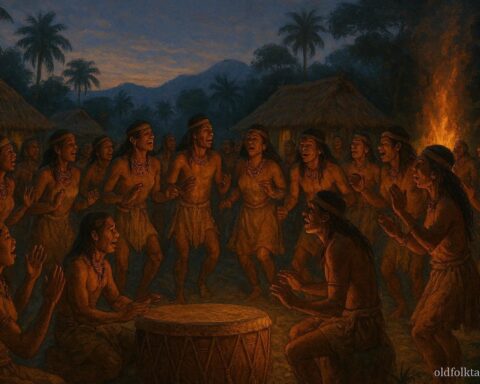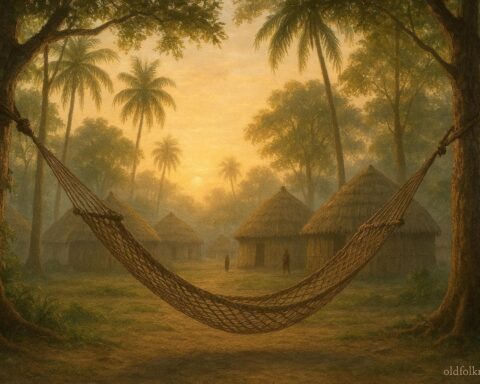
In a village along the edges of the great Paraguayan wetlands, where the land gradually dissolves into marsh and water, there once lived a young man named Karãu. He was known throughout the region not for his work in the fields or his skill with animals, but for his passion for music and dance. Whenever there was a celebration a wedding, a harvest festival, a saint’s day gathering Karãu would be at the center of it, his feet moving to the rhythm of the drums, his voice raised in song, his whole being alive with the joy of the moment.
Karãu’s mother had raised him alone after his father’s death many years before. She had worked hard to provide for him, managing their small plot of land, tending their few animals, and ensuring that he never went hungry even when times were difficult. She loved her son deeply, though she sometimes worried about his priorities. He seemed to live only for the next celebration, the next opportunity to lose himself in music and movement, while the responsibilities of daily life the planting, the harvesting, the maintenance of their home often fell to her aging shoulders.
Click to read all South American Folktales — timeless stories from the Andes to the Amazon.
As the years passed and Karãu grew into manhood, his mother’s health began to decline. The hard work of decades had taken its toll on her body, and increasingly she needed her son’s help with tasks that had once been simple for her. But Karãu, absorbed in his own pleasures, often failed to notice her growing frailty. When she asked him to help with heavy work, he would promise to do it later, after the next dance, after the next gathering. Later always seemed to become tomorrow, and tomorrow never quite arrived.
One evening, a great celebration was announced in the village. It would be a night of music, dancing, and feasting to mark the beginning of the harvest season. Karãu’s eyes lit up with anticipation. He spent the afternoon preparing himself, choosing his best clothes, tuning his guitar, practicing the steps of new dances he had learned.
His mother, feeling particularly weak that day, asked him not to go. “Stay with me tonight, my son,” she said, her voice barely above a whisper. “I don’t feel well. I need you here.”
But Karãu could already hear the distant drums beginning to beat, could imagine the torches being lit in the village square, could picture the dancers beginning to gather. “You’ll be fine, mamá,” he said dismissively. “You just need rest. I’ll check on you when I get back.”
Before she could protest further, he was gone, hurrying through the gathering dusk toward the sounds of celebration.
The party was everything Karãu had hoped for. The music was infectious, the dancing spirited, the atmosphere alive with joy and community. Karãu threw himself into the celebration with his characteristic abandon, dancing every dance, singing every song, moving from partner to partner, from one circle of dancers to another.
Several hours into the evening, one of his neighbors found him in the midst of a particularly energetic dance. The man’s face was grave as he approached. “Karãu,” he said urgently, “you need to come home. Your mother has taken a turn for the worse. She’s asking for you.”
Karãu barely paused in his dancing. “She’s always worried about nothing,” he called over his shoulder. “Tell her I’ll be home soon. Let me just finish this dance.”
The neighbor persisted. “Karãu, this is serious. You should come now.”
But Karãu was lost in the music, in the movement, in the moment. “One more dance,” he insisted. “Just one more. Then I’ll go.”
One dance became two, then three. The music was too good, the night too perfect. Karãu convinced himself that his mother was simply being overly cautious, that she would be fine, that there was no real emergency. The neighbor eventually gave up trying to convince him and left, shaking his head in disapproval.
The celebration continued late into the night. It was only as the first hints of dawn began to lighten the eastern sky that Karãu finally decided to head home. He was exhausted but happy, still humming the melodies from the evening, his feet still light with the memory of the dances.
As he approached his home, he noticed something wrong. The door was open, and several neighbors were gathered outside, their faces somber. His stomach tightened with sudden dread as he broke into a run.
Inside, he found his mother lying on her bed, still and silent. Her eyes were closed, her hands folded across her chest. She had died hours ago, in the early evening, not long after he had left for the party. She had called for him repeatedly, the neighbors told him, asking for her son with her final breaths. But Karãu had been dancing, lost in music and pleasure while his mother died alone, calling his name.
The weight of what he had done crashed over Karãu like a physical blow. His legs gave out, and he collapsed beside his mother’s bed, clutching her cold hand. The guilt was overwhelming, suffocating. He had ignored her pleas, dismissed her needs, chosen his own pleasure over her comfort in her final hours. She had raised him, sacrificed for him, loved him unconditionally and when she needed him most, when she was dying and calling for him, he had been dancing.
Karãu’s anguished cries filled the house, then spilled out into the dawn. He wept uncontrollably, calling out for his mother, begging her forgiveness, cursing himself for his selfishness and cruelty. The neighbors tried to comfort him, but there was no comfort to be had. He had missed his chance to say goodbye, to hold her hand as she passed, to tell her he loved her. That opportunity was gone forever, and no amount of weeping could bring it back.
After his mother’s burial, Karãu could not bear to remain in the village. Everywhere he looked, he saw reminders of his failure the house they had shared, the neighbors who had witnessed his neglect, the very path he had taken to the celebration while abandoning her. His guilt consumed him, giving him no peace.
He began to wander, leaving the village behind and drifting into the marshlands at the edge of the wetlands. He walked for days, not eating, barely sleeping, crying continuously. His grief poured out of him in endless sobs and wails that echoed across the empty landscape. “Mamá,” he cried to the indifferent sky. “Mamá, forgive me. Mamá, I’m sorry. Mamá, mamá, mamá.”
The gods of the marshlands, who watch over the forgotten places where land meets water, heard Karãu’s endless mourning. They saw a young man destroyed by guilt and regret, unable to find peace, unable to stop crying for the mother he had failed. They took pity on him, though their mercy came in a strange form.
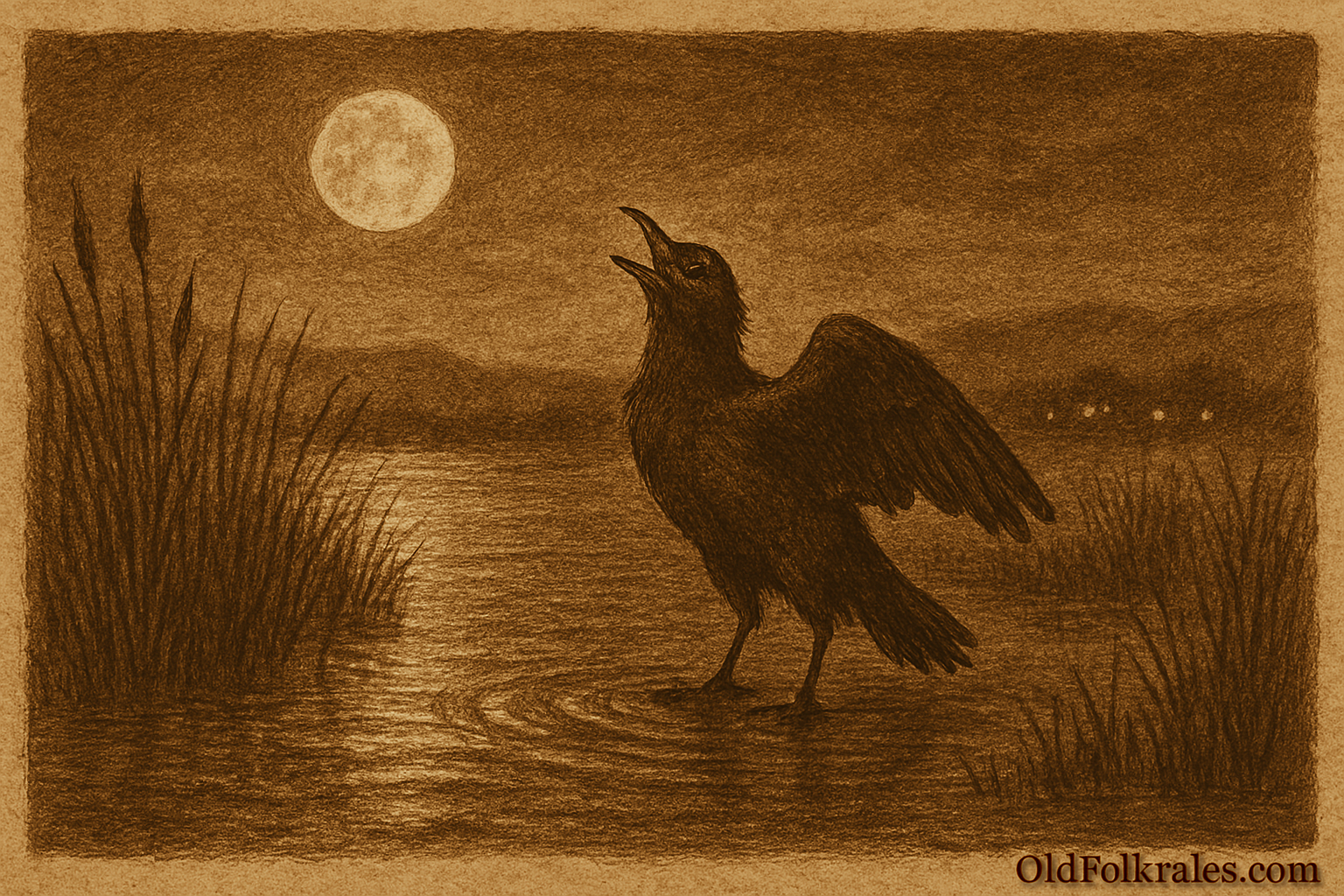
As Karãu wandered deeper into the wetlands, his body began to change. His arms transformed into wings, black and sleek. His legs became thin and adapted for wading through shallow water. His mouth elongated into a beak. His entire form shrank and shifted until he was no longer a young man but a marsh bird dark-feathered, solitary, haunting the edges of the waterways.
But his voice remained, transformed but recognizable. The bird that Karãu had become could not stop crying out, just as the man had been unable to stop mourning. His call echoed across the marshlands, a plaintive, sorrowful sound that carried the weight of eternal regret: “Karãu, karãu, karãu” forever calling out his own name, forever mourning the mother he had lost through his own selfish choices.
To this day, the karãu bird inhabits the marshlands of Paraguay. It is a solitary creature, most often heard at night, when its mournful cry drifts across the water. When people hear it calling in the darkness that sad, repetitive sound that seems to carry infinite sorrow they remember the story of the young man who loved dancing more than he loved his mother, who chose pleasure over duty, and who now spends eternity crying out his regret in a voice that never stops mourning, never finds peace, never receives the forgiveness he seeks.
Click to read all Andean Highland Folktales — echoing from the mountain peaks of Peru, Bolivia, and Ecuador.
The Moral Lesson
This Guaraní legend teaches the vital importance of honoring family obligations, particularly our duties to aging parents who have sacrificed for us. Karãu’s transformation into an eternally mourning bird illustrates that some opportunities especially the chance to be present for loved ones in their final moments can never be reclaimed once lost. The story warns against prioritizing momentary pleasures over lasting responsibilities, showing how selfish choices made in the pursuit of enjoyment can result in lifelong regret. The karãu bird’s perpetual crying serves as a permanent reminder that guilt and remorse, once earned through neglect of sacred duties, may become inescapable burdens that follow us forever, and that the time to show love and respect to our parents is always now, never later.
Knowledge Check
Q1: Who was Karãu before his transformation in this Paraguayan legend? Karãu was a young man from a village near the Paraguayan wetlands who was known throughout the region for his love of music and dancing. He lived with his mother, who had raised him alone after his father’s death, and was more interested in celebrations and parties than in fulfilling his responsibilities to help care for his aging mother or maintain their home.
Q2: What choice did Karãu make on the night his mother died? When Karãu’s mother felt gravely ill and asked him to stay home with her, he dismissed her concerns and went to a village celebration anyway. Later, when a neighbor came to tell him his mother had taken a turn for the worse and was asking for him, Karãu refused to leave the party, saying he would come home after “just one more dance” a dance that turned into hours of continued celebration while his mother died alone.
Q3: How did Karãu react when he discovered his mother had died? Karãu was overwhelmed with guilt and grief when he returned home at dawn to find his mother had died hours earlier while calling for him. He collapsed beside her bed, crying uncontrollably and calling out for her forgiveness. The weight of his failure choosing to dance while she died alone crushed him completely, and he could not be comforted by neighbors or find any peace with himself.
Q4: Why did Karãu wander into the marshlands after his mother’s burial? Karãu could not bear to remain in the village where everything reminded him of his failure and neglect. His guilt consumed him completely, giving him no peace. He began wandering into the marshlands, crying continuously for his mother, unable to eat or sleep, seeking some escape from his overwhelming remorse but finding none in the empty wetlands.
Q5: How was Karãu transformed and what became of him? The marsh gods, hearing Karãu’s endless mourning and taking pity on his suffering, transformed him into a black marsh bird. His body changed completely arms became wings, legs adapted for wading, mouth became a beak but his voice remained, forever crying out his name and his regret. He became the karãu bird that still inhabits Paraguayan marshlands, eternally mourning with a sorrowful cry that echoes across the wetlands.
Q6: What does the karãu bird’s cry represent in Guaraní culture? The karãu bird’s mournful cry, heard especially at night across the marshlands, represents eternal regret and unforgiven guilt. When people hear the bird calling “karãu, karãu, karãu,” they remember the story of the young man who neglected his dying mother for his own pleasure, and the cry serves as a perpetual reminder to honor family obligations, respect aging parents, and never take for granted the time we have with loved ones before it’s too late.
Source: Adapted from 30 Leyendas Populares del Paraguay by Jorge Montesino (2006) and Portal Guaraní
Cultural Origin: Guaraní Indigenous Peoples, Paraguay