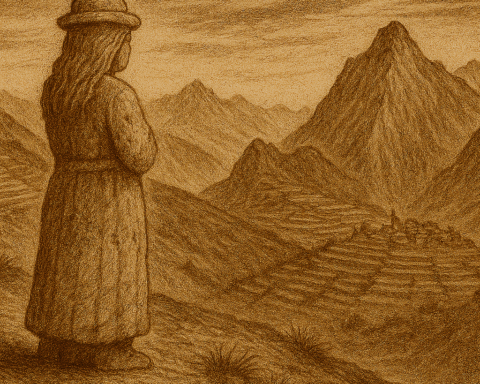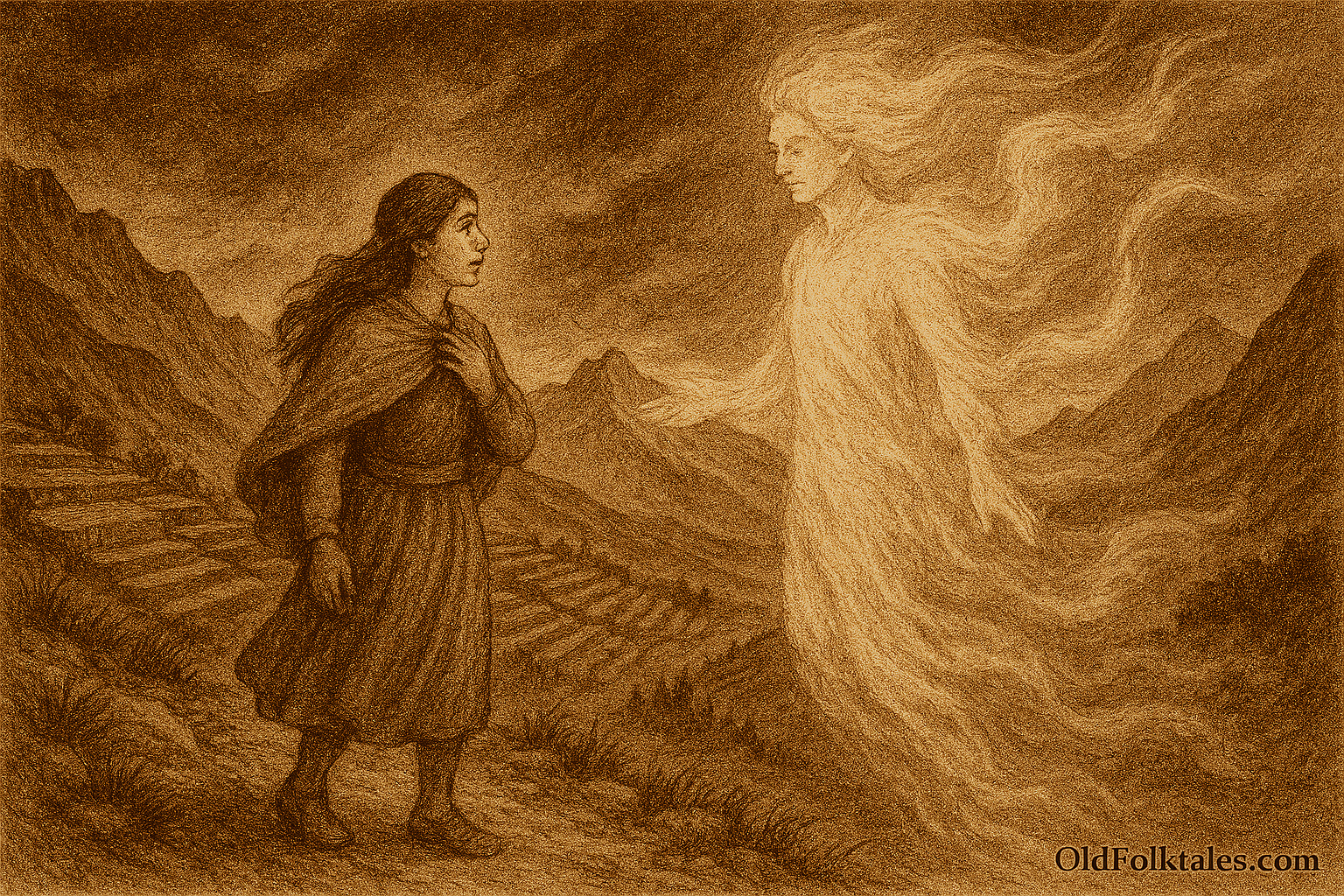
In the high valleys of the Andes, where the mountains pierce the clouds and the air grows thin and cold, there once lived a young woman named Qori. She was known throughout her village for her beauty and her spirited nature. Her laughter rang like bells across the terraced fields, and her dark eyes sparkled with intelligence and curiosity. But Qori had one quality that worried her family she was fiercely independent and refused every suitor who came seeking her hand in marriage.
“I will not marry a man who cannot match my spirit,” she would declare, turning away farmers and herders alike. Her mother and father worried that their daughter would grow old alone, but Qori remained unmoved by their concerns.
One spring day, as Qori walked through the high pastures collecting medicinal herbs, a gentle breeze began to follow her. It was unusually warm and persistent, playing with the edges of her woven mantle and caressing her hair with invisible fingers. The breeze seemed almost alive, swirling around her in playful spirals, carrying the scent of wild flowers from distant valleys.
Click to read all South American Folktales — timeless stories from the Andes to the Amazon.
“Who are you?” Qori asked the wind, half-joking, not expecting an answer.
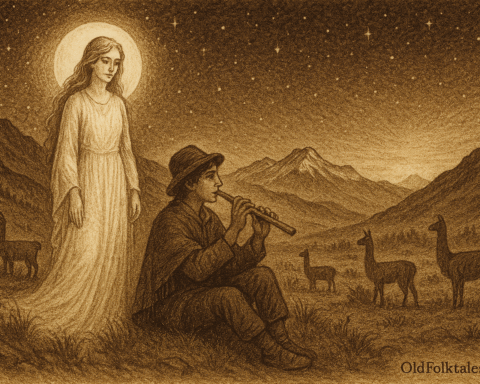
To her amazement, the breeze coalesced before her eyes, taking the form of a handsome young man dressed in garments that shimmered like mist. His hair moved constantly as if underwater, and his eyes held the depth of endless skies.
“I am Wayra,” he said, his voice like wind through canyon walls. “I have traveled across mountains and valleys, through forests and over lakes, and never have I encountered anyone as free-spirited as you. You move through the world like wind itself, unbounded and wild.”
Qori was enchanted. Here, at last, was someone who understood her nature. Wayra courted her with gifts unlike any mortal suitor could offer he brought her the songs of distant birds, the fragrances of flowers that grew in far-off valleys, and stories from every corner of the world he had touched. He was gentle and attentive, his presence like a cool breeze on a hot day, refreshing and welcome.
When Wayra asked for her hand in marriage, Qori agreed without hesitation. Her parents were troubled by this strange suitor who seemed more spirit than man, but they could not deny their daughter’s happiness. The wedding was celebrated with music and dancing, and Wayra promised to care for Qori with all the tenderness of a summer breeze.
At first, their life together was blissful. Wayra was a devoted husband, surrounding Qori with warmth and gentleness. He helped her crops grow by bringing rain clouds from distant mountains. He dried her washing in the sun and kept the smoke from her cooking fire from filling her home. He whispered sweet words that only she could hear and protected her from the harsh cold of mountain nights.
But Wayra was, in his essence, a force of nature powerful, ancient, and unpredictable. And Qori, strong-willed as she was, sometimes forgot this truth.
The first time she spoke to him dismissively, waving him away when he tried to help her with her work, Wayra became cool and distant. The gentle breeze that usually surrounded their home turned sharp and cutting. That night, the wind howled around their dwelling, rattling the doors and making the walls shudder.
“You must never disrespect me,” Wayra warned, his eyes flashing like storm clouds. “I am Wayra, spirit of the wind. I have bent trees and carved mountains. Remember who I am.”
Qori apologized, and Wayra’s anger subsided. He became gentle once more, and for a time, peace returned to their home.
But as months passed, Qori grew comfortable again. She began to take her husband’s nature for granted, forgetting that he was not merely a man but a powerful elemental force. When Wayra offered advice, she ignored him. When he tried to help, she refused. When he spoke, she sometimes mocked his words, treating him as if he were an ordinary husband with no more power than any other man.
Each act of disrespect awakened something darker in Wayra’s nature. The gentle breeze became a harsh wind. The helpful spirit became unpredictable and fierce. He would arrive home in sudden gusts, slamming doors and scattering everything in his path. His voice, once soft and musical, became a roar that shook the rafters. He whipped through the house in violent spirals, destroying Qori’s carefully arranged belongings and terrifying her with his raw, uncontrolled power.
Qori realized too late that she had awakened the destructive side of the wind. The man she had married was gone, replaced by something wild and dangerous a force that could not be controlled or reasoned with once provoked.
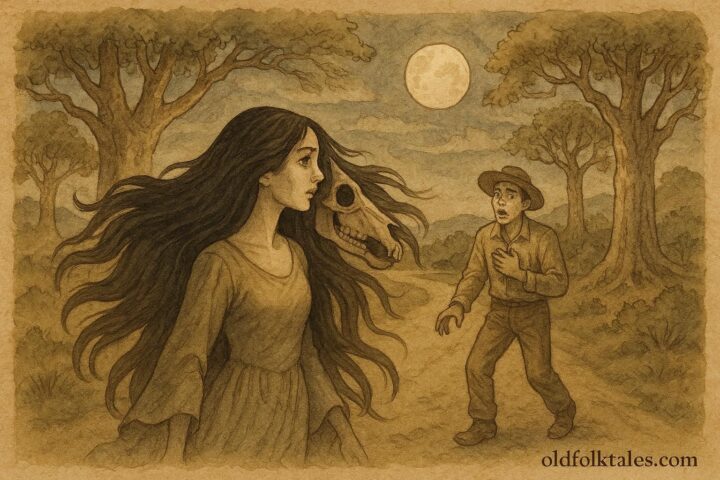
One terrible night, when Wayra’s fury reached its peak and the house seemed ready to be torn apart, Qori knew she had to escape. She waited until his rage had exhausted itself into an uneasy calm, then she fled in the darkness, running down the mountain paths she had known since childhood. She sought refuge in her mother’s house, hiding there while Wayra searched for her.
For days, terrible winds ravaged the valleys, searching every corner for Qori. Trees were uprooted, roofs were torn from houses, and the people huddled in their homes, terrified by the wind’s violence. But Qori’s mother, wise in the old ways, knew how to hide her daughter from the wind spirit. She burned sacred herbs and spoke ancient prayers, creating a sanctuary that Wayra could not penetrate.
Eventually, Wayra’s fury exhausted itself. He retreated to the high mountains, his voice fading to a distant howl. But he never truly left. To this day, when the wind grows violent and destructive, the people of the Andes say it is Wayra, still searching for his lost wife, still angry at the disrespect he endured. And when gentle breezes blow through the valleys, they say it is Wayra remembering the early days of his marriage, when he was treated with love and reverence.
Qori never married again. She lived out her days teaching others the lesson she had learned so painfully, that nature’s forces, no matter how gentle they may seem, must always be treated with respect, for they contain within them tremendous power that, once awakened, cannot easily be contained.
Click to read all Andean Highland Folktales — echoing from the mountain peaks of Peru, Bolivia, and Ecuador.
The Moral Lesson
This Quechua legend teaches the vital importance of respect particularly respect for the forces of nature and for those we share our lives with. Qori’s story reminds us that taking anyone or anything for granted, especially powers greater than ourselves, can have devastating consequences. The tale also illustrates how contempt and disrespect can transform even the gentlest relationships into destructive ones, and that some forces, once provoked, cannot be easily appeased or controlled. It emphasizes the Andean worldview that nature spirits must be honored and treated with reverence, for they are both benevolent providers and potentially dangerous powers.
Knowledge Check
Q1: Who was Wayra in Quechua mythology and folklore? Wayra was the spirit of the wind in Quechua cosmology, an elemental force who could take human form. He represented both the gentle, life-giving aspects of wind that helps crops grow and the violent, destructive power of storms. As a nature spirit, he embodied the dual nature of wind itself beneficial when respected, dangerous when provoked.
Q2: Why did Qori agree to marry the wind spirit Wayra? Qori married Wayra because he was the first suitor who truly understood and matched her free-spirited, independent nature. Unlike mortal men, Wayra appreciated her wildness and offered her unique gifts from across the world. He represented the unbounded freedom she valued, making him the only suitor worthy of her hand.
Q3: What caused Wayra to become violent in this Andean tale? Wayra became violent when Qori began to disrespect him, taking his gentle nature for granted. She dismissed him, ignored his advice, mocked his words, and forgot that he was a powerful nature spirit rather than an ordinary man. Each act of disrespect awakened his destructive side, transforming gentle breezes into violent storms.
Q4: How does this legend explain the origin of destructive winds and storms? The legend explains that destructive winds and storms occur when Wayra becomes angry originally provoked by his wife’s disrespect and continuing as he searches for her after she fled. When violent winds blow through the Andes, people say it is Wayra still seeking Qori and expressing his fury at being dishonored.
Q5: What is the cultural significance of respecting nature spirits in Quechua tradition? In Quechua cosmology, nature spirits like Wayra are powerful forces that must be treated with reverence and respect. This legend reinforces the belief that nature provides for humans when honored but becomes dangerous when disrespected. It reflects the Andean worldview that humans must maintain proper relationships with natural forces through respect and ritual.
Q6: How did Qori escape from the violent wind spirit? Qori fled to her mother’s house during a moment when Wayra’s rage had temporarily calmed. Her mother, knowledgeable in ancient ways, protected her by burning sacred herbs and reciting prayers that created a spiritual sanctuary Wayra could not penetrate, demonstrating the power of traditional wisdom and ritual protection.
Source: Adapted from Quechua cosmology narratives and Universidad Mayor de San Andrés folklore archives (Bolivia)
Cultural Origin: Quechua Indigenous Peoples, Bolivian Andes and Highland Regions