Long ago, in the high valleys of the Andes Mountains, where the air grows thin and the peaks touch the clouds, there lived a community of humble farmers. These were people who knew the language of the earth, they understood when to plant, when to harvest, and how to read the shifting moods of the sky. For generations, they had lived in harmony with Pachamama, the great Earth Mother who sustained all life.
But then came a season unlike any other. The rains that usually blessed the terraced fields failed to arrive. The sun beat down relentlessly, turning the soil to dust. Crops withered before they could mature, and the stores of grain that families had saved began to dwindle. Weeks turned into months, and the famine tightened its grip around the throats of the villagers. Children cried from hunger, and the elderly grew weak. The people looked to the mountains and the sky, wondering if Pachamama had forgotten them.
Click to read all South American Folktales — timeless stories from the Andes to the Amazon.
In their desperation, the villagers gathered in the village square. They brought what little they had dried corn kernels, wilted vegetables, and handfuls of precious seeds and arranged them as offerings on a stone altar. With voices hoarse from worry, they prayed. They sang the old songs their grandmothers had taught them. They burned sacred herbs and called out to Pachamama, begging her to remember her children, to send rain, to restore life to their dying fields.
As the sun began to set behind the distant peaks, casting long shadows across the valley, an old woman appeared at the edge of the village. She was bent with age, her face deeply lined, her clothing threadbare and dusty from long travels. She walked with a crooked stick, moving slowly from door to door. Her eyes, though tired, held a strange brightness like stars reflected in deep water.
“Please,” she said at each threshold, “I am hungry and far from home. Can you spare a bit of food for a weary traveler?”
But the villagers, consumed by their own suffering, turned her away. “We have nothing to spare,” they said, their faces hard with fear. “Our own children are starving. We cannot feed every beggar who comes to our door.” Door after door closed in the old woman’s face. House after house rejected her plea.
Finally, as darkness began to settle over the village, the old woman arrived at a small dwelling on the outskirts a modest home made of adobe and stone, with a thatched roof that had seen better days. Inside lived a poor family: a husband, a wife, and their three young children. When the old woman knocked, the father opened the door.
“Please,” the old woman said again, “I have traveled far and have not eaten in days. Could you share even a morsel of food?”
The father looked back at his wife. Between them passed a glance of understanding, weighted with the knowledge of what little they possessed. On their table sat a small clay pot containing their last meal, a thin soup made from the final handful of dried potatoes and herbs they had managed to gather. It was barely enough to quiet the hunger of their own children.
But the wife nodded gently. “We cannot turn away someone in need,” she said softly. “Pachamama teaches us that kindness is the greatest wealth.”
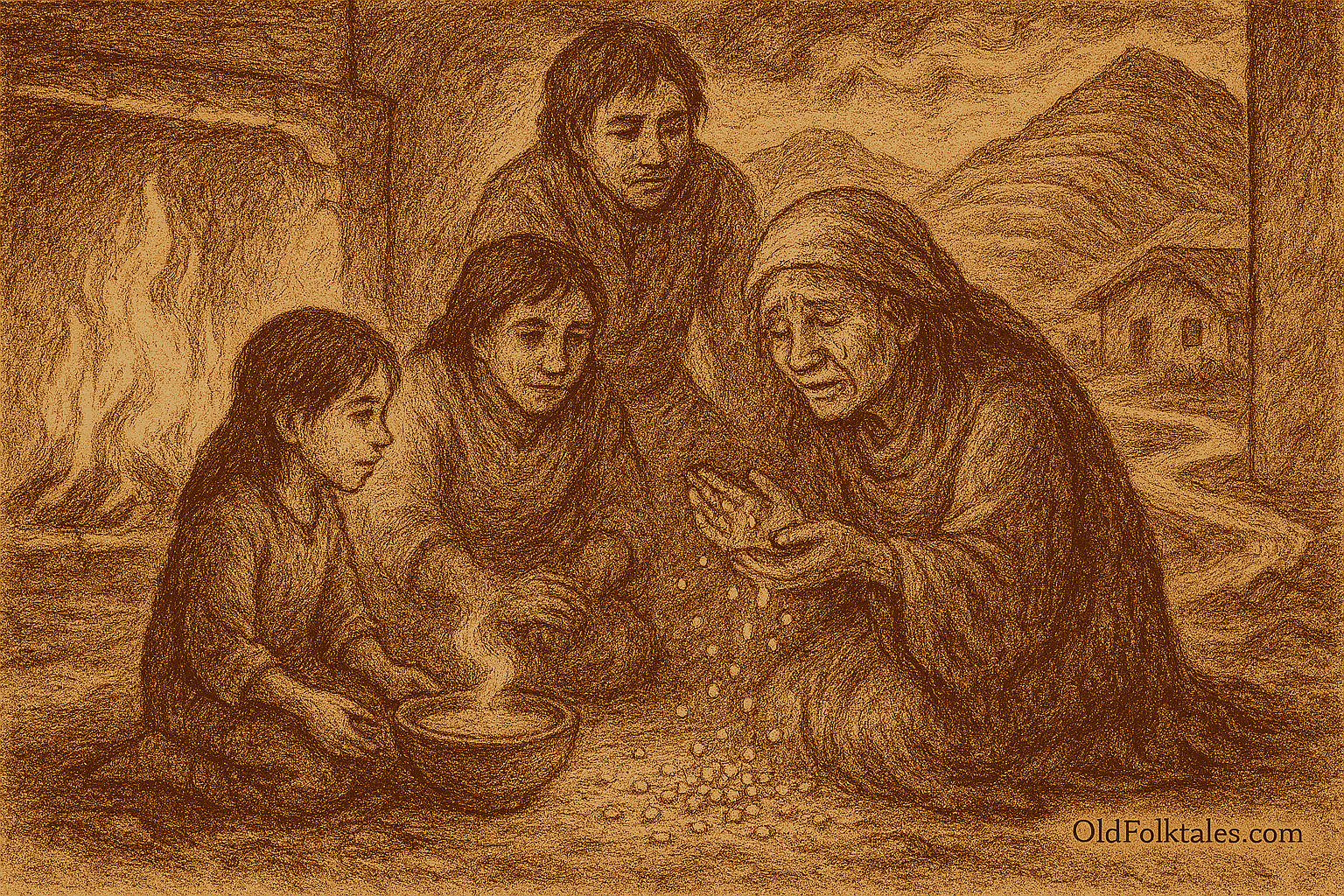
The father stepped aside and welcomed the old woman into their home. They sat her by their small fire, wrapped a blanket around her thin shoulders, and placed before her a bowl of their precious soup. The old woman ate slowly, gratefully, while the family watched with genuine smiles despite their own empty stomachs.
When the old woman finished, she looked up at them with tears glistening in her ancient eyes. She rose to her feet, and as she did, something miraculous happened. The weariness fell away from her like a discarded cloak. She grew taller, and her eyes blazed with an inner light that filled the small room with warmth. The family fell to their knees, for they understood now who stood before them.
“I am Pachamama,” she said, her voice carrying the strength of mountains and the gentleness of rain. “I walked among my children to see who remembered compassion even in times of suffering. You alone opened your hearts. You alone remembered that we are all connected.”
Tears flowed freely down the Earth Mother’s face, but these were not tears of sorrow. As each droplet touched the ground, it transformed into a small, perfect seed, pearl-white and luminous. “These are for you and your people,” Pachamama said. “Plant them when the rains return, and they will sustain you through all the seasons to come. This grain will grow where others cannot. It will nourish your bodies and remind you that generosity creates abundance.”
She knelt beside the children and taught the family how to cultivate the seeds how deep to plant them, how to tend them, when to harvest the golden grain that would grow. Then, with a smile that held all the love of a mother for her children, Pachamama disappeared into the night.
The rains returned the next morning, gentle and steady. The family planted their miraculous seeds and shared them with their neighbors. Soon, the terraced fields bloomed with tall plants crowned with clusters of colorful seeds—white, red, yellow, and black. The people called this new grain quinoa, and it became their most sacred crop, saving them from starvation and thriving in the harsh mountain climate where other crops failed.
Click to read all Andean Highland Folktales — echoing from the mountain peaks of Peru, Bolivia, and Ecuador.
The Moral Lesson
This ancient tale teaches us that compassion and generosity are not luxuries reserved for times of abundance they are essential virtues that define our humanity, especially during hardship. The family’s willingness to share their last meal, despite their own desperate circumstances, demonstrates that true wealth lies not in what we hoard but in what we give. Pachamama’s gift of quinoa reminds us that kindness creates abundance, and that the divine notices and rewards those who remember to care for others even when they themselves are suffering.
Knowledge Check
Q1: Who is Pachamama in Andean mythology and what does she represent?
A1: Pachamama is the Earth Mother goddess in Andean mythology, representing nature, fertility, and the sustaining force of the earth. She is revered as the divine being who provides for all living things and maintains the balance between humans and the natural world.
Q2: Why did Pachamama disguise herself as an old woman in the story?
A2: Pachamama disguised herself as an old, hungry traveler to test the villagers’ compassion and moral character during difficult times. This test revealed who truly understood her teachings about kindness and generosity, even when facing their own hardships.
Q3: What was significant about the family’s decision to share their last meal?
A3: The family’s decision demonstrated authentic selflessness and faith in Pachamama’s principle that caring for others is more important than self-preservation. By sharing their final food despite having hungry children of their own, they proved their compassion was genuine, not performative.
Q4: What do Pachamama’s tears symbolize in this story?
A4: Pachamama’s tears symbolize divine compassion and the sacred origin of quinoa. They represent the transformation of divine emotion into earthly sustenance, showing how spiritual virtue (compassion) can manifest as material blessing (nourishment).
Q5: Why is quinoa considered a sacred grain in Andean culture?
A5: Quinoa is considered sacred because, according to this myth, it was a direct gift from Pachamama given as a reward for human compassion. Its ability to thrive in harsh mountain conditions where other crops fail makes it both spiritually significant and practically essential to Andean communities.
Q6: What does this folktale teach about the relationship between humans and nature?
A6: The folktale teaches that the relationship between humans and nature is reciprocal and moral. When humans show respect, compassion, and generosity values that honor Pachamama nature responds with abundance. It emphasizes that environmental blessings are connected to human ethical behavior.
Source: Adapted from Andean ethnobotany folklore collections and FAO indigenous food heritage texts documenting Quechua and Aymara oral traditions.
Cultural Origin: Quechua and Aymara peoples, Andean Highlands (Peru, Bolivia, Ecuador, Chile, Argentina