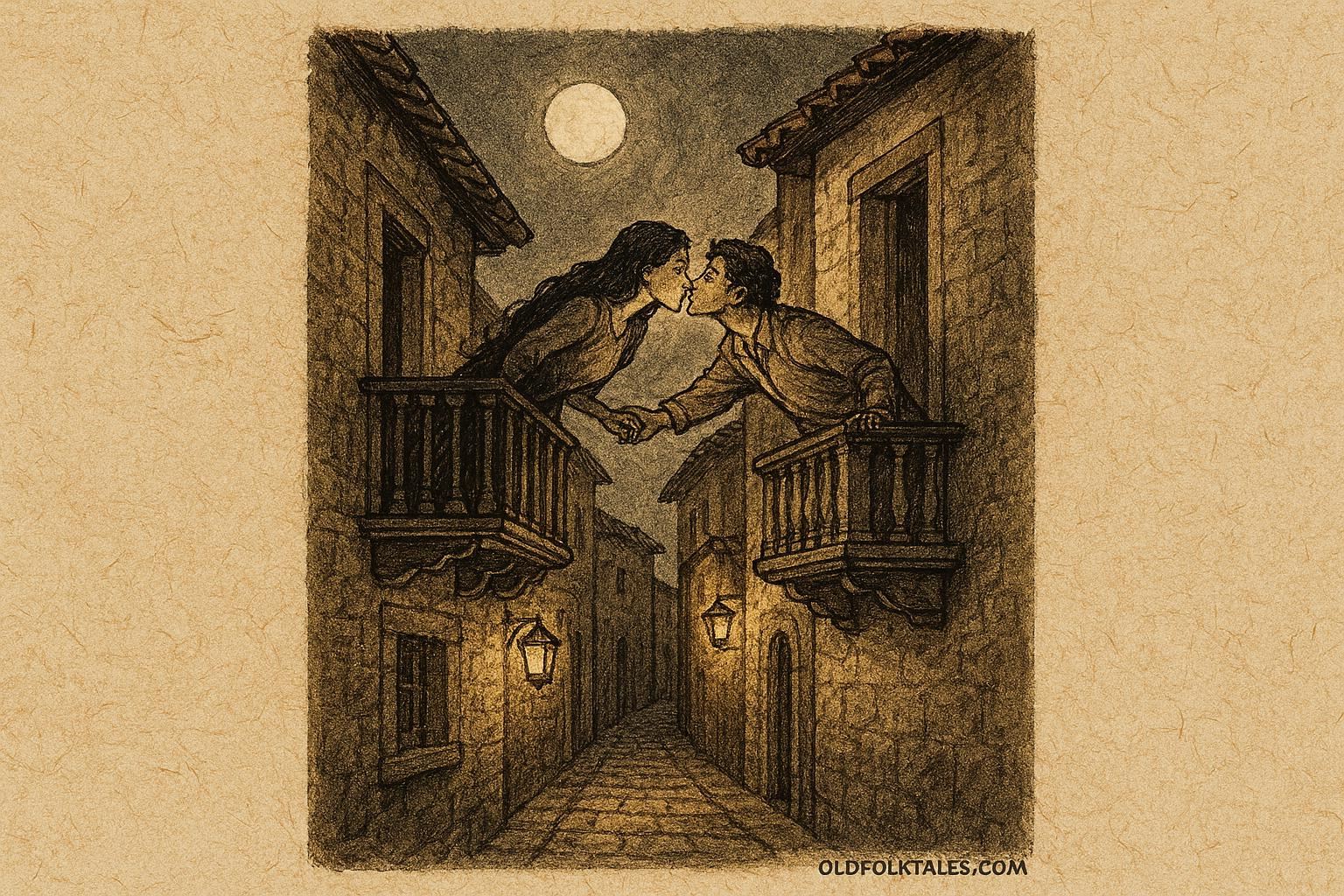
In the heart of colonial Mexico, where cobblestone streets twisted like serpents and narrow alleys huddled tightly between sunbaked adobe houses, there existed a lane so narrow that lovers could almost touch across it from opposing balconies. This lane, known forever after as El Callejón del Beso, held the story of two young hearts whose passion defied social order and led to tragedy.
Leonor, the daughter of a wealthy merchant, was known for her beauty and grace. She had hair as dark as obsidian and eyes that glimmered like stars against the evening sky. She lived in a grand house perched above the alley, where the sun hit the red-tiled roof and painted the walls with warm, golden light. Across the alley, on a modest house just close enough to reach out and touch the other’s hand, lived Carlos, a young man of humble origin, whose courage and kindness had won Leonor’s heart.
Discover South America’s folktales filled with magic, transformation, and ancestral wisdom
From the moment they first met during a festival in the town square, their connection was immediate and electric. But the rigid social hierarchy of colonial Mexico forbade their union. Leonor’s family expected her to marry a man of wealth and status, while Carlos, despite his noble heart, was considered beneath her station. Still, the two found ways to meet in secret, their love growing like a hidden vine along the walls of the narrow alley.
By nightfall, when the lanterns cast dancing shadows across the stone, Leonor and Carlos would steal to the edge of their balconies, leaning forward until their hands almost touched. One evening, in the soft glow of a waxing moon, they dared to kiss, lips meeting over the gap that separated two worlds, one of wealth, one of modest means. Their whispered promises carried through the still night, echoing off the alley walls like a solemn hymn of devotion.
But fate, as it often does in stories of forbidden love, took a cruel turn. Leonor’s father, suspecting her secret meetings, climbed the alley with servants to confront the young man. In the shadows, he caught sight of the lovers’ hands intertwined and their lips brushing. Enraged, he struck at Carlos, sending him tumbling from the balcony. Carlos fell to the alley below, badly wounded, while Leonor, screaming in anguish, clung to the edge of her balcony. Though she survived, the lovers were torn apart, and Carlos’ injuries never fully healed. The tragedy became a warning whispered throughout the colonial city.
Villagers would later say that the alley itself seemed haunted by their story. Couples who dared to meet there often left flowers on the ledges, a symbol of their daring hearts, but also a reminder that secret passions, unchecked by prudence or social wisdom, can lead to peril. El Callejón del Beso became a living legend, immortalized in art, song, and oral retellings, reminding each new generation of the delicate balance between desire and discretion.
Discover Mexico’s timeless tales blending Indigenous roots and Spanish tradition
Moral Lesson
Hidden actions and defiance of social or moral rules may bring unintended tragedy, teaching that love must be tempered with prudence and respect for consequences.
Knowledge Check
-
Who are the main characters of El Callejón del Beso?
Leonor, the wealthy merchant’s daughter, and Carlos, a young man of humble origin. -
What does the narrow alley symbolize?
The gap between social classes, secrecy, and the fragility of forbidden love. -
What is the primary moral lesson of the story?
Secret actions and defiance of societal rules can lead to tragic consequences. -
What cultural context does the story reflect?
Colonial Mexican society, highlighting family honor and social hierarchy. -
Why is the story still told today?
As a cautionary tale about the dangers of secrecy and the consequences of defying social norms. -
What emotions and imagery are central to the tale?
Love, longing, fear, and tragedy, depicted against the backdrop of moonlit cobblestones and narrow, sun-drenched balconies.
Source: Colonial Mexican folktale, Mexico (Colonial-era oral tradition).
Origin: Colonial Mexican Folklore