Long ago, before the skies were filled with stars in their familiar patterns, the gods walked among the earth and heavens, shaping the fates of mortals and immortals alike. Among them was Coyolxauhqui, the goddess of the moon, radiant and proud. She was the daughter of Coatlicue, the Earth Mother, whose mysterious powers were the source of life and destiny. Coyolxauhqui had many brothers and sisters, each imbued with divine strength and ambition.
One day, Coyolxauhqui learned that her mother, Coatlicue, had miraculously become pregnant with a child who would hold immense power. The news inflamed a fire of jealousy and pride within her. How could her mother, who had already borne so many children, produce one destined to outshine them all? Coyolxauhqui’s envy festered like a shadow across her heart, and she could not bear the thought of being eclipsed by a sibling.
Discover the vibrant legends of Guatemala, Honduras, and Costa Rica in our folktale collection.
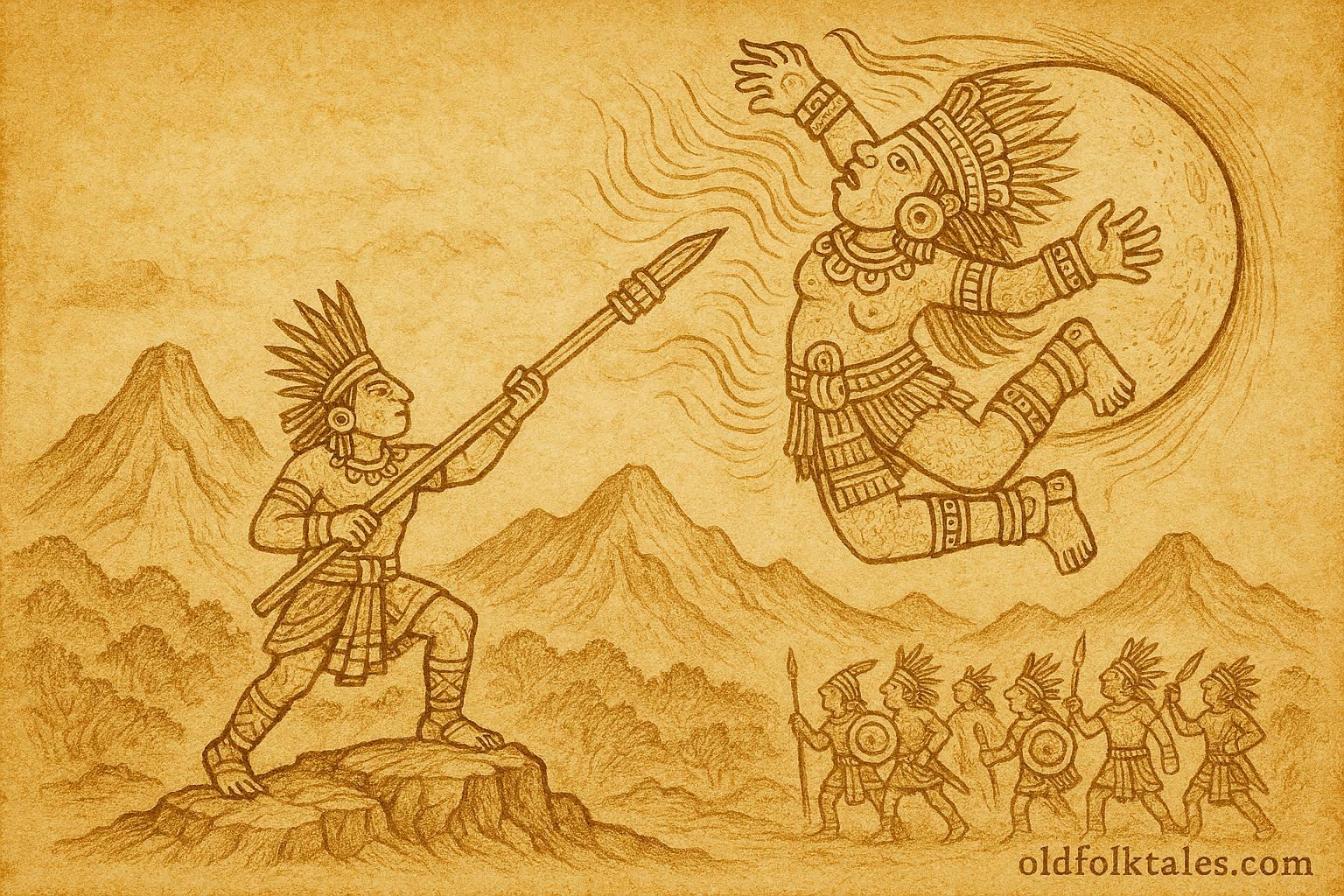
Determined to assert her dominance, Coyolxauhqui rallied her brothers, calling them to her side. United by fear, loyalty, or perhaps shared envy, they formed a formidable army. Together, they ascended the mountains that formed the edge of the earth, their weapons glinting, their faces set with anger. Their goal was clear: to strike down Coatlicue and destroy the unborn child within her womb before it could grow and surpass them.
But the cosmos itself had been woven with threads of fate beyond Coyolxauhqui’s understanding. From the heart of his mother, Huitzilopochtli, the god of the sun and war—emerged fully grown and fearsome. His skin shimmered like gold in the early light, his eyes burning with divine resolve. Clutching weapons forged from obsidian, he faced his enraged sister and her allies. The battle was swift, yet monumental, echoing across the mountains and valleys.
Huitzilopochtli struck Coyolxauhqui with precision and wrath, dismantling her pride piece by piece. Her body fell from the mountain, scattered across the earth. Yet even in her defeat, she was transformed. Her remains were cast into the sky, forming the moon, whose face bears the faint traces of her dismemberment. From that time forward, Coyolxauhqui’s cycles of waxing and waning were a reminder of her pride and the consequences of her jealousy.
The villagers, watching the heavens, saw the moon’s phases as a cosmic lesson. They learned that envy and arrogance, no matter how powerful, invite destruction. Coyolxauhqui’s fate was not only a tale of divine conflict but also a guide for human behavior. Pride unchecked could tear apart families and communities, whereas wisdom, patience, and respect preserved harmony.
Through generations, the story of Coyolxauhqui was recounted to children and adults alike. Mothers warned their daughters not to let jealousy govern their actions, and fathers spoke of humility as the path to protection and prosperity. The phases of the moon became a living symbol of reflection: each waxing and waning cycle a subtle nudge to temper ambition with prudence and restraint.
Explore the land of La Llorona, trickster coyotes, and magical realism in Mexican folklore
Moral Lesson
Pride and envy lead to downfall, while wisdom, patience, and self-restraint protect individuals and communities from ruin. Coyolxauhqui’s story reminds us that actions driven by arrogance or jealousy often carry irreversible consequences.
Knowledge Check
1. Who was Coyolxauhqui?
She was the Aztec goddess of the moon and sister to Huitzilopochtli.
2. What sparked Coyolxauhqui’s anger?
She was jealous of her mother Coatlicue’s miraculous pregnancy, fearing the unborn child would surpass her.
3. How did Coyolxauhqui act on her envy?
She rallied her brothers to attack Coatlicue and destroy the unborn child.
4. Who intervened to protect the unborn child?
Huitzilopochtli, the god of the sun and war, emerged fully grown and armed to defend his mother.
5. What does Coyolxauhqui’s fate symbolize?
Her dismemberment and transformation into the moon symbolize the destructive consequences of pride and jealousy.
6. What lesson did Aztec society derive from this story?
That unchecked pride and envy lead to ruin, while wisdom and restraint preserve harmony and safety.
Source: Codex Borgia; Codex Florentino
Cultural Origin: Mexico (Aztec mythology)