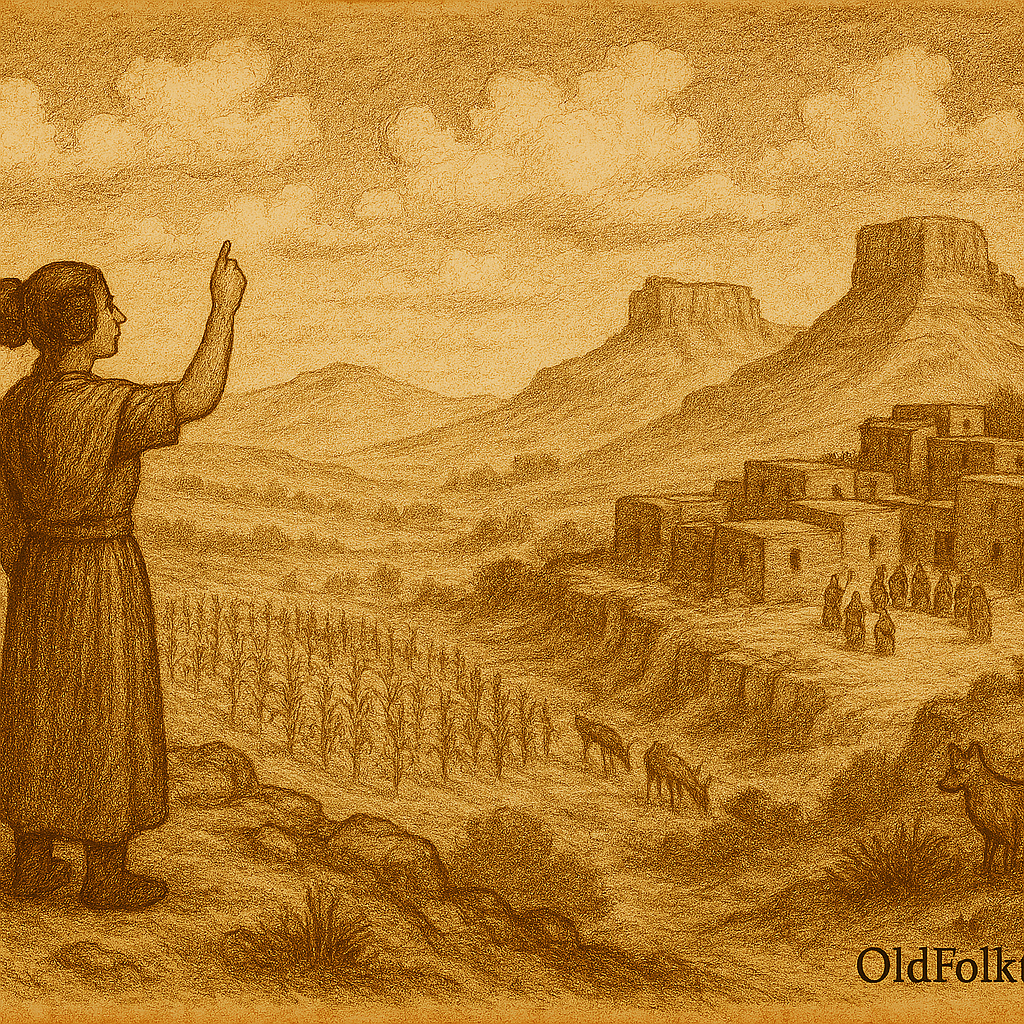
In one village perched atop First Mesa, where the houses rose in tiers of golden stone and the ceremonial plazas had witnessed centuries of prayer-dances, there lived a woman named Tuwa whose mind was sharp and observant. She had watched the skies since childhood, noting patterns in cloud formation and wind direction, and had observed correlations between certain atmospheric conditions and the arrival of rain. Her observations were genuine, she had, through years of careful attention, accumulated real knowledge about weather patterns in her region.
Tuwa began to believe that she could predict when rain would come based on her observations. She would count clouds as they formed, note their shapes and movements, calculate based on patterns she had identified. And often, her predictions proved accurate, she would announce that rain would come within two days, and indeed it would arrive close to her projected time. Her neighbors began to take notice, impressed by her apparent ability to foresee the weather.
Click to read all South American Folktales — timeless stories from the Andes to the Amazon.
But gradually, Tuwa’s attitude toward her knowledge began to shift. What had started as simple observation evolved into something more presumptuous. She began to see the rain not as a sacred gift dependent on proper relationship but as a natural phenomenon she had decoded, a pattern she had mastered through her intelligence and careful attention. The elaborate ceremonies that the village performed to maintain relationship with the rain spirits began to seem, in her eyes, unnecessary quaint traditions from a time when people didn’t understand natural processes as she now did.
When the ceremonial leaders announced the schedule for rain dances ceremonies that required extensive preparation, days of fasting and prayer, careful attention to ritual detail, and participation from the entire community, Tuwa began to speak dismissively about them. “I can tell you when the rain will come by observing the clouds,” she would say. “All this ceremony, these days of preparation and prayer, they’re not what brings the rain. The rain comes according to natural patterns that I have learned to read. We could save ourselves much effort by simply paying attention to the sky rather than performing these elaborate rituals.”
Some of the younger people, impressed by Tuwa’s accurate predictions and attracted to the idea that intelligence and observation could replace the demanding requirements of ceremonial life, began to echo her sentiments. “Perhaps she is right,” they whispered. “Perhaps the old ways are based on misunderstanding, and we now have better knowledge.” A few even began to skip the ceremonial preparations, claiming that participating in Tuwa’s observations was a more practical approach to understanding rain.
The elders watched this development with grave concern. They understood something that Tuwa, for all her intelligent observation, had failed to grasp, that prediction is not relationship, that understanding patterns is not the same as maintaining proper balance, and that the ceremonies served purposes far deeper than simply bringing rain. But they did not argue with her directly. The Hopi way was not to force understanding through confrontation but to allow experience to teach its own lessons.
That year, as summer approached and the time came for the rain ceremonies that should bring the monsoons, Tuwa continued her predictions based on cloud counting and observation. “Rain will come in four days,” she announced confidently, noting certain atmospheric conditions and cloud formations that in previous years had preceded moisture. The village performed the rain ceremonies, but with less unity than usual, Tuwa and those influenced by her remained partially disengaged, going through motions while believing their cloud-watching was what actually mattered.
The fourth day came and went without rain. Tuwa was puzzled but not deterred. She recalculated, adjusted her observations, and made a new prediction. “Six more days,” she announced. “I was slightly off in my calculations, but the clouds are forming in patterns that definitely indicate coming moisture.” Again, the deadline passed without rain. The sky remained a hard, bright blue, cloudless and merciless.
Tuwa made prediction after prediction, each confidently stated based on her observations and calculations, and each proving wrong. Clouds would form in patterns she recognized, then dissipate without bringing moisture. Conditions would develop that in previous years had reliably preceded rain, yet the dry spell continued. Her accumulated knowledge, which had seemed so reliable, suddenly appeared meaningless. The patterns she thought she had mastered proved elusive and unresponsive to her understanding.
Meanwhile, the corn in the fields below the mesa began to suffer. The young plants, dependent on the summer rains that should have arrived, started to curl and yellow in the relentless sun. Water stores in the village dwindled. Anxiety grew as what should have been the rainy season remained stubbornly dry. The village performed additional rain ceremonies, but the prayers felt hollow, the dances mechanically correct but lacking the unified intention and humility that characterized ceremonies when the entire community approached them with proper spirit.
Weeks passed. The situation grew critical. Children cried from thirst. The corn crop, essential for survival through the coming winter, faced complete failure. The village had experienced dry periods before, but this felt different the ceremonies that had always eventually brought response seemed to fall into an empty sky that gave nothing back.
Finally, one of the eldest men in the village, a ceremonial leader whose understanding reached back through his grandfather’s teachings to knowledge preserved for centuries, called for Tuwa to meet with him and the other elders. They gathered in a kiva, the underground ceremonial chamber, away from casual observation.
“Daughter,” the old man said gently, “you have intelligence and the gift of observation. You have noted true patterns in the sky and the clouds. But you have made a dangerous mistake you have confused prediction with relationship, have believed that understanding patterns gives you mastery over what you observe. The rain does not come because you count clouds correctly. The clouds you count are themselves expressions of forces far beyond human comprehension or control. Our ceremonies do not mechanically cause rain they maintain the humility and proper relationship that allow the rain to come as gift rather than as something we believe we can command through knowledge.”
Another elder, a woman who had performed in the rain dances for more than sixty years, added: “When you began to see the rain as something you had decoded, as a natural process you had mastered rather than a sacred gift requiring reverence, you broke something essential. Your attitude spread to others, and the ceremonies that should have been performed with unified humility and respect became divided between those who approached them properly and those who believed they were unnecessary superstition. The rain has not come because we have approached it with arrogance rather than humility, with the presumption of mastery rather than the acknowledgment of dependence.”
She continued: “Your predictions worked for a time because you were observing real patterns. But those patterns operate within a larger context the relationship between humans and the sacred forces that govern weather. When that relationship is maintained through proper ceremony and humble spirit, the patterns you observed tend to hold. But when the relationship is broken through presumption and arrogance, even the patterns become unreliable. You cannot control what you sought to master. You can only maintain proper relationship with it.”
Tuwa felt her certainty crumbling. She had been so sure that her intelligence and observations had transcended the need for the old ways, so convinced that understanding patterns was the same as mastering what produced them. But the undeniable failure of her predictions, the deteriorating crisis that her attitude had helped create, forced her to recognize the truth in the elders’ words. She had confused knowledge about something with relationship with something, had believed that prediction gave her power when in truth it had fed a dangerous illusion of control.
“What can I do?” she asked, her voice small with genuine humility for the first time in months.
“Return to proper understanding,” the elder replied simply. “Acknowledge that you do not control the rain, that your observations while valuable do not give you mastery over what you observe. Participate in the ceremonies not as meaningless tradition but as necessary practice of the humility and reverence that maintain right relationship. Teach those you influenced to return to proper spirit. And most importantly, release the presumption that intelligence and observation can replace ceremony and humble dependence on gifts we cannot create ourselves.”
Tuwa underwent a genuine transformation. She performed purification rituals, fasted, and spent days in prayer and contemplation that stripped away the arrogance that had accumulated. When the next rain ceremony was scheduled, she participated with complete presence and authentic humility, no longer performing actions while internally dismissing their significance but approaching the ritual with reverence and genuine acknowledgment of human limitation and dependence.
The shift in the village was palpable. Those who had been influenced by Tuwa’s dismissive attitude returned to proper approach. The ceremonies were performed with unified spirit, with the entire community approaching the rain not as something they could predict or control but as a sacred gift they humbly requested while acknowledging they had no power to demand or create it.
Within days, clouds began to gather real clouds that brought real rain, gentle at first and then steady, soaking into the desperate earth, reviving the suffering corn, filling the cisterns, bringing relief and joy to the entire village. The monsoons finally established themselves, late but sufficient to save the season.
Tuwa never lost her gift for observation or her intelligence. But she learned to hold her knowledge differently not as mastery that transcended the need for ceremony, but as one small piece of understanding within a much larger web of relationships that required humility and reverence to maintain. She continued to observe cloud patterns, but now she did so as part of her ceremonial participation, as a way of paying attention to the gifts being given rather than as a tool for prediction and control.
The story of the woman who counted clouds became a teaching about the difference between knowledge and wisdom, between prediction and relationship, between the illusion of control and the humble acknowledgment of dependence that actually allows gifts to flow.
Click to read all Andean Highland Folktales — echoing from the mountain peaks of Peru, Bolivia, and Ecuador.
The Moral Lesson
This Hopi tale teaches that attempting to control or master sacred forces through knowledge and prediction weakens the relationships that actually allow such forces to bless us, while humble reverence and proper ceremony sustain the balance necessary for gifts to flow. Tuwa’s error was confusing observation of patterns with mastery over what created those patterns, believing that her ability to predict rain meant she had transcended the need for ceremonial relationship with the forces that bring it. The story reminds us that in indigenous worldviews, knowledge about something is not the same as relationship with it, and that the presumption of control based on intellectual understanding can break the very connections that allow blessings to continue.
Knowledge Check
Q1: What is the purpose of rain ceremonies in traditional Hopi culture?
A1: In Hopi culture, rain ceremonies are not mechanical formulas intended to manipulate or control weather but acts of humility, reverence, and alignment with patterns far greater than human understanding. These elaborate rituals, performed with exacting precision and requiring extensive preparation, fasting, prayer, and community participation, serve to maintain proper relationship with the forces that bring rain. They remind both humans and spiritual forces of their proper roles and approach sacred powers with the humility appropriate to those who depend utterly on gifts they cannot create themselves. The ceremonies maintain balance rather than attempt control.
Q2: What observations did Tuwa make and why did they initially seem reliable?
A2: Tuwa had watched the skies carefully since childhood, noting patterns in cloud formation, wind direction, and correlations between certain atmospheric conditions and the arrival of rain. Through years of careful attention, she accumulated genuine knowledge about weather patterns in her region. Her predictions about when rain would come based on counting clouds, noting their shapes and movements, and identifying patterns often proved accurate, giving her apparent ability to foresee weather and impressing her neighbors with her seemingly reliable forecasting skills based on natural observation.
Q3: How did Tuwa’s attitude toward rain and ceremonies change over time?
A3: Tuwa’s attitude shifted from simple observation to presumption of mastery. She began seeing rain not as a sacred gift dependent on proper relationship but as a natural phenomenon she had decoded through intelligence and observation. The elaborate rain ceremonies began to seem unnecessary to her quaint traditions from a time when people lacked her understanding. She spoke dismissively about the ceremonies, claiming she could predict rain through cloud observation, and suggested the village could save effort by watching the sky rather than performing elaborate rituals. She influenced younger people to question whether the old ways were based on misunderstanding.
Q4: What happened when Tuwa’s predictions began to fail?
A4: Despite her confident predictions based on recognized patterns and atmospheric conditions that had previously preceded rain, the rain did not come. She made prediction after prediction, recalculating and adjusting her observations, but each deadline passed without moisture. Clouds would form in familiar patterns then dissipate without bringing rain. Conditions that had reliably preceded rain in previous years remained dry. Meanwhile, corn crops suffered, water stores dwindled, and the village faced genuine crisis as what should have been the rainy season remained stubbornly dry despite continued ceremonies that lacked proper unified spirit and humility.
Q5: How did the elders explain the failure of both predictions and ceremonies?
A5: The elders explained that Tuwa had confused prediction with relationship and believed understanding patterns gave her mastery over observed phenomena. They taught that rain doesn’t come because clouds are counted correctly—clouds themselves are expressions of forces beyond human control. Ceremonies don’t mechanically cause rain but maintain the humility and proper relationship that allow rain to come as gift rather than something commanded through knowledge. When Tuwa’s attitude of having “mastered” rain spread, creating division between those who approached ceremonies properly and those who saw them as unnecessary, the essential relationship broke. Patterns became unreliable because they operate within the larger context of human-sacred relationship.
Q6: What cultural values about knowledge, humility, and relationship does this Arizona highland story convey?
A6: The story embodies Hopi values emphasizing that prediction and observation are not the same as relationship, that intellectual understanding cannot replace reverence and ceremonial practice, and that attempting to control sacred forces through knowledge weakens the very relationships that allow blessings to flow. It reflects indigenous understanding that humans exist in dependent relationship with forces far beyond their comprehension or control, that ceremonies serve essential functions in maintaining proper humility and balance, and that intelligence and observation while valuable must be held within framework of reverence rather than presumption of mastery. The tale teaches that control weakens balance while respect sustains it, and that acknowledging dependence on gifts we cannot create is wisdom rather than weakness.
Source: Adapted from Hopi rain and balance narratives recorded in ceremonial traditions and documented in ethnographic studies of Hopi cosmology, weather ceremonies, and spiritual understanding of human relationship with natural forces.
Cultural Origin: Hopi people, Arizona Highlands (Hopi Mesas), United States