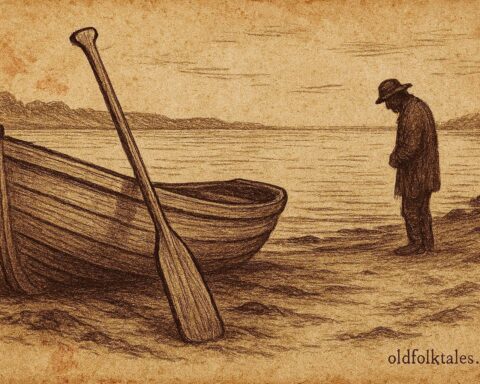
Along the rugged coastline of Newfoundland, where cliffs rise sharply from dark water and fog drifts in without warning, the sea has always been a keeper of stories. It remembers every life taken, every boat lost, and every promise broken upon its surface. Fishermen know this, or at least they once did. But memory fades, and when it does, the sea finds ways to remind.
In a small outport village tucked into a narrow bay lived a fisherman named Callum Pike. He came from a long line of fishermen and inherited not only his father’s boat but also his father’s nets, thick and heavy with years of use. These nets had fed generations. They had hauled cod, capelin, and mackerel from the depths and returned safely every time.
But Callum was not content with tradition. The old ways, he believed, were slow and cautious. He wanted more. More fish. More profit. More proof that he was smarter than those who came before him.
The elders warned him.
“Take only what you need,” they said. “The sea keeps count, even when we do not.”
Callum smiled politely and did not listen.
Explore the ancestral legends of Canada, Mesoamerica, and South America’s Indigenous tribes.
One season, when fish grew scarce and competition fierce, Callum altered his nets. He weighted them heavily so they would sink deeper than usual, dragging across places long avoided. These were waters spoken of quietly, where ships had gone down in storms and men had never returned.
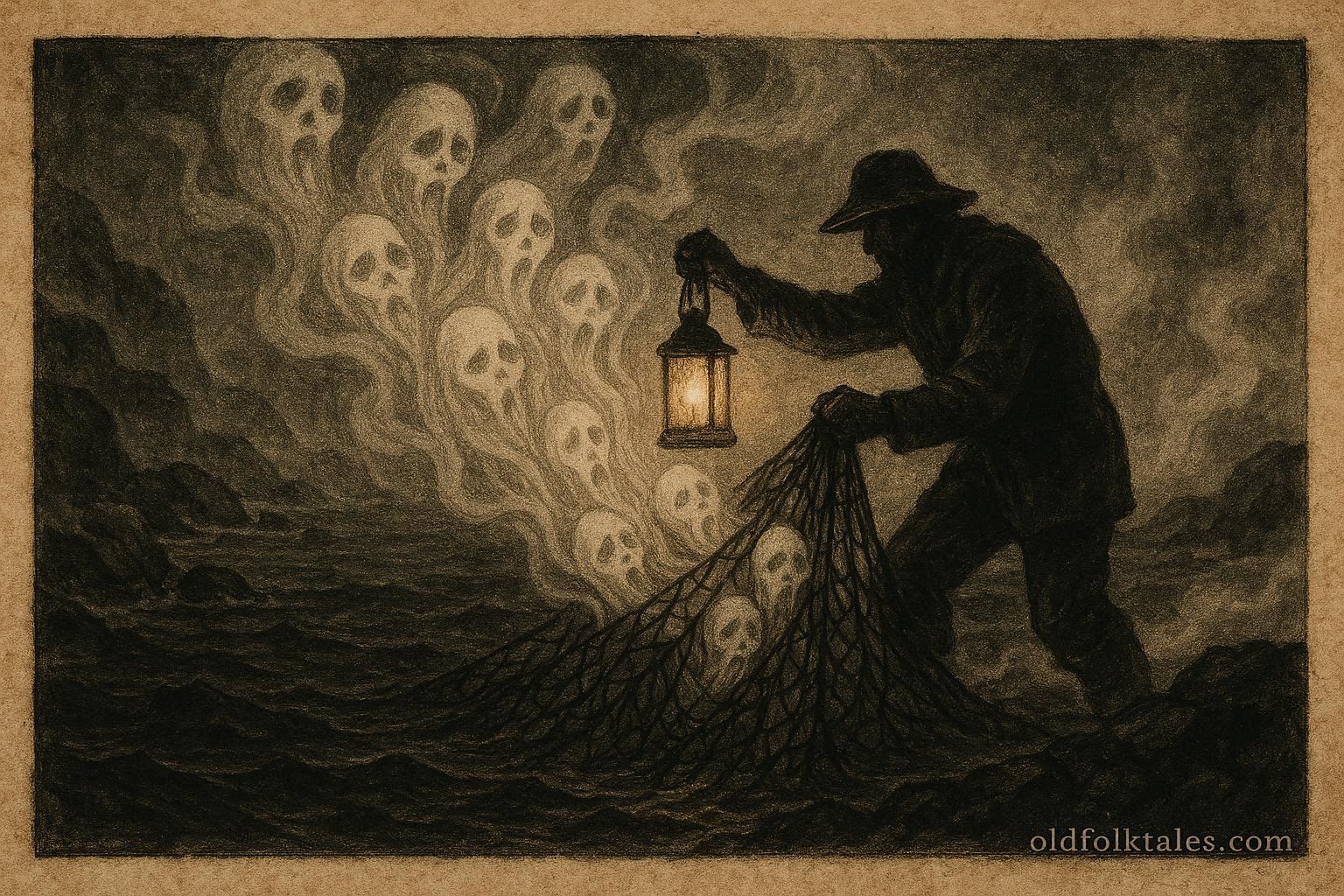
On his first haul, the net came up heavier than ever before. Callum grinned, expecting a fortune of fish. But when the net broke the surface, there were no fish inside.
Instead, there was silence so complete it felt loud.
Then the voices began.
They rose softly at first, murmurs woven through the wet cords of the net. Names spoken half-remembered. Laughter, distant and hollow. A child calling for his father. A man shouting a warning lost to wind.
Callum staggered back, dropping the ropes. The voices faded as the net slipped partially back into the water.
Terrified, he cut the line and fled the spot.
That night, the village slept uneasily. Dogs whined. The wind carried strange echoes. Callum lay awake, convincing himself it had been exhaustion, imagination, or some trick of water and sound.
The next morning, he returned.
Greed has a way of dulling fear.
He cast the net again, deeper this time. When he hauled it up, the voices returned, louder and clearer. This time, he recognized some of them. A fisherman lost twenty years earlier. A neighbor’s brother who never came home. Even his own uncle, drowned in a sudden squall when Callum was a boy.
The net was heavy with memory.
Word spread quickly. Other fishermen gathered at the wharf as Callum returned, pale and shaking. They heard the voices too. Some wept. Others crossed themselves. An elder woman stepped forward and touched the net with trembling hands.
“This net has been made a door,” she said. “You have dragged remembrance where it does not belong.”
She explained that the sea holds the dead gently, but greed tears at what should rest. Tools used without respect become vessels for consequence.
The villagers demanded the net be destroyed. Callum resisted. The net was valuable. It had cost time and money to modify. But that night, the voices followed him home, whispering through the walls, rising with the tide.
By morning, he agreed.
At low tide, the village gathered. The net was carried to the edge of the bay. The elder instructed Callum to speak.
“I took too much,” he said, voice breaking. “I pulled where I should not have pulled.”
The net stirred. The voices softened.
They burned the net where land met sea, the smoke drifting out over the water. As the last cords turned to ash, the voices faded completely.
Fish slowly returned to the bay in the seasons that followed. Callum fished again, using simpler nets and taking less. He never grew wealthy, but he slept peacefully.
To this day, fishermen say that greedy tools remember what they are made to touch. And that the sea, when disturbed, does not always return fish. Sometimes, it returns the past.
Moral Lesson
Greed disrupts balance and awakens consequences long buried. The story teaches that taking more than one’s share disturbs not only the natural world but the memory of those who came before. Respect, restraint, and remembrance protect both the living and the dead.
Knowledge Check
- Why did Callum alter his fishing net?
He wanted to catch more fish and increase his profit. - What did the net pull up instead of fish?
Voices of people lost to the sea. - Why were those waters avoided by others?
They were associated with shipwrecks and drownings. - What did the elder woman explain about the net?
That greed had turned it into a doorway for memory. - How was the haunting ended?
By burning the net and acknowledging wrongdoing. - What lesson did the village learn?
That restraint and respect keep balance with the sea.
Source:
Adapted from Memorial University Folklore and Language Archive and Atlantic oral traditions.
Cultural Origin:
Maritime folklore, Newfoundland.