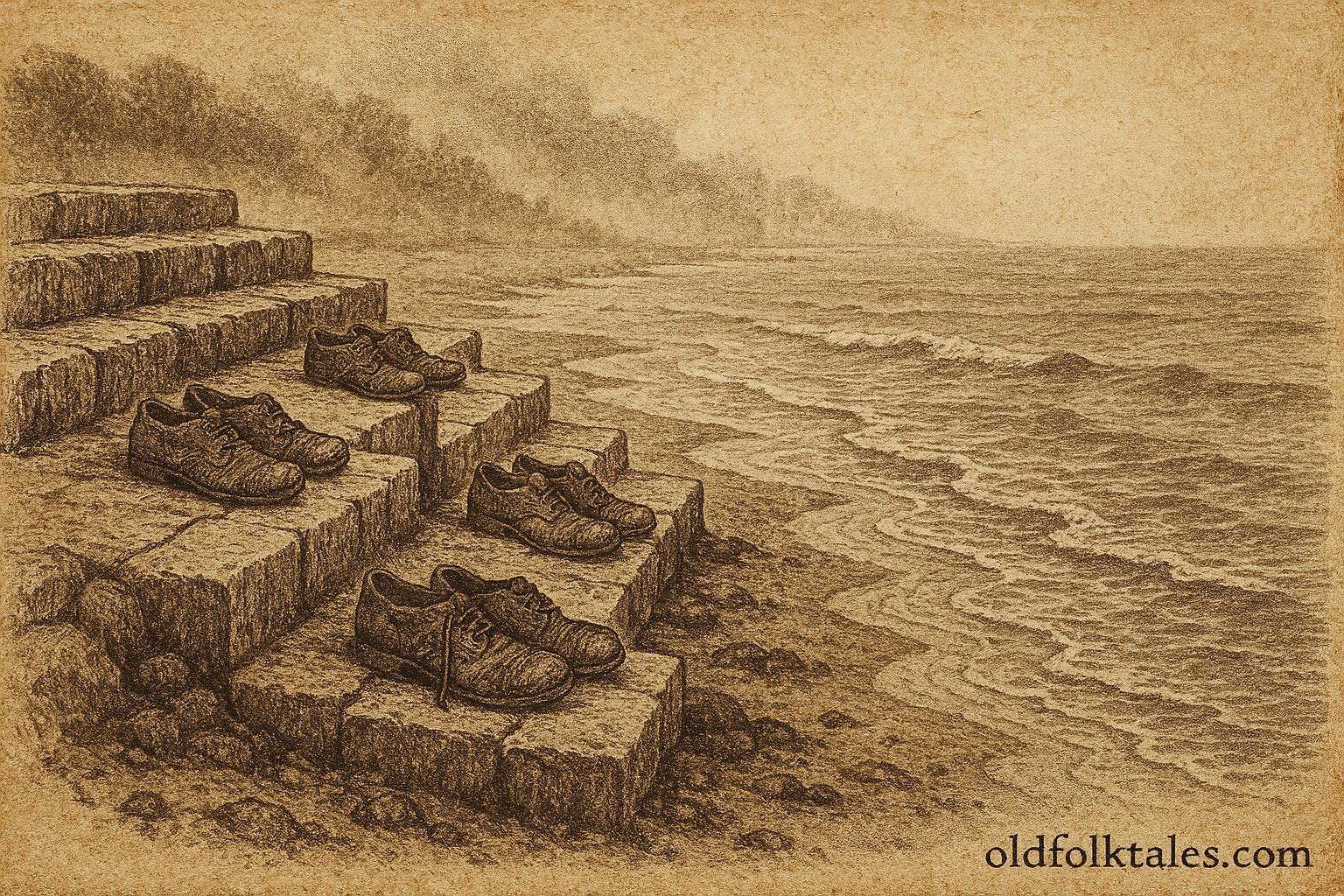
Along the rocky coast of Nova Scotia, where the Atlantic pressed endlessly against stone and cliff, there stood a set of old tidal steps carved into the shoreline. No one remembered exactly who had built them. Some said fishermen had shaped them generations ago to reach their boats at low tide. Others believed they were older still, formed by hands that respected the rhythm of the sea more than convenience.
The steps were visible only when the tide receded. At high tide, they disappeared completely beneath dark, restless water. The villagers knew the timing of the tides well, yet the steps were never treated casually. Children were warned not to linger there, and travelers were advised to cross only when the sea lay calm and low.
It was said that the steps marked a boundary. Not just between land and water, but between safety and loss.
The first time the shoes appeared, no one noticed them right away.
The morning tide had just begun to pull back, leaving wet stone glistening under gray light. A fisherman named Alistair was the first to see them as he made his way toward the shore. A pair of worn leather shoes sat neatly on the third step from the bottom, toes facing inland, as though someone had calmly removed them before climbing away.
Discover ancient tales passed down by the Indigenous peoples of the Americas.
They were not Alistair’s. Nor did he recognize them as belonging to anyone in the village.
At first, the shoes were treated as a curiosity. Someone suggested a traveler must have left them behind. Another said a drunk might have wandered barefoot through the night. The shoes were moved to the side and left near the boathouse.
That night, the tide returned higher than usual.
By morning, another pair of shoes sat on the steps.
This time, they were different. Smaller. Well-worn. The stitching frayed at the heel.
A quiet unease settled over the village.
The elders were called. They studied the shoes carefully, noting how cleanly they were placed, how no footprints led away from them, and how the leather felt cold despite the mild weather. One elder spoke at last, her voice low.
“These are not lost,” she said. “They are left.”
That evening, the elders told the old stories. Long ago, they said, people had ignored the sea’s warnings. They crossed when the tide was turning. They trusted their strength over the water’s patience. When lives were taken, the spirits of the drowned left signs so others would not follow them.
Shoes were such signs.
They marked where the sea had claimed someone who did not listen.
In the days that followed, the pattern repeated. After nights of rough water or fast-rising tides, shoes appeared on the steps. Sometimes they were old and cracked. Sometimes they looked nearly new. Always they were placed neatly, never scattered or damaged.
No bodies were found. No names were attached to the shoes.
Yet each appearance coincided with a near loss.
One morning, a young man returned shaken after misjudging the tide while crossing the rocks. Another time, a visiting trader was forced to abandon his route when waves surged suddenly. The shoes appeared after each incident, as though reminding the village of what almost happened.
Some people grew fearful. Others grew careless.
A few younger villagers laughed at the idea of spirit warnings. They said tides rose and fell as they always had. They claimed the shoes were planted by pranksters or carried in by the sea itself.
One fog-heavy evening, a man named Rowan decided to prove the stories false.
He was known for his stubbornness and pride. When warned not to cross the steps at dusk, he smiled and said the tide obeyed no spirits, only the moon. He set out just as the water began to return, his boots striking wet stone as the fog thickened around him.
The village waited.
The tide rose faster than expected.
By nightfall, the steps vanished beneath churning water.
Rowan did not return.
At dawn, the sea withdrew again. The villagers gathered at the shoreline in silence. On the fourth step from the bottom lay a pair of boots. Rowan’s boots. Cleanly placed. Facing inland.
No one touched them.
From that day on, the shoes were no longer questioned.
The steps became a place of quiet attention. People paused before crossing. They watched the water. They remembered those who had ignored warning signs. Children were taught that the sea did not shout. It spoke softly, through patterns, through timing, through signs left for those willing to see.
The shoes continued to appear from time to time, always after dangerous tides, always without explanation. They were never removed again. The village allowed the sea to reclaim them slowly, leather cracking, soles thinning, until only traces remained.
And so the tidal steps stood as they always had, marking not only the movement of water, but the thin line between listening and loss.
Moral Lesson
Warnings do not always arrive as words. They appear through patterns, signs, and moments that ask for attention. When people dismiss quiet cautions and trust arrogance over awareness, consequences follow swiftly. Wisdom lies in observing limits, respecting natural boundaries, and recognizing that some places demand humility rather than challenge.
Knowledge Check
- What were the tidal steps used for?
They allowed access to the shore during low tide and marked a boundary with the sea. - What did the shoes symbolize?
They served as warnings left by spirits of the drowned. - Why did the villagers grow uneasy after repeated appearances?
Because each appearance followed dangerous tides or near losses. - What mistake did Rowan make?
He ignored warnings and crossed as the tide returned. - Why were the shoes never removed again?
They were understood as protective signs meant to be seen. - What cultural lesson does the story emphasize?
Respect for natural forces and attentiveness to subtle warnings.
Source:
Adapted from Memorial University Folklore and Language Archive and Nova Scotia coastal oral accounts.
Cultural Origin:
Maritime folklore, Nova Scotia.