In the misty highlands of Guatemala, where pine forests cling to volcanic mountainsides and morning fog settles in valleys like a living presence, the K’iche’ Maya people have maintained their communities through intricate webs of tradition, ceremony, and shared responsibility. Among the many practices that bind people together both literally and symbolically was the tradition of the sacred rope, a ceremonial cord that connected the community’s ritual bundles during important observances.
These bundles were not ordinary packages but sacred vessels containing items of spiritual significance: copal incense for prayers, seeds saved from ancestral harvests, stones from sacred sites, woven textiles bearing traditional patterns, and other objects that represented the community’s continuity across generations. During major ceremonies, these individual family bundles would be brought together and bound with a specially woven rope a physical manifestation of community unity, showing that while each family maintained its own traditions and identity, all were connected within the larger whole.
Click to read all South American Folktales — timeless stories from the Andes to the Amazon.
The rope itself was significant. It was woven from maguey fiber by the community’s ritual keepers, created through a careful process that involved prayers at each stage of preparation. The weaving was done collectively, with different hands contributing to its creation, so that the rope literally contained the work and intention of many people. To bind the bundles together with this rope was to acknowledge interdependence. To unbind them properly at ceremony’s end involved specific prayers and careful unwinding, ensuring that the symbolic separation was done with the same reverence as the binding.
In one highland village, there lived a woman named Ixchel, competent and practical, known for her skill at weaving and her efficiency in managing household responsibilities. She was neither disrespectful by nature nor intentionally destructive, but she possessed a mind that valued practical solutions over symbolic considerations. When she saw inefficiency, she moved to correct it. When she encountered what seemed like unnecessary complication, she sought simpler alternatives.
One year, after a major ceremonial gathering, Ixchel was among those assigned to help unbind and return the family bundles. The ceremony had run long into the night, and dawn was already breaking over the eastern peaks. People were tired, eager to return to their homes and rest before the day’s work began. The proper ritual unbinding of the rope with its prayers, its careful unwinding, its respectful attention to each knot would take perhaps another hour.
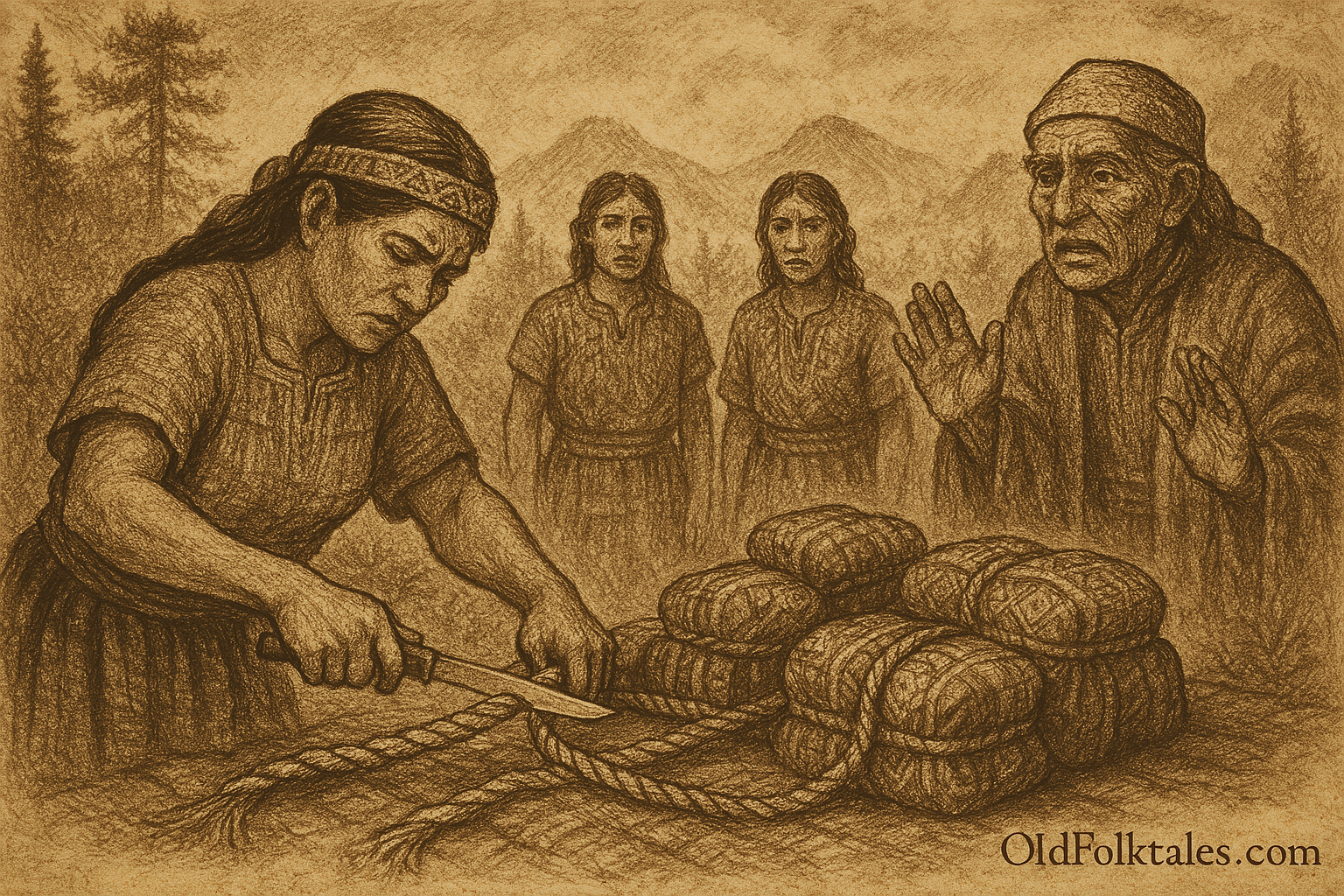
Ixchel looked at the bound bundles, at the intricate way the rope wove through and around them, at the tired faces of her neighbors, and made what seemed to her a practical decision. She took out her knife and, with several quick cuts, severed the rope. The bundles immediately fell free, and families could quickly gather their own and depart.
“There,” she said with satisfaction. “We can all go home now. Why spend an hour unwinding what can be freed in a moment?”
A shocked silence fell over those present. The ritual keeper, an elderly man whose family had maintained ceremonies for generations, stared at the severed rope with an expression of profound dismay. The cut ends lay on the ground like wounded things, the carefully woven fibers that had taken days to create destroyed in seconds.
“What have you done?” he asked quietly, his voice heavy with something deeper than anger a kind of grief.
Ixchel felt the weight of that silence but defended her action. “I saved us all time. The ceremony was complete. The rope was just holding the bundles together now they’re free, and we can all rest. Surely that’s more important than an hour of unnecessary ritual.”
The ritual keeper shook his head slowly. “You have cut more than rope. But you will see.”
In the days and weeks that followed, something shifted in the village. It was subtle at first small disagreements that would normally have been resolved quickly instead festered and grew. A boundary dispute between two families, the kind of minor issue that had always been mediated peacefully, escalated into bitter accusations. A cooperative work group that had functioned smoothly for years fell apart in arguments about who had contributed enough labor and who had shirked responsibility.
Families that had shared resources during difficult times now calculated debts with suspicious precision. The easy reciprocity that had characterized village life where you helped your neighbor today knowing they would help you tomorrow, without keeping exact account gave way to transactional relationships where every favor was weighed and measured. People spoke to each other with an edge that hadn’t been there before. Trust, that invisible thread that holds communities together, seemed to fray week by week.
The village elders gathered to discuss the deteriorating social fabric. They recognized what was happening. The cutting of the sacred rope had been more than a practical shortcut it had been a symbolic severing of the bonds that held the community together. The rope was not merely a physical object but a representation of unity, interdependence, and shared commitment to maintaining relationship. When Ixchel cut it impatiently, she had enacted literally performed a breaking of connection that now manifested in the community’s daily life.
The ritual keeper called Ixchel to meet with him and several elders. They sat together in the early evening, as the light faded and the cool mountain air settled over the village. He did not scold or lecture but asked her questions.
“Do you see what has happened since the ceremony?”
Ixchel, who had been watching the village’s deterioration with growing unease, nodded slowly. “There is… discord. People argue more. Families are divided. I don’t understand why.”
“The rope was not just binding bundles,” the ritual keeper explained. “It was binding us our intentions, our commitments to each other, our recognition that we are separate families but one community. When you cut it impatiently, seeking efficiency over reverence, you enacted a breaking. Not a mystical curse, but a symbolic act that weakened the bonds we maintain through constant attention and care.”
Another elder, a woman who had witnessed many cycles of community life, added: “We are held together not by force but by countless small acts of respect, patience, and shared meaning. The ceremonies, the rituals, the careful attention we give to symbolic actions these are not decorative additions to ‘real’ life. They are how we maintain the invisible structures that make cooperative life possible. When we treat them as unnecessary complications to be shortcut, we damage the very foundations of community.”
Ixchel felt the truth of this settling into her understanding. “How do we repair what I have broken?”
The ritual keeper considered. “The rope must be rewoven, but that alone is not enough. The weaving must be done as a community act, with intention to restore what was damaged. And you must participate, understanding now what you did not understand before that every thread matters, that patience and attention in sacred matters are not luxuries but necessities.”
Over the following weeks, the community gathered to reweave the sacred rope. It was not a quick process. The maguey fibers had to be properly prepared, blessed with copal smoke, and woven with prayers. Different families contributed to the work, just as they had in previous generations. Ixchel participated fully, her hands learning the slow rhythm of creation, her mind beginning to grasp how the physical act of weaving together mirrored the social act of maintaining community bonds.
As the rope was rewoven, something else was also mended. The families in boundary disputes agreed to mediation. The work group reformed with renewed commitment to fairness. The suspicious calculations of debt and obligation softened back into the easier reciprocity of neighbors who trusted each other. It was not that the rope itself had magical power, but that the communal act of reweaving it done with attention, patience, and shared purpose reestablished the patterns of relationship that had been disrupted.
When the rope was completed, a ceremony was held to rebind the community bundles. This time, every step was performed with exquisite care. The binding took hours, with prayers spoken over each knot, with conscious attention to the symbolism of bringing separate elements into unified whole. Ixchel participated, no longer restless with impatience but understanding that the time spent was not wasted but essential a collective practice of the very unity the rope represented.
At the ceremony’s conclusion, when it came time to unbind the bundles, the process was performed with equal reverence. The rope was carefully unwound, each family receiving back their bundle with blessings spoken. The rope itself was preserved, wound carefully and stored by the ritual keepers for future ceremonies. No one reached for a knife. The hour spent in proper unbinding was recognized not as inefficiency but as a necessary practice of respect and attention.
Ixchel carried the lesson with her through the rest of her life. She learned that some acts, even small ones, have significance beyond their immediate practical effect. She understood that symbols matter, that rituals serve purposes deeper than their surface actions suggest, and that the patience to honor sacred processes properly is not an obstacle to efficiency but a foundation for the kind of social trust and cooperation that makes all other work possible.
Click to read all Andean Highland Folktales — echoing from the mountain peaks of Peru, Bolivia, and Ecuador.
The Moral Lesson
This K’iche’ Maya tale teaches that small acts of disrespect toward sacred symbols and communal rituals can unravel the invisible bonds that hold communities together. Ixchel’s practical decision to cut the rope seemed logical in the moment it saved time and appeared to harm no one. But the rope was more than a physical object; it was a symbol of community unity and interdependence, and its destruction enacted a breaking of social bonds that manifested in real discord. The story reminds us that symbolic acts have genuine consequences, that rituals maintain social order through repeated practice of shared values, and that impatience with ceremonial processes can damage the very foundations of cooperative life. What appears as mere tradition or unnecessary complication often serves essential functions in maintaining trust, reciprocity, and collective identity. Respecting these processes, even when we don’t fully understand their importance, is part of maintaining the social fabric that sustains us all.
Knowledge Check
Q1: What was the sacred rope and its ceremonial function in K’iche’ Maya tradition?
A1: The sacred rope was a ceremonial cord woven from maguey fiber that was used to bind together individual family bundles during important community observances. These bundles contained items of spiritual significance like copal incense, ancestral seeds, sacred stones, and traditional textiles. The rope physically represented community unity showing that while each family maintained its own traditions and identity, all were connected within the larger whole. The rope was woven collectively with prayers at each stage, literally containing the work and intention of many people.
Q2: Why did Ixchel cut the sacred rope instead of properly unbinding it?
A2: Ixchel cut the rope out of practical impatience and efficiency-minded thinking. The ceremony had run late into the night, people were tired, and the proper ritual unbinding with its prayers and careful unwinding would take another hour. She saw this as unnecessary complication and decided that cutting the rope would free the bundles instantly, allowing everyone to go home and rest. Her decision valued immediate practical benefit over symbolic and ceremonial significance, viewing the rope merely as a physical constraint rather than understanding its deeper meaning.
Q3: What social consequences followed the cutting of the sacred rope?
A3: After the rope was cut, the village experienced deteriorating social cohesion. Small disagreements that would normally be resolved quickly instead escalated into bitter disputes. A boundary conflict between families became serious. A cooperative work group that had functioned smoothly for years fell apart in arguments. Easy reciprocity gave way to transactional relationships where every favor was calculated suspiciously. Trust frayed, people spoke with new harshness, and families stopped sharing resources as they once had. The invisible threads holding the community together seemed to unravel.
Q4: How did the elders explain the connection between the cut rope and community discord?
A4: The elders explained that the rope was not merely binding physical bundles but represented the binding of the community itself their shared intentions, commitments to each other, and recognition of interdependence. When Ixchel cut it impatiently, she enacted a symbolic breaking that weakened the bonds maintained through constant attention and care. They emphasized that communities are held together by countless small acts of respect and shared meaning, and that ceremonies and symbolic actions are not decorative but fundamental to maintaining the invisible structures that make cooperative life possible.
Q5: What was required to repair the damage caused by cutting the rope?
A5: Repairing the damage required reweaving the sacred rope as a community act, done with conscious intention to restore what had been broken. The maguey fibers had to be properly prepared, blessed with copal smoke, and woven with prayers. Different families contributed to the work, and Ixchel participated fully, learning the slow rhythm of creation. The communal act of reweaving done with attention, patience, and shared purpose reestablished the patterns of relationship that had been disrupted. A ceremony was then held to rebind the bundles with exquisite care and proper reverence.
Q6: What cultural values about ritual and community does this Guatemalan highland story convey?
A6: The story embodies K’iche’ Maya values emphasizing that symbolic acts have real consequences, that rituals maintain social order through repeated practice of shared values, and that patience with ceremonial processes is essential to community wellbeing. It reflects the Maya understanding that communities are held together by invisible bonds that require constant attention and care through proper observance of traditions. The tale teaches that what outsiders might view as inefficient ritual or unnecessary complication often serves vital functions in maintaining trust, reciprocity, and collective identity and that disrespecting these processes, even in small ways, can damage the foundations of cooperative life.
Source: Adapted from K’iche’ Maya ritual narratives preserved in highland oral traditions and documented in ethnographic studies of Maya ceremonial practices in the Guatemalan highlands.
Cultural Origin: K’iche’ Maya people, Guatemalan Highlands, Guatemala