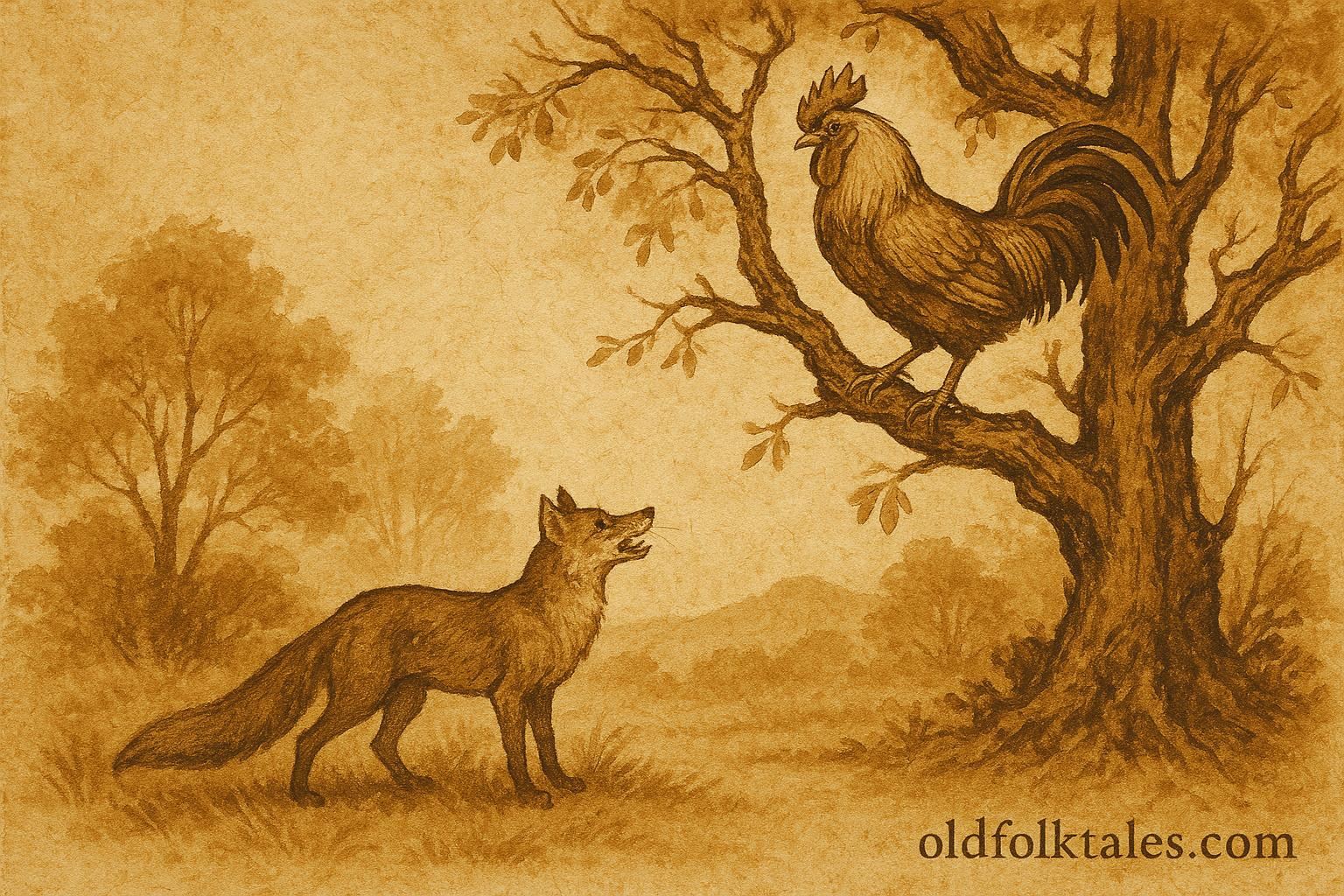
In a quiet countryside shaped by fields, trees, and wandering paths, there stood a tall tree whose branches reached toward the sun. High upon one of those branches perched a rooster, bright-eyed and alert, greeting the morning with his sharp crow. From this height, he could see far across the land and sense danger long before it arrived.
Below, moving softly through the grass, came a fox. His fur was sleek, his steps careful, and his eyes fixed upon the rooster above. Hunger guided him, but more than hunger, it was confidence. The fox believed that clever words could succeed where strength could not.
Click to read all South American Folktales — timeless stories from the Andes to the Amazon.
Stopping beneath the tree, the fox lifted his head and spoke warmly. He praised the rooster’s fine feathers and strong voice, calling him the pride of the countryside. He spoke of a new age of peace, claiming that animals had agreed to live without fear or harm. Foxes and roosters, he said, were now friends.
The rooster listened quietly. He did not interrupt or insult the fox, but he did not move from his branch. His eyes remained sharp, and his claws held firm to the bark. The fox continued, inviting the rooster to come down and celebrate this new harmony together.
For a moment, the promise sounded pleasant. But the rooster had learned that words could be shaped to hide intentions. Instead of descending, he leaned forward and replied calmly. He thanked the fox for the good news and said he could already see two dogs approaching to confirm the peace.
At the mention of dogs, the fox stiffened. His ears twitched, and his eyes darted toward the path. Without waiting to see if the dogs were real, he leapt back and fled into the brush.
From above, the rooster watched him go, safe and unmoved. He remained on his branch, wiser than before, knowing that survival depended not on trust, but on awareness.
Moral Lesson
This folktale teaches that vigilance and wisdom protect against deception. Flattery and false promises often conceal danger, and awareness is the key to survival.
Knowledge Check
1. Who are the main characters in the story?
A cunning fox and a vigilant rooster.
2. What tactic does the fox use to deceive the rooster?
Flattery and false promises of peace.
3. Why does the rooster not trust the fox?
He recognizes that words can hide harmful intentions.
4. How does the rooster escape danger?
By turning the fox’s words against him with clever awareness.
5. What does the fox represent symbolically?
Deception, cunning, and hidden danger.
6. What cultural purpose did this story serve?
To teach children moral alertness and survival awareness.
Source: Spanish colonial animal folklore; adapted from European fables
Cultural Origin: Latin America (Spanish Colonial tradition)