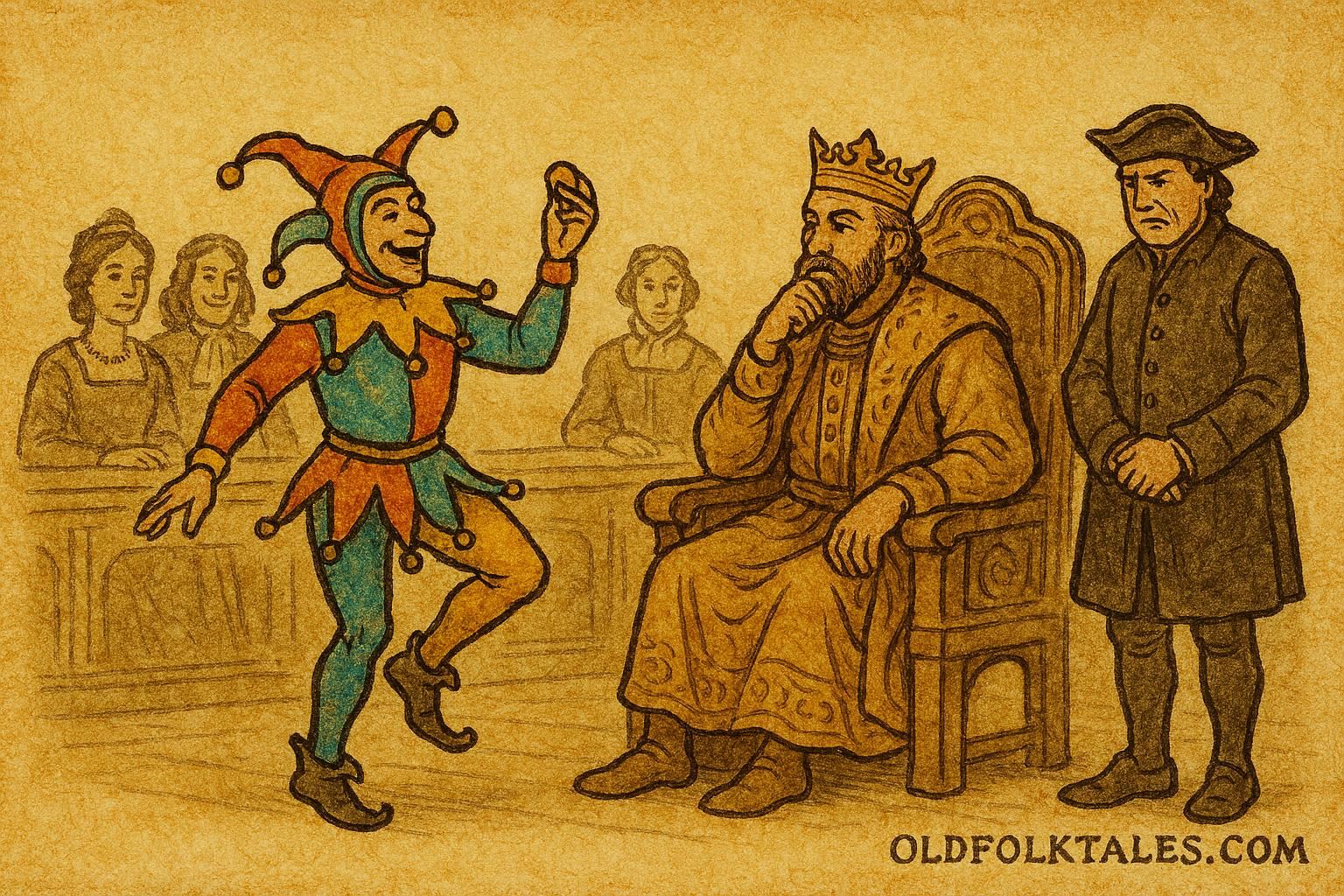
In a colonial court adorned with banners, polished floors, and the quiet tension of ambition, there lived a jester whose presence inspired laughter but little respect. His clothing was bright and mismatched, his cap crowned with bells that jingled at every step. Courtiers laughed before he spoke, certain that wisdom could not possibly dwell beneath such foolish attire.
The jester’s duty was to amuse the ruler and nobles, easing the weight of courtly life with jokes, riddles, and playful mockery. Yet behind his exaggerated gestures and careless grin lay a mind both observant and sharp. While others spoke cautiously, the jester listened freely. He heard whispered bargains, noticed nervous glances, and recognized how power bent truth to serve itself.
Click to read all South American Folktales — timeless stories from the Andes to the Amazon.
The nobles mocked him openly, assuming his words held no consequence. Advisors dismissed him as harmless entertainment. This freedom, granted by underestimation, became his shield. Through riddles disguised as nonsense and jokes wrapped in laughter, the jester began to reveal what others dared not say plainly.
During feasts, he told humorous tales of greedy foxes guarding henhouses, prompting uneasy laughter among certain officials. In playful songs, he spoke of scales that tipped unfairly, drawing knowing smiles from servants and guards. Each jest seemed innocent, yet each carried a truth too precise to ignore.
One official, powerful and corrupt, grew uneasy. Though never named, his actions were mirrored too clearly in the jester’s performances. The court laughed, but the ruler began to listen. Amusement slowly turned to attention as patterns emerged in the jester’s words.
At last, during a public gathering, the jester presented a riddle before the entire court. Its answer, once spoken aloud, exposed the corrupt official’s schemes so clearly that denial became impossible. Laughter erupted—not mocking this time, but revelatory. The official stood exposed by his own reflection in humor.
The ruler, struck by the clarity hidden within jest, ordered an inquiry. Truth surfaced, and corruption was confirmed. Turning to the jester, the ruler acknowledged what pride had once obscured: wisdom often arrives wearing humble clothing.
The jester bowed deeply, bells ringing softly. He sought no reward, only the freedom to speak truth through laughter. The court never laughed at him the same way again.
Moral Lesson
This folktale teaches that truth can be spoken safely through humility and humor. Wisdom does not always announce itself with authority; sometimes it arrives disguised as foolishness.
Knowledge Check
1. Who is the main character of the story?
A jester serving in a Spanish colonial court.
2. Why is the jester underestimated?
Because of his foolish appearance and entertainer’s role.
3. How does the jester reveal corruption?
Through humor, riddles, and symbolic jokes.
4. What protects the jester from punishment?
His role as an entertainer allows indirect truth-telling.
5. How does the ruler change?
He learns to recognize wisdom beyond appearances.
6. What cultural traditions influence the story?
Spanish court satire and Indigenous indirect truth-telling.
Source: Spanish colonial court folklore; oral narrative tradition
Cultural Origin: Mexico and Peru (Spanish Colonial Latin American folklore)