In the green highlands of Gojjam, where the land rises and falls in rolling hills and the Blue Nile carves its ancient path through deep gorges, there stood a prosperous farm. The earth was rich and red, the rains came faithfully during the kiremt season, and the fields produced abundant harvests of teff, barley, and sorghum. Eucalyptus trees lined the boundaries, their silvery leaves rustling in the mountain breezes, and round stone houses with conical thatched roofs dotted the landscape like mushrooms after rain.
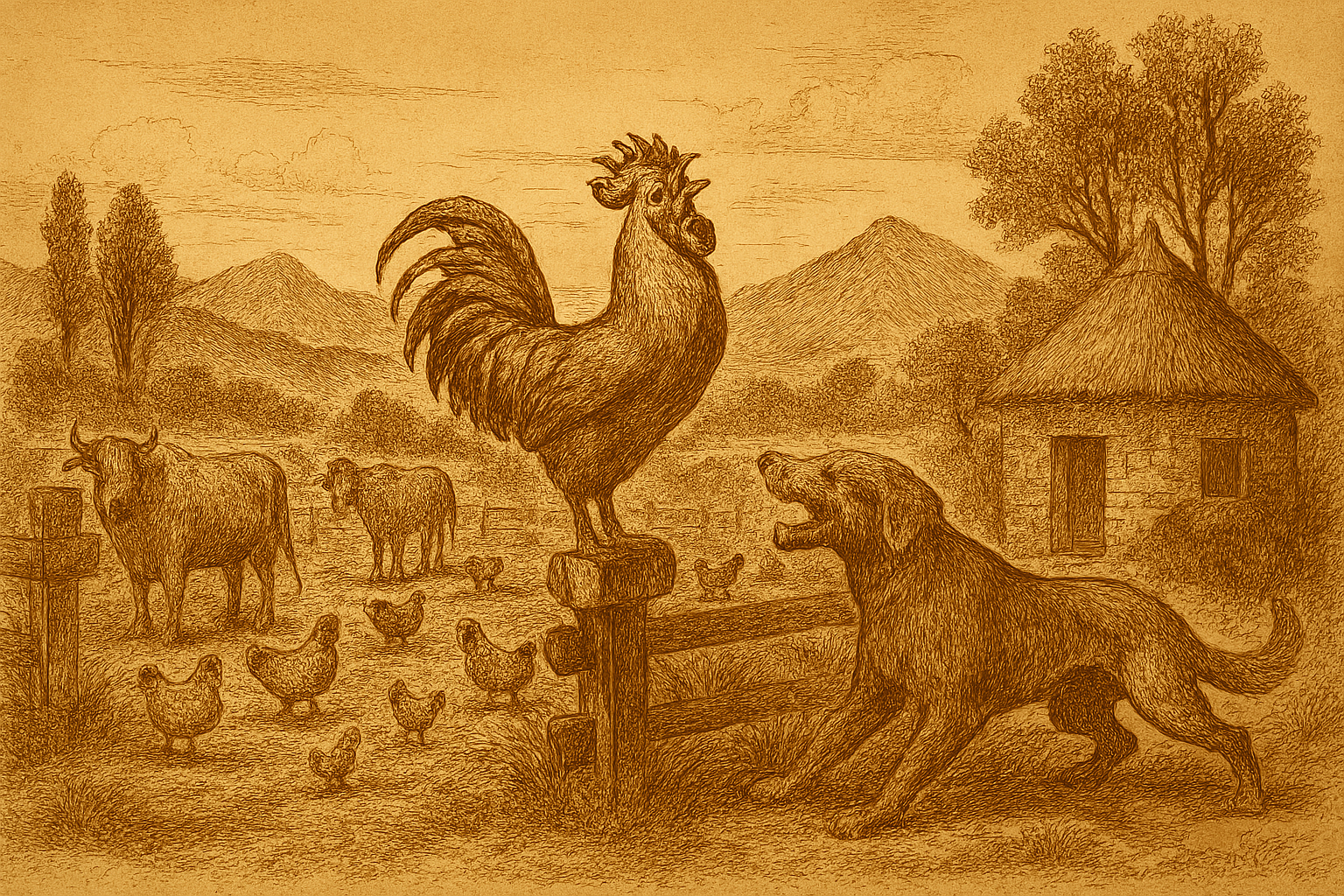
On this farm lived all manner of creatures cattle with long, curved horns, sturdy donkeys that carried loads up and down the steep paths, sheep and goats that grazed on the hillsides, and chickens that scratched in the dust of the farmyard. Among these chickens ruled a rooster whose magnificence was undeniable. His feathers gleamed like polished copper in the highland sun, his comb stood tall and crimson as a king’s crown, and his tail arched in a cascade of iridescent bronze and green that seemed to capture all the colors of dawn.
Click to read all South American Folktales — timeless stories from the Andes to the Amazon.
But it was not his appearance alone that set this rooster apart, it was his voice and his overwhelming pride. Every morning, long before the first light touched the mountain peaks, he would climb to the highest point he could find a fence post, a stone wall, the roof of the chicken coop and announce his presence to the world with a crow so loud and piercing that it seemed to shake the very air.
“Kokoko-kooroo!” he would cry, his chest swelling with self-importance. “I am the master of this farm! I am the strongest, the bravest, the most magnificent creature under the Ethiopian sky! All must acknowledge my supremacy!”
The hens, timid and practical, would duck their heads and go about their business of scratching for grain and insects. They had learned long ago that disagreeing with the rooster only brought more noise and bluster. The other animals the cattle standing patient in their enclosure, the donkeys chewing thoughtfully on hay, the dogs lying in patches of sunlight largely ignored him. They had more important concerns than the ravings of a vain bird.
But the rooster took their silence as agreement, as acknowledgment of his greatness. Day after day, his pride grew larger, his boasts more extravagant. He strutted through the farmyard with his chest thrust forward, challenging any creature that crossed his path to dispute his claim of superiority.
“I am stronger than the bull!” he would crow, flapping his wings for emphasis. “I am fiercer than the farm dogs! No creature on this land can match my power and courage!”
An old hen, one who had seen many seasons come and go, tried once to offer him counsel. “Brother Rooster,” she clucked gently, approaching him as he preened his feathers in a patch of dust, “perhaps it would be wiser to show more… humility. There are creatures much larger and more dangerous than you. Your boasting may attract unwanted attention.”
The rooster fixed her with a contemptuous glare, his golden eyes flashing with indignation. “Humility?” he squawked, nearly choking on the word. “Humility is for the weak and fearful! I am neither. I am the king of this farmyard, and no creature large or small poses any threat to me. Your words come from cowardice, not wisdom.”
The old hen shook her head sadly and walked away, muttering prayers under her breath in the ancient tongue. She had seen pride destroy many creatures before, and she recognized the signs of coming disaster.
The farmer, too, noticed the rooster’s increasing arrogance and tried to warn him in his own way. When the rooster crowed too long or too loudly, disturbing the peace of the early morning, the farmer would clap his hands sharply or toss a handful of pebbles to quiet him. But the rooster interpreted even these reprimands as acknowledgment of his importance. “See?” he would say to the other chickens. “Even the human pays attention to me! My voice commands respect from all beings!”
Then one day, a traveler passed through the farm, leading a string of pack animals on his way to the market in a distant town. Among these animals was a creature the farmyard had never seen before a large, rangy hunting dog with yellow eyes and powerful jaws. The farmer welcomed the traveler and offered him water and a place to rest, as was the custom of Ethiopian hospitality. The traveler accepted gratefully and tied his animals in the shade of a large eucalyptus tree.
The hunting dog lay down, panting in the highland heat, paying no attention to the chickens that scratched nearby. But the rooster, seeing a new audience for his prowess, could not resist the opportunity to demonstrate his dominance.
He approached the dog with his characteristic swagger, chest puffed out, wings slightly spread to make himself appear larger. The hens scattered nervously, sensing danger, but the rooster was blind to their fear. He had convinced himself so thoroughly of his own invincibility that he could no longer perceive genuine threats.
“You there!” the rooster crowed at the dog. “Stranger in my domain! Know that you rest in the kingdom of the greatest warrior in all of Gojjam! I am the master here, and even you, large as you are, must acknowledge my superiority!”
The dog opened one yellow eye and regarded the rooster with mild interest, the way a cat might observe a particularly noisy insect. The old hen, watching from a safe distance, tried one more time to intervene. “Please, brother!” she called urgently. “Come away! That is not a creature to challenge!”
But pride had made the rooster deaf to reason. He interpreted the dog’s silence as fear or respect, and his boldness grew even greater. He hopped closer, pecking at the ground near the dog’s massive paws, crowing his challenges ever louder.
“Are you afraid to answer me?” he taunted. “Do you acknowledge that I am the stronger? Come, admit it! I am the king of this place, and you are merely a tired beast of burden, far from home!”
The dog’s patience, already thin from a long journey in the hot sun, finally snapped. In one fluid motion so quick that the watching animals barely saw it happen the dog lunged forward. There was a brief flurry of feathers, a single sharp cry that was cut off almost before it began and then silence.
When the dust settled, the proud rooster lay motionless on the ground, his magnificent feathers scattered like fallen leaves, his boasting voice silenced forever. The dog, having dealt with the annoyance, returned to his spot in the shade and resumed his panting, unconcerned. To him, it had been nothing a momentary irritation dispatched without thought or effort.
The farmer came running at the commotion, saw what had happened, and shook his head sadly. He had lost a fine rooster beautiful, strong, and with a crow that carried across three valleys. But he had also lost him to his own pride, which no fence or warning could protect against.
The old hen gathered the younger chickens around her that evening as the sun set behind the western hills, painting the sky in shades of orange and purple. “Remember what you saw today,” she told them, her voice heavy with sorrow. “Beauty and strength are gifts, but pride turns gifts into curses. The rooster was truly magnificent, truly strong for a chicken. But he forgot what he was. He forgot that there are always creatures stronger, always dangers greater than ourselves. His boasting brought exactly what I feared the attention of something he could not defeat.”
The young chickens huddled closer, understanding now what the old hen had tried to teach. In the highlands of Gojjam, where life was often hard and dangers many, survival required not just strength but wisdom, the wisdom to know one’s limitations, to recognize genuine threats, and to understand that pride, unchecked, blinds one to the very dangers that can bring destruction.
From that day forward, the farmyard was quieter. A new rooster eventually rose to take the proud one’s place, but he crowed with less arrogance, strutted with less swagger, and when the old hen offered counsel, he listened with respect. The memory of his predecessor’s fate had taught him what all creatures must eventually learn: that pride, when it grows too large, casts a shadow that attracts the very dangers we should most fear.
Click to read all Andean Highland Folktales — echoing from the mountain peaks of Peru, Bolivia, and Ecuador.
The Moral Lesson
This Ethiopian folk tale carries a timeless warning about the dangers of unchecked pride and arrogance. The rooster’s downfall illustrates how pride blinds us to real danger, making us incapable of accurately assessing threats or recognizing our own limitations. In Ethiopian highland culture, where survival often depended on communal cooperation, careful judgment, and respect for genuine power whether of nature, larger animals, or human authority excessive pride was understood as a fatal flaw that could bring swift destruction. The rooster possessed genuine gifts: beauty, strength, and a commanding voice. But his arrogance transformed these virtues into liabilities by making him unable to distinguish between creatures he could truly dominate and those far beyond his capacity to challenge. The tale teaches that self-awareness and humility are not signs of weakness but essential forms of wisdom. True strength lies not in boasting about one’s power but in understanding its limits, in recognizing genuine dangers, and in showing proper respect for forces greater than ourselves. Pride doesn’t just make us foolish, it makes us vulnerable, attracting exactly the kind of attention that can lead to our destruction.
Knowledge Check
Q1: Who was the proud rooster of Gojjam in Ethiopian folklore?
A1: The proud rooster of Gojjam was a magnificent bird who ruled a farmyard in the Ethiopian highlands. He possessed beautiful copper-colored feathers, an impressive crimson comb, and an extraordinarily loud crow. However, his most defining characteristic was his overwhelming pride and constant boasting about being the strongest, bravest, and most magnificent creature on the farm. His arrogance eventually led to his destruction when he challenged a creature far more dangerous than himself.
Q2: What was the setting of this Ethiopian highland tale?
A2: The story is set in Gojjam, a region in the Ethiopian highlands characterized by rolling green hills, red earth, and the presence of the Blue Nile. The specific setting was a prosperous farm with fields of teff, barley, and sorghum, eucalyptus trees, traditional round stone houses with thatched roofs, and a farmyard populated by cattle, donkeys, sheep, goats, chickens, and dogs typical of agricultural life in highland Ethiopia.
Q3: What warnings did the rooster receive, and how did he respond?
A3: The rooster received warnings from multiple sources: an old, wise hen repeatedly counseled him to show humility and warned that his boasting might attract dangerous attention, and even the farmer tried to quiet his excessive crowing. However, the rooster’s pride made him deaf to all warnings. He interpreted the old hen’s advice as cowardice, viewed the farmer’s reprimands as acknowledgment of his importance, and remained convinced of his own invincibility despite clear signals that he was courting danger.
Q4: What creature ultimately destroyed the proud rooster?
A4: A hunting dog belonging to a traveler passing through the farm ultimately destroyed the rooster. The dog was large, rangy, with yellow eyes and powerful jaws clearly a formidable predator. When the rooster approached and challenged the dog, boasting of his superiority and demanding acknowledgment of his dominance, the tired and irritated dog swiftly attacked and killed him. To the dog, the rooster was merely a minor annoyance easily dispatched.
Q5: What does the rooster’s fate symbolize in Ethiopian cultural context?
A5: In Ethiopian cultural context, the rooster’s fate symbolizes the consequences of pride that blinds one to reality and genuine danger. The story reflects highland Ethiopian values that emphasized communal harmony, proper respect for hierarchy and genuine power, and the wisdom of knowing one’s place and limitations. The rooster’s inability to distinguish between creatures he could truly dominate (other chickens) and those far beyond his capacity to challenge (the hunting dog) represents the fatal flaw of arrogance that prevents accurate assessment of threats a potentially deadly weakness in the harsh highland environment.
Q6: What lesson did the old hen teach the young chickens after the rooster’s death?
A6: After the rooster’s death, the old hen gathered the young chickens and taught them that beauty and strength are gifts, but pride transforms them into curses. She explained that the rooster was genuinely magnificent and strong for a chicken but he forgot what he was and failed to recognize that there are always creatures stronger and dangers greater than ourselves. His boasting attracted exactly the deadly attention she had feared. The lesson emphasized that survival requires not just strength but wisdom, the wisdom to know one’s limitations, recognize genuine threats, and understand that unchecked pride blinds us to the very dangers that can destroy us.
Source: Retold from an Ethiopian folk tale recorded by Wolf Leslau in Ethiopian Folk Literature.
Cultural Origin: Ethiopian Highlands, Ethiopia