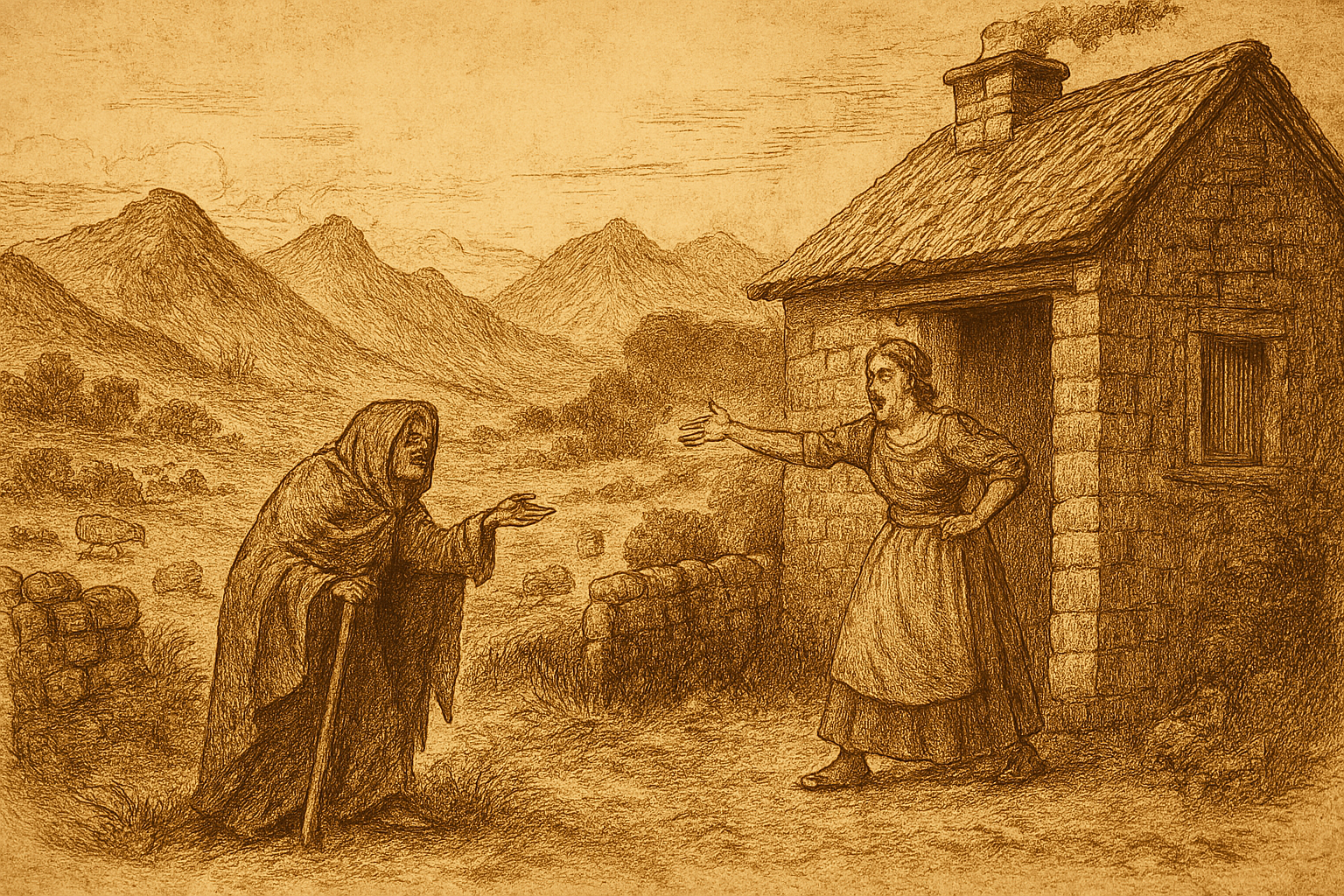
In a glen tucked between the towering peaks of the Scottish Highlands, where the heather blooms purple in summer and the burns run cold and clear from the mountains, there once lived a woman whose wealth set her apart from all her neighbors. Her stone house was the largest in the valley, with thick walls and a slate roof that didn’t leak when the rains came. Her barns overflowed with grain, her cellars bulged with salted meat and preserved vegetables, and her fields yielded harvests that made other farmers shake their heads in wonder. Sheep dotted her hillsides like patches of cloud, and her cattle were the envy of every crofter for miles around.
But for all her material abundance, there was something bitter and twisted in the woman’s heart. Where others saw neighbors and kin, she saw only those beneath her station. Where others recognized shared humanity, she saw only weakness and unworthiness. The poor, the struggling, the unfortunate all these she regarded with a contempt so deep it seemed to poison the very air around her.
Click to read all Andean Highland Folktales — echoing from the mountain peaks of Peru, Bolivia, and Ecuador.
When beggars came to her door, as they sometimes did in those hard times, she didn’t simply turn them away. She mocked them. She laughed at their ragged clothes and empty bellies. “Why should I share what I’ve earned?” she would cry, her voice sharp as a blade. “If you’re hungry, it’s because you’re lazy. If you’re poor, it’s because you lack the wit and will to prosper as I have.” And she would slam the door, leaving them to stumble away empty-handed, their shoulders bent with hunger and humiliation.
Her neighbors whispered among themselves, troubled by her hardness. In Highland tradition, there was an understanding almost sacred that those who had plenty bore responsibility toward those who had little. The land was harsh, the weather unpredictable, and fortune could turn as quickly as the mountain winds. Today’s prosperous farmer might be tomorrow’s beggar. Compassion wasn’t merely virtue; it was survival, a recognition that all people were bound together in a web of mutual dependence.
But the wealthy woman scoffed at such notions. “Foolish sentiment,” she called it. “The mark of weak minds and empty purses.”
Then came the year of the failed harvest. All across the Highlands, the crops withered in the fields. An early frost had killed the young plants, and what little grew afterward was stunted and poor. The potato blight swept through like an invisible plague, turning the tubers black and rotten in the ground. Families who had stored grain from previous years survived, though barely. Those who had not faced starvation.
The woman’s own stores remained full she had been fortunate, and her granaries still held ample supplies from better years. But when hungry neighbors came to her door, their children’s faces gaunt and pale, their voices trembling as they asked if they might buy or borrow even a small measure of grain, the woman’s response was cruel beyond measure.
“Buy?” she laughed, the sound harsh and mocking. “With what? You have nothing I want. And borrow? So you can fail to repay me, as failures always do?” She looked at the hungry children with cold eyes. “You should have prepared better. You should have worked harder. I owe you nothing nothing! and I’ll not throw away my prosperity on the improvident and the idle.”
She locked her granaries with heavy iron padlocks and kept the keys on a chain around her neck. At night, she could hear the sounds of hunger in the village children crying, adults speaking in low, desperate voices. But she closed her shutters and told herself that their suffering was their own fault, the natural consequence of their inferior character and poor planning.
Yet even as she congratulated herself on her prudence and strength of will, something began to change in her own household. It started small, so small she barely noticed at first. A ewe fell sick and died for no apparent reason. A cow’s milk turned sour hours after milking, though the weather was cool and the pail was clean. Grain that should have kept well through the winter began to spoil, developing a strange mold that made it inedible.
Then her children three sons and two daughters, all previously healthy and strong began to sicken. They grew pale and listless. They lost their appetites and complained of aches in their bones. No fever touched them, no rash appeared on their skin, yet they grew weaker with each passing day. The woman brought in healers from distant villages, offered them generous payment for their services, but none could identify the ailment or provide effective treatment.
More livestock died. Food continued to spoil with mysterious rapidity. The woman’s husband, a quiet man who had long been troubled by his wife’s cruelty but lacked the courage to oppose her, grew gaunt and silent, his eyes filled with a fear he couldn’t name.
Winter deepened its grip on the glen, and the woman’s anxiety turned to desperation. Her children were wasting away before her eyes. Her stores, once so abundant, were dwindling at an alarming rate as food spoiled and animals died. For the first time in her life, she felt the cold finger of want touching her shoulder.
One gray afternoon, as snow fell softly outside and the woman sat by the fire, staring into the flames and wringing her hands in helpless anguish, there came a knock at her door. She opened it to find an old woman standing on the threshold a crone bent with age, wrapped in a threadbare shawl, her face deeply lined and her eyes sharp as a hawk’s.
“I know what ails your house,” the old woman said without preamble.
The wealthy woman’s pride warred with her desperation. Desperation won. “Tell me,” she whispered. “Tell me what’s wrong, and what I must do to save my children.”
The old woman’s gaze was steady and uncompromising. “Your house is cursed, but not by any outside force. You have cursed it yourself with your hard heart and cruel tongue. Prosperity cannot remain where mercy is absent. The blessing has left your home because you drove it away with your contempt for those who suffer.”
The woman felt as if she had been struck. “What must I do?” she asked, her voice breaking.
“Open your stores,” the old woman said simply. “Give freely to those in need. Share what you have while you still have something to share. Perhaps then the curse will lift though much of what you valued has already been lost, and will not return.”
The woman wanted to argue, to defend herself, to explain that she had earned her wealth and owed nothing to anyone. But looking at the old woman’s ancient, knowing eyes, and thinking of her children’s pale faces, she found she could not speak the words.
That very day, she unlocked her granaries. She went from door to door in the village, distributing grain and salted meat, offering it freely without expectation of repayment. She gave blankets to those who shivered in cold cottages. She shared what remained of her stores until her own supplies were no more abundant than her neighbors’.
Slowly agonizingly slowly the curse began to lift. Her children’s health improved, though they never quite regained the robust strength they had known before. The spoiling of food ceased, though her stores were now modest rather than overflowing. New lambs were born healthy in the spring, though her flocks were much reduced.
The woman lived the rest of her life in moderation, her wealth greatly diminished but her heart for the first time open to the suffering of others. She never forgot the lesson she had learned at such terrible cost: that prosperity built on contempt for the vulnerable is hollow and fragile, certain to crumble when tested. She was no longer proud, no longer scornful. Her neighbors, remembering both her cruelty and her eventual change, treated her with cautious respect but never quite with warmth.
And when she died many years later, the tale of her transformation was passed down as a warning and a hope proof that even the hardest heart might soften, though often only through suffering, and that mercy, once learned through bitter experience, could still take root and grow.
Click to read all South American Folktales — timeless stories from the Andes to the Amazon.
The Moral Lesson
This Highland tale carries a timeless and universal truth: contempt for the vulnerable and suffering ultimately destroys the prosperity of those who harbor it. The wealthy woman’s downfall illustrates that material abundance divorced from compassion and generosity is inherently unstable and unsustainable. In traditional Scottish Highland culture, where harsh conditions and unpredictable fortune could reduce anyone to poverty, there was a deep understanding that prosperity carried with it moral obligations particularly the duty to show mercy to those in need. The woman’s curse was self-inflicted, born from her own cruelty rather than any external evil. Her redemption came only when she opened both her stores and her heart, demonstrating that true wealth lies not in hoarded resources but in the generous spirit that shares freely. The story reminds us that our fortunes are fragile and interconnected, that pride and scorn poison our own lives as much as others’, and that lasting prosperity can only flourish where compassion and mercy dwell.
Knowledge Check
Q1: Who was the woman who mocked the poor in Scottish Highland folklore?
A1: The woman who mocked the poor was a wealthy landowner in a Scottish Highland glen who possessed abundant stores of grain, livestock, and provisions. Unlike her neighbors, she treated beggars and struggling people with cruel contempt, refusing to share her prosperity and mocking those who suffered from poverty or misfortune. Her story has been preserved in Gaelic oral tradition as a cautionary tale about the consequences of hard-heartedness and the absence of compassion toward the vulnerable.
Q2: How did the wealthy woman treat the poor during the famine in the Highlands?
A2: During a devastating famine that struck the Highlands, when crops failed and families faced starvation, the wealthy woman’s cruelty reached its peak. Despite having full granaries and abundant stores, she refused to sell or lend even small amounts of grain to hungry neighbors, including children. She locked her stores with iron padlocks, mocked those who came seeking help, and blamed their suffering on laziness and poor planning, showing no mercy even as people starved around her.
Q3: What mysterious misfortunes began to afflict the woman’s household?
A3: After the woman refused to help her starving neighbors, inexplicable misfortunes began plaguing her household. Livestock died without apparent cause, stored food spoiled mysteriously despite proper conditions, and most devastatingly, her children fell ill with a wasting sickness that no healer could identify or cure. These afflictions had no natural explanation and continued to worsen despite her wealth and access to the best medical care available, suggesting a supernatural or moral dimension to her suffering.
Q4: Who revealed the true cause of the woman’s troubles, and what was the explanation?
A4: An old woman a crone figure common in Highland folklore appeared at the wealthy woman’s door and revealed the truth: the household was cursed, but not by any external force. The woman had cursed herself through her hard heart and cruel treatment of others. The old woman explained that “prosperity cannot remain where mercy is absent” and that the blessing had left the home because the woman had driven it away with her contempt for those who suffered.
Q5: What did the woman have to do to lift the curse from her household?
A5: To lift the curse, the woman had to fundamentally change her behavior by opening her locked stores and giving freely to those in need. She had to share her wealth without expectation of repayment and show genuine compassion to her struggling neighbors. Only by practicing the generosity and mercy she had previously withheld could she hope to restore the blessing to her household though the old woman warned that much of what had been lost would never be fully recovered.
Q6: What does this Scottish Highland story teach about wealth and social responsibility?
A6: The story teaches that wealth carries moral obligations, particularly the responsibility to show compassion and generosity toward those who are vulnerable or suffering. In traditional Highland Gaelic culture, prosperity was understood to be fragile and temporary today’s wealthy person could become tomorrow’s beggar so hoarding resources while others starved violated the fundamental social covenant that bound communities together. The tale emphasizes that contempt for the poor and vulnerable brings spiritual and material consequences, that true prosperity requires an open heart as well as full stores, and that mercy and generosity are not optional virtues but essential practices that sustain both individual and communal wellbeing.
Source: Retold from a traditional Gaelic moral tale recorded from oral sources by John Gregorson Campbell in The Gaelic Otherworld: Superstitions of the Highlands and Islands of Scotland and Witchcraft and Second Sight in the Highlands and Islands.
Cultural Origin: Scottish Highlands, Gaelic Scotland