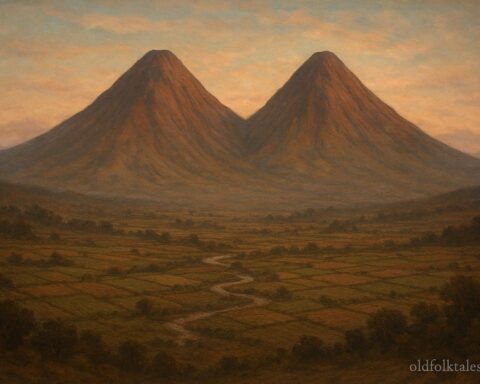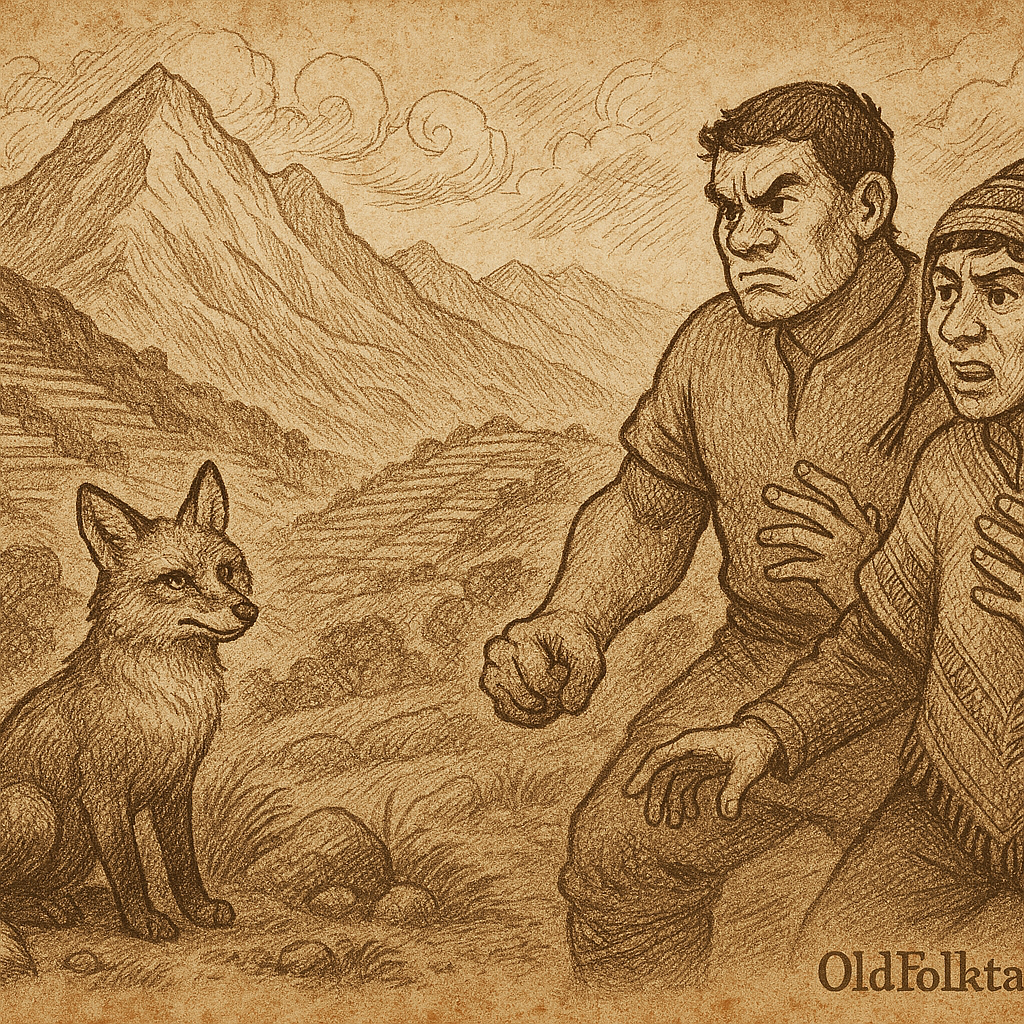
In a small village nestled between the towering peaks of the Andes, where terraced fields climbed the mountainsides like giant steps and the air was thin and clear as crystal, there lived two brothers named Waman and Puma. They were as different as the sun and the moon, though they shared the same blood and the same thatched-roof home at the edge of their village.
Waman, the elder brother, was built like the mountain itself broad-shouldered and strong, with arms thick from years of breaking earth and hauling stones. He was proud of his strength and believed that power and force were the answers to every problem life presented. When a boulder blocked a path, Waman would push it aside with his bare hands. When a dispute arose, he settled it with his imposing presence and booming voice. Subtlety was foreign to him, and he saw no need for it.
Click to read all South American Folktales — timeless stories from the Andes to the Amazon.
Puma, the younger brother, was lean and quick, his body honed by running messages between villages and chasing after straying livestock across rocky slopes. But more than physical swiftness, Puma possessed an aggressive cunning that often crossed into greed. His eyes were always calculating, always searching for advantage. He schemed constantly about ways to acquire more, more land, more animals, more silver and he felt no shame in taking shortcuts or bending the truth when it served his purposes.
Despite their differences, the brothers worked their family’s land together, raising potatoes and quinoa, and tending a small herd of llamas. But neither was particularly successful, for Waman’s brute force often damaged what he sought to build, and Puma’s greed led him to make reckless choices that brought short-term gain but long-term loss.
One autumn afternoon, when the harvest was nearly complete and the storerooms were being filled for the long winter ahead, the brothers were walking home along a narrow mountain path. The sun was beginning its descent behind the western peaks, painting the sky in shades of orange and purple, and shadows were lengthening across the valley below.
As they rounded a bend where the path narrowed between two large boulders, they encountered a fox. But this was no ordinary fox. Its coat gleamed russet-red in the slanting sunlight, and its eyes held an intelligence that was immediately unsettling. The fox sat directly in the middle of the path, its bushy tail wrapped neatly around its paws, looking for all the world as if it had been waiting for them.
“Good evening, brothers,” the fox said, its voice smooth as water over polished stones.
Waman stopped so abruptly that Puma nearly crashed into his back. The elder brother’s face darkened with anger not at hearing a fox speak, for in these mountains, such things were not entirely unknown, but at being addressed so casually by an animal that should show proper deference to humans.
“Move aside, fox!” Waman bellowed, his voice echoing off the rocks. “The path is for people, not for vermin that should be slinking through the brush!”
The fox’s whiskers twitched with amusement. “Vermin, am I? How interesting. And yet, I possess something you do not, mighty Waman.”
“And what could a scraggly fox possibly have that I lack?” Waman demanded, his massive hands curling into fists.
“Knowledge,” the fox replied simply. “I know where to find a treasure that has been hidden in these mountains since your grandfather’s grandfather was young. Gold and silver, buried in a cave not far from here.”
Puma’s eyes lit up with barely concealed avarice. “Treasure?” he breathed, pushing past his brother. “Tell us where! Tell us now, and we’ll… we’ll share it with you!” The lie was transparent in his eager voice; both the fox and Waman knew Puma had no intention of sharing anything.
The fox stood and stretched languidly, as if considering the offer. “Share? How generous. But I think not. You see, the path to this treasure is treacherous. It requires not strength” here the fox looked at Waman “nor greed” it turned its gaze to Puma “but cleverness and careful thought. The cave entrance is guarded by three challenges, and only those with wit can pass them.”
“Bah! Challenges!” Waman scoffed. “I’ll smash through whatever stands in my way!”
“And I’ll figure out any trick,” Puma added quickly, his mind already racing with schemes. “Just tell us where this cave is!”
The fox’s eyes gleamed with something that might have been mischief or might have been pity. “Very well. But first, answer me this simple question, and I’ll know whether you’re ready for what lies ahead: A farmer has a fox, a chicken, and a sack of grain. He must cross a river, but his boat can only carry him and one other thing. If he leaves the fox alone with the chicken, the fox will eat it. If he leaves the chicken alone with the grain, the chicken will eat it. How does he get all three across safely?”
Waman’s face reddened with frustration. “What does this riddle have to do with treasure? Stop wasting our time with foolish games!”
“I know!” Puma shouted, though his expression betrayed his uncertainty. “He… he takes the grain first! No, wait the fox! Or he makes two trips? No, three trips? Or ” He sputtered, his greedy mind too focused on the imagined treasure to think clearly through the problem.
The brothers argued between themselves, Waman insisting they should simply follow the fox by force, Puma spinning one incorrect solution after another, each more convoluted than the last. Their voices grew louder and more heated until they were shouting at each other, their frustration with the riddle transforming into anger at one another.
While they argued, the fox watched with patient amusement. Finally, when their shouting reached its peak, the fox spoke again, its voice cutting clearly through their noise.
“Enough! The answer is simple for those who think instead of react: The farmer takes the chicken across first, leaving the fox and grain together they won’t harm each other. He returns alone. Then he takes the fox across but brings the chicken back with him. He leaves the chicken and takes the grain across. Finally, he returns one last time to fetch the chicken. Simple, straightforward, requiring only the patience to think it through.”
The brothers fell silent, shame coloring their faces as they realized how obvious the answer had been.
“You see,” the fox continued, “the treasure you seek is not gold or silver, though I spoke truly that such things exist in these mountains. The real treasure is the wisdom to solve problems with thought rather than force, and the character to pursue what is right rather than what is merely profitable. Waman, your strength is meaningless if you apply it without thinking. You would have charged into that imaginary cave and been crushed by the first trap. And Puma, your cunning is wasted when corrupted by greed. You would have betrayed your own brother for treasure, and in doing so, betrayed yourself.”
The fox stood and prepared to leave but paused to look back at the brothers one more time. “There is no cave. There never was. But there is a lesson, and it is worth more than any treasure: Strength without wisdom is destruction. Cleverness without integrity is merely another form of foolishness. When you learn to combine thought with action, and wisdom with ambition, then and only then will you find the treasure you truly need.”
With that, the fox trotted away, disappearing into the lengthening shadows between the rocks, leaving the two brothers standing alone on the mountain path.
For a long moment, neither spoke. Then Waman sighed heavily. “The fox was right, brother. I’ve been so proud of my strength that I never learned when not to use it.”
Puma nodded slowly, his calculating eyes dimmed with genuine reflection. “And I’ve been so focused on getting ahead that I forgot why I wanted to get ahead in the first place. What good is wealth if you lose your integrity and your brother to obtain it?”
The two brothers walked home together in thoughtful silence as the stars began to appear in the darkening sky above the Andes. They never saw the fox again, but they never forgot its lesson. Waman learned to think before acting, tempering his strength with consideration. Puma learned to value integrity over advantage, redirecting his cleverness toward honest pursuits.
And though they never found a cave full of treasure, the brothers prospered in ways that gold could never measure. Their fields flourished because they combined Waman’s strength with careful planning. Their herds grew because Puma’s cleverness was applied to husbandry rather than schemes. And most importantly, they learned to work together, each tempering the other’s weaknesses with his own strengths.
In the end, the fox had given them exactly what it promised treasure beyond measure though not in the form they had expected.
Click to read all Andean Highland Folktales — echoing from the mountain peaks of Peru, Bolivia, and Ecuador.
The Moral Lesson
This Quechua trickster tale teaches us that true wisdom lies not in physical strength or cunning alone, but in the thoughtful application of our abilities guided by integrity and humility. The fox represents wisdom itself neither strong nor greedy, but clever and principled. The story reminds us that we often seek the wrong kind of treasures, chasing material wealth or power while overlooking the genuine riches of character, wisdom, and harmonious relationships. Most importantly, it shows that the best teacher is sometimes the one who humbles us, revealing our weaknesses so we might grow beyond them. The greatest treasures in life are not found in hidden caves, but in the lessons that transform who we are.
Knowledge Check
Q1: What were the main character flaws of the two brothers in this Quechua tale?
A: Waman’s flaw was his over-reliance on brute strength and his belief that force could solve any problem without thinking. Puma’s flaw was his greed and cunning that prioritized personal gain over integrity, leading him to scheme and manipulate for advantage.
Q2: What role does the fox play as a trickster figure in Quechua folklore?
A: The fox serves as a wise trickster who uses cleverness and intelligence to teach important lessons. Rather than using tricks for selfish purposes, this fox uses deception (the false treasure) to reveal truth and guide the brothers toward genuine wisdom and self-improvement.
Q3: What is the significance of the river-crossing riddle in the story?
A: The riddle tests whether the brothers possess the patience and clear-thinking necessary to solve problems wisely. Their failure to answer it reveals their fundamental flaws Waman’s refusal to think carefully, and Puma’s mind clouded by greed demonstrating they aren’t ready for real “treasures.”
Q4: Why does the fox reveal there was no treasure cave at the end?
A: The fox reveals the truth to show that the real treasure was the lesson itself teaching the brothers about their flaws and how to overcome them. This revelation emphasizes that wisdom and character development are more valuable than material wealth.
Q5: How do animal trickster tales function in Quechua cultural education?
A: Trickster tales featuring clever animals like foxes serve as teaching tools, especially for young listeners, conveying important values like humility, thoughtfulness, and integrity. These stories use engaging narratives to transmit cultural wisdom about proper behavior and character.
Q6: What transformation occurs in the brothers by the story’s end?
A: Both brothers experience genuine personal growth: Waman learns to temper his strength with careful thought and planning, while Puma redirects his cleverness from selfish schemes toward honest, productive purposes. Most importantly, they learn to work together harmoniously, combining their strengths.
Source: Adapted from traditional Quechua trickster tales and animal fables from the Andean oral tradition, as documented in Quechua-language folklore collections and indigenous storytelling practices.
Cultural Origin: Quechua peoples, Andean region of South America (Peru, Bolivia, Ecuador)