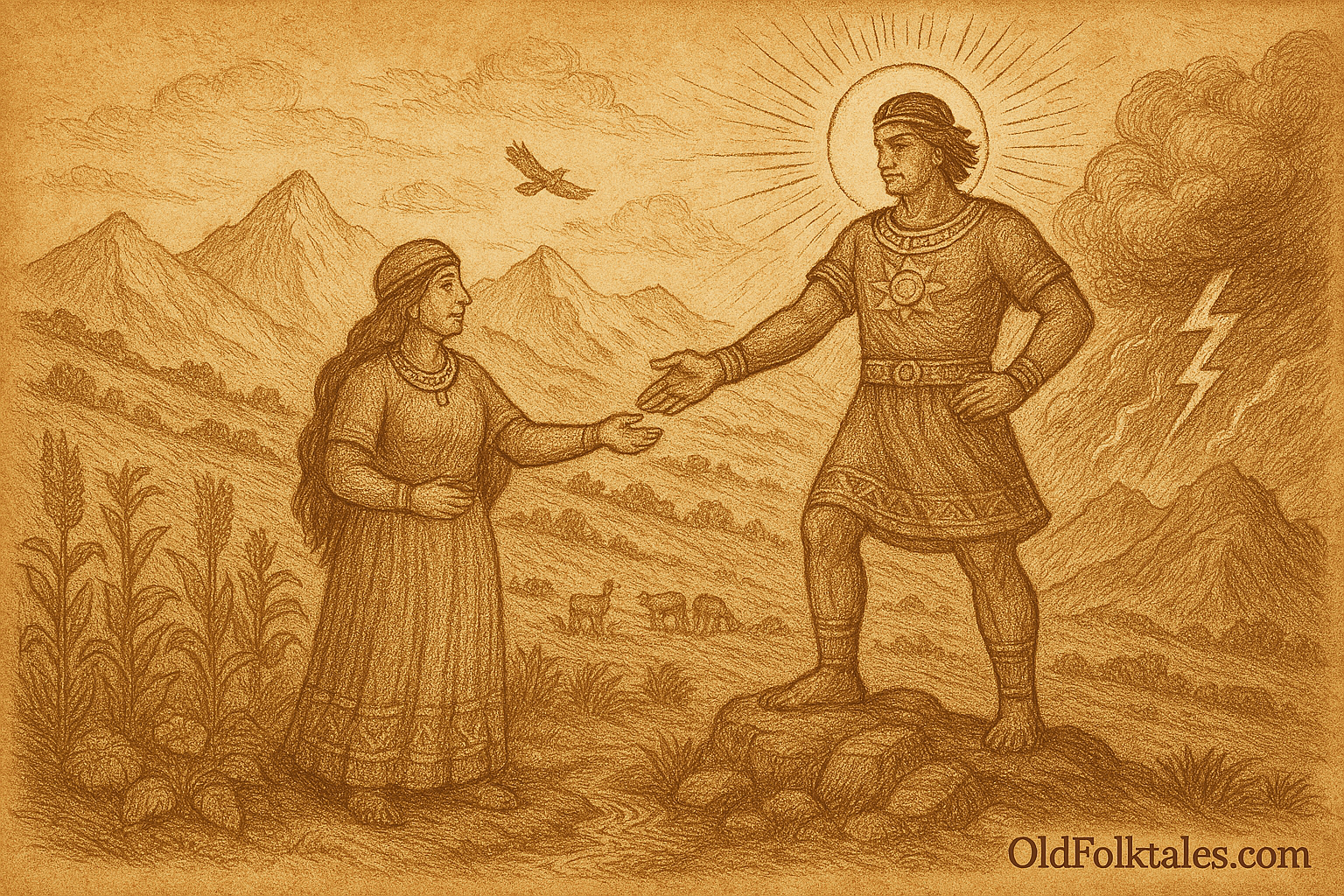
In the time before time, when the world was still learning its rhythms and the mountains had not yet counted their years, there existed two great powers that shaped all life in the lands we now call the Andes. Inti, the magnificent Sun God, blazed across the sky each day in robes of gold and flame, while Pachamama, the eternal Mother Earth, cradled all living things in her nurturing embrace.
Inti was proud and fierce, his light capable of bringing both life and destruction. Each morning, he rose from his resting place beyond the eastern peaks, convinced that his brilliance alone sustained the world. His rays were so intense that they could split stones and turn rivers into ribbons of mist. He believed that the stronger he shone, the more he proved his devotion to the world below.
Click to read all South American Folktales — timeless stories from the Andes to the Amazon.
Pachamama was patient and wise, her brown soil rich with the promise of maize, potatoes, and quinoa. She understood the delicate balance required for life to flourish the need for warmth and coolness, light and shadow, rain and sunshine. In her heart, she carried the songs of every plant that pushed through her surface, every animal that walked upon her, and every human who called her home.
For countless days, Inti blazed with increasing fervor across the heavens. “I shall show my strength!” he declared to the winds. “I shall prove my power to all who depend upon my light!” His flames grew hotter and more relentless, beating down upon the earth with merciless intensity.
At first, the people rejoiced. The sun’s warmth promised abundant harvests, and they offered him prayers of gratitude, placing golden offerings upon stone altars high in the mountains. But as the days stretched on without relief, their joy turned to concern, and then to despair.
The rivers that had once rushed down from glacial heights began to slow, then trickle, then disappear entirely. The lakes that shimmered like mirrors in the mountain valleys grew shallow, their edges ringed with cracked, dry earth. The crops that had pushed so eagerly through Pachamama’s soil began to wither, their leaves curling inward as if trying to hide from Inti’s relentless gaze.
Pachamama felt the suffering of her children both human and otherwise. She felt the agony of each plant as its roots searched desperately for moisture that no longer existed. She heard the cries of animals seeking water where none could be found. She witnessed the grief of mothers who could not feed their children, and farmers who watched helplessly as their fields turned to dust.
Finally, when the suffering grew too great to bear, Pachamama gathered her strength and called out to Inti. Her voice rose from deep within the mountains themselves, carried on winds that still remembered the coolness of dawn.
“Great Inti!” she cried, her voice resonating through every canyon and valley. “Mighty Sun God, I honor your power and acknowledge your light, for without you, no seed would sprout and no flower would bloom. But I beg you now show mercy! Your fierce love is destroying the very life you seek to nurture!”
Inti paused in his blazing journey across the sky. He had been so consumed by demonstrating his strength that he had not truly looked at the world below. Now, hearing Pachamama’s plea, he turned his golden gaze downward and saw what his pride had wrought.
The sight humbled him. The green valleys had become brown wastelands. The vibrant fields lay barren and broken. The people, who had once danced in celebration of his light, now huddled in whatever shade they could find, their faces gaunt and their spirits diminished.
Inti’s fierce heart softened with understanding. “Pachamama,” he said, his voice like distant thunder. “I have been blind in my pride. I sought to prove my devotion through strength alone, but true devotion requires wisdom. I understand now that life needs not just my light, but also periods of rest and renewal.”
Pachamama’s relief washed over the land like a cool breeze. “And I understand,” she replied gently, “that I cannot sustain life through my nurturing alone. We must work together, you and I, in sacred balance.”
And so, these two great powers made a covenant that would endure for all time. Inti agreed to moderate his intensity, sometimes shining brilliantly to warm the earth and help crops grow, and at other times withdrawing slightly to allow clouds, rain, and cooler temperatures to refresh the land. Pachamama promised to receive his light with gratitude, using it wisely to nourish the life that depended upon her.
From that moment forward, the world knew seasons. There came times of planting, when Inti’s gentle warmth coaxed seeds from Pachamama’s soil. There followed seasons of growth, when his fuller strength helped crops reach toward the sky. Then came harvest time, when his mellowing light painted the world in golden hues. And finally, there arrived periods of rest, when Inti’s reduced intensity allowed Pachamama and all her children to restore themselves for the cycle to begin anew.
The people of the Andes celebrated this sacred balance, offering gratitude to both Inti and Pachamama at the turning of each season. They built their lives around this eternal partnership, learning to plant and harvest according to the rhythms established by these two great forces.
And so it continues to this day, the dance between sun and earth, light and soil, warmth and coolness, a reminder that even the mightiest powers must work in harmony to sustain the web of life.
Click to read all Andean Highland Folktales — echoing from the mountain peaks of Peru, Bolivia, and Ecuador.
The Moral Lesson
This ancient Quechua tale teaches us that true strength lies not in raw power alone, but in balance and cooperation. Even the most magnificent forces, when acting without restraint or awareness of others’ needs, can cause destruction rather than creation. The story reminds us that sustainable prosperity comes from recognizing our interdependence and working in harmony with the natural world and with each other. Pride without wisdom leads to ruin, but when power is tempered with compassion and understanding, it becomes a force for lasting good.
Knowledge Check
Q1: Who are Inti and Pachamama in Quechua mythology?
A: Inti is the Sun God who provides light and warmth, while Pachamama is Mother Earth who nurtures all living things. They are central deities in Quechua cosmology, representing the fundamental forces necessary for life in the Andes.
Q2: What problem did Inti’s fierce pride create in the story?
A: Inti’s excessive pride led him to shine too intensely without restraint, scorching the earth, drying up rivers and lakes, withering crops, and causing widespread suffering among both people and animals.
Q3: How did Pachamama convince Inti to change his behavior?
A: Pachamama appealed to Inti with respect and honesty, acknowledging his importance while explaining how his untempered strength was destroying the life he meant to sustain. Her plea helped him see the consequences of his actions.
Q4: What is the symbolic meaning of the seasons in this tale?
A: The seasons symbolize the sacred balance between opposing forces—warmth and coolness, activity and rest, giving and receiving. They represent the natural cycles that emerge when powerful forces work in harmony rather than competition.
Q5: Why is the relationship between Inti and Pachamama important to Quechua agricultural culture?
A: The balanced relationship between sun and earth directly governs agricultural success in the Andes. Understanding and respecting this relationship helped Quechua people know when to plant, tend, harvest, and rest their fields according to seasonal cycles.
Q6: What universal lesson does this Quechua origin story teach about power and responsibility?
A: The story teaches that those with great power must exercise it with wisdom and restraint. True leadership and strength come not from domination, but from understanding interdependence and working cooperatively to benefit all.
Source: Adapted from traditional Quechua mythology and agricultural narratives documented in Andean oral traditions and ethnographic studies of Quechua cosmology.
Cultural Origin: Quechua peoples, Andean region of South America (primarily Peru, Bolivia, Ecuador)