Before the people knew the golden gift of corn, their lives were shaped by hunger and hardship. The villages that clung to the misty highlands of Oaxaca and Chiapas survived on roots, berries, and wild herbs. The soil was thin, the winds harsh, and though the mountains offered beauty, they rarely offered abundance. The people prayed to the gods for food that could sustain them through the changing seasons.
Their prayers rose with the smoke of small fires, winding toward the heavens. And one day, the gods answered, not with thunder or lightning, but with light.
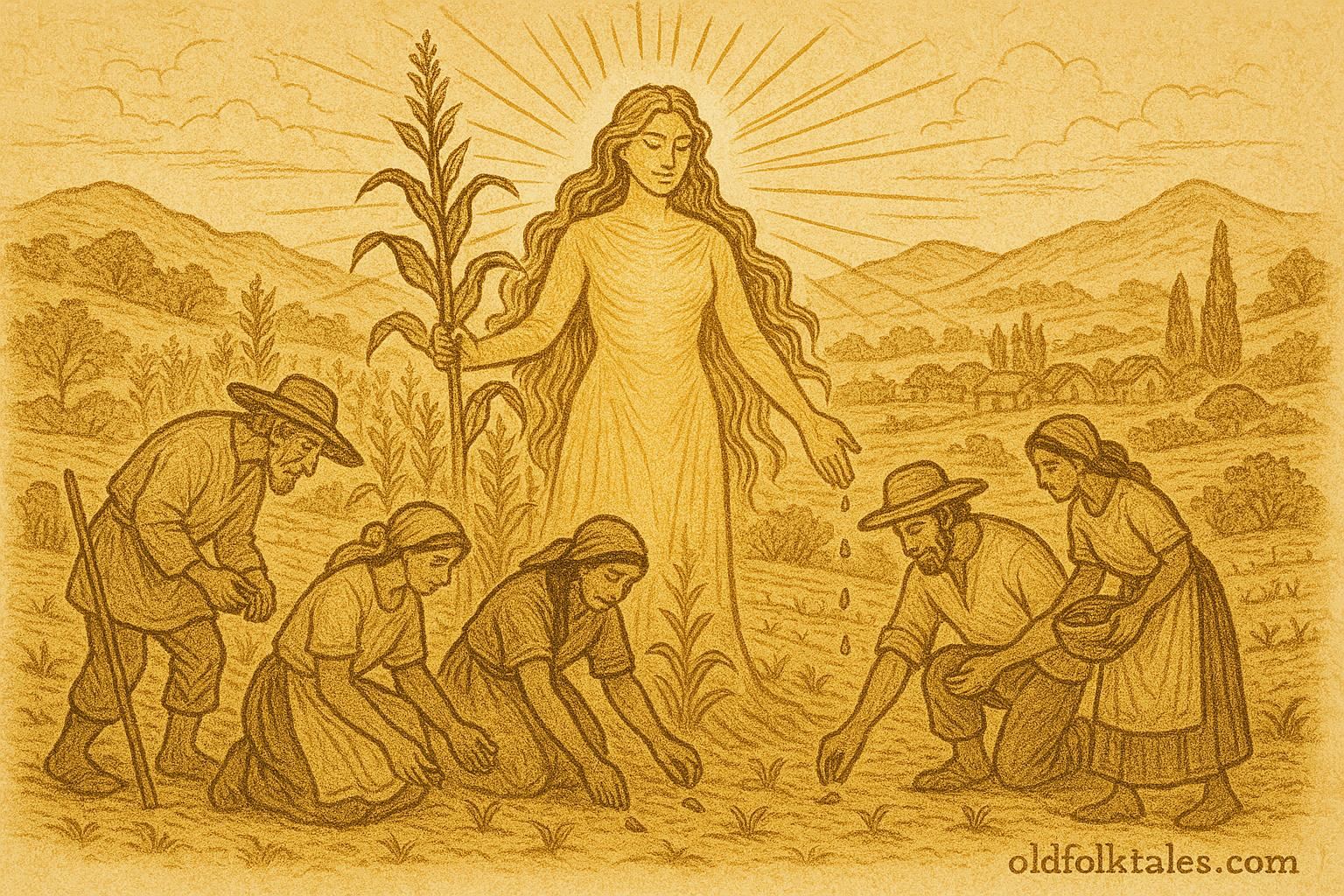
From the high peaks where the clouds met the sun, a young woman appeared. Her skin glowed with the warmth of ripe maize; her hair shimmered like silk tassels in the wind. She walked barefoot down the mountainside, her steps leaving trails of green that sprouted tiny shoots wherever she passed. The villagers, seeing her approach, fell silent in awe. Some thought she was a goddess. Others whispered that she was a spirit sent to test their hearts.
When she reached the village, she smiled and spoke softly:
“I have come to bring you a gift from the earth and the sky. But first, you must learn to honor both.”
She taught them how to prepare the soil, how to loosen it with stones and shape it into rows that welcomed the sun. From her woven pouch, she drew a handful of golden kernels. Each one shone with a faint light, as though it contained the heart of the sun itself.
“These are seeds of life,” she said. “Plant them with care. Sing to the earth as you work, for she listens to the songs of her children.”
The villagers did as she told them. They cleared the fields with reverence and planted the kernels, singing from dawn until dusk. The young woman sang with them, her voice clear as birdsong, rising and falling with the rhythm of the wind. Days turned into weeks, and from the dark earth, slender green shoots began to rise.
The people watched in amazement. They tended the plants as though they were their own children. The young woman showed them when to water, when to rest, and how to read the clouds for signs of rain. She told them that corn was more than food, it was a bridge between earth and sky, the nourishment of both body and spirit.
When the first harvest came, the hills turned golden. The villagers gathered the ears of corn with laughter and tears of joy. They roasted the kernels, ground them into masa, and shaped their first tamales. Never had food tasted so rich, so full of life. They wanted to thank the woman who had changed their fate, but when they turned to find her, she was gone.
They searched the fields and mountains, calling her name. The only answer was the soft rustle of the corn leaves in the wind. That night, one elder dreamed of her. In his dream, she stood at the edge of a glowing field and said,
“Do not weep for me. I have not left you. I am the corn itself. Each seed you plant is a part of me. When you harvest, remember that the gift must be shared, and the earth must be honored.”
From that day forward, the villagers called her Madre del Maíz, the Corn Mother. Each year, before the harvest, they prepared offerings of tamales, flowers, and fresh ears of maize. They left them at the edge of the fields, singing the songs she had taught them. The fields would sway gently as though bowing to the music, and the people knew that their prayers had been heard.
Generations passed, and the story of the Corn Mother became the heart of the people’s faith and farming. Parents told their children that corn carried the spirit of the divine woman who gave them life. Farmers still sang to the soil, and during times of drought, they prayed for her return in the rains.
In every golden field, in every warm tortilla and sweet tamal, the people saw her reflection, patient, nurturing, eternal. They understood that abundance was not just in the harvest but in gratitude, respect, and balance with the earth that sustains all life.
Moral Lesson
The story of The Corn Mother teaches lessons on gratitude, balance, and reverence for the earth. It reminds us that true nourishment comes not only from what we grow, but from the respect we show to nature and to the cycles that sustain life.
Knowledge Check
1. Who was the Corn Mother, and what did she bring to the people?
She was a radiant spirit sent by the gods who brought corn, teaching people how to cultivate and honor the earth.
2. What did the Corn Mother teach the villagers besides planting?
She taught them to sing to the earth, to respect its rhythms, and to live in harmony with nature.
3. What happened after the first harvest?
The Corn Mother vanished into the cornfields, becoming one with the maize and leaving her spirit in every seed.
4. Why do villagers still offer tamales and flowers at harvest time?
They make offerings to honor the Corn Mother’s gift and to give thanks for the spirit of abundance she left behind.
5. What does corn symbolize in this story?
Corn represents life, nourishment, divine connection, and the sacred balance between humans and the natural world.
6. From which regions and traditions does this folktale originate?
The story originates from the highlands of Oaxaca and Chiapas in Mexico, rooted in Zapotec and Mixe Indigenous mythology.
Cultural Origin: Mexico (Zapotec and Mixe rural myth)
Source: Adapted from Mexican Folk Tales by Américo Paredes (Smithsonian Collection) and Folktales of Mexico by Neil Philip.