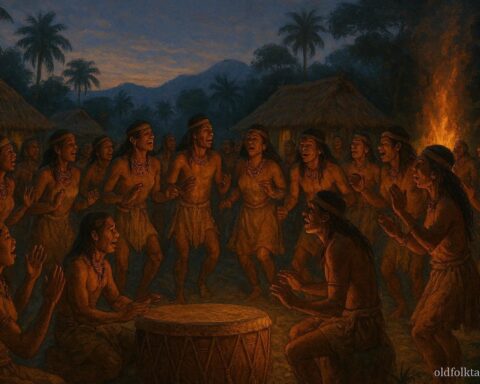
Long ago, in the lush green valleys between the mountains of the Maya lands, there stood a small village surrounded by rivers that once shimmered like silver in the sun. The people there lived in harmony with the earth. They planted maize, beans, and squash, the three sacred sisters, and gave thanks to the gods with offerings of copal smoke and song. But one year, the rains ceased to fall.
The sky grew silent and pale. The fields turned to dust, and the rivers shrank into cracked beds of stone. The maize wilted, its golden stalks turning brittle and gray. Hunger came, and with it despair. Children cried for food, and the elders prayed each dawn to the spirits of rain and earth, but the clouds did not answer.
Among the villagers lived a poor boy named Ahkin, whose parents had died the previous year. He survived by gathering roots and wild berries, and though his stomach was often empty, his heart was full of faith. Each night he prayed before the hearth, whispering to the spirit of the maize:
“Mother of life, do not forget your children. Show us the way.”
One night, as he slept near the dying embers, a dream came to him. In the dream, a gentle voice called his name, and before him appeared a radiant woman made of light and golden grain. Her hair flowed like silk corn husks, and her skin gleamed with the color of ripe maize.
“I am Ix’kanil, the Corn Mother,” she said softly. “The people have forgotten the sacred ways, how to thank the earth before taking its gifts. Go to the hills of the east. There, a cave waits beneath a ceiba tree. Bring no tools, only your faith.”
When Ahkin awoke, the stars still glittered overhead. The voice lingered in his mind like music carried on the wind. Though the others doubted him, he gathered his courage and began his journey toward the eastern hills.
He walked for days, barefoot through thorn and stone. When thirst burned his throat, he prayed to the Rain God, Chaac, and drops of dew appeared upon the leaves. When hunger gnawed at his belly, he thanked the forest and found fruit to eat. Finally, as dawn rose red and gold over the horizon, he came to the great ceiba tree, whose roots coiled like serpents over the earth.
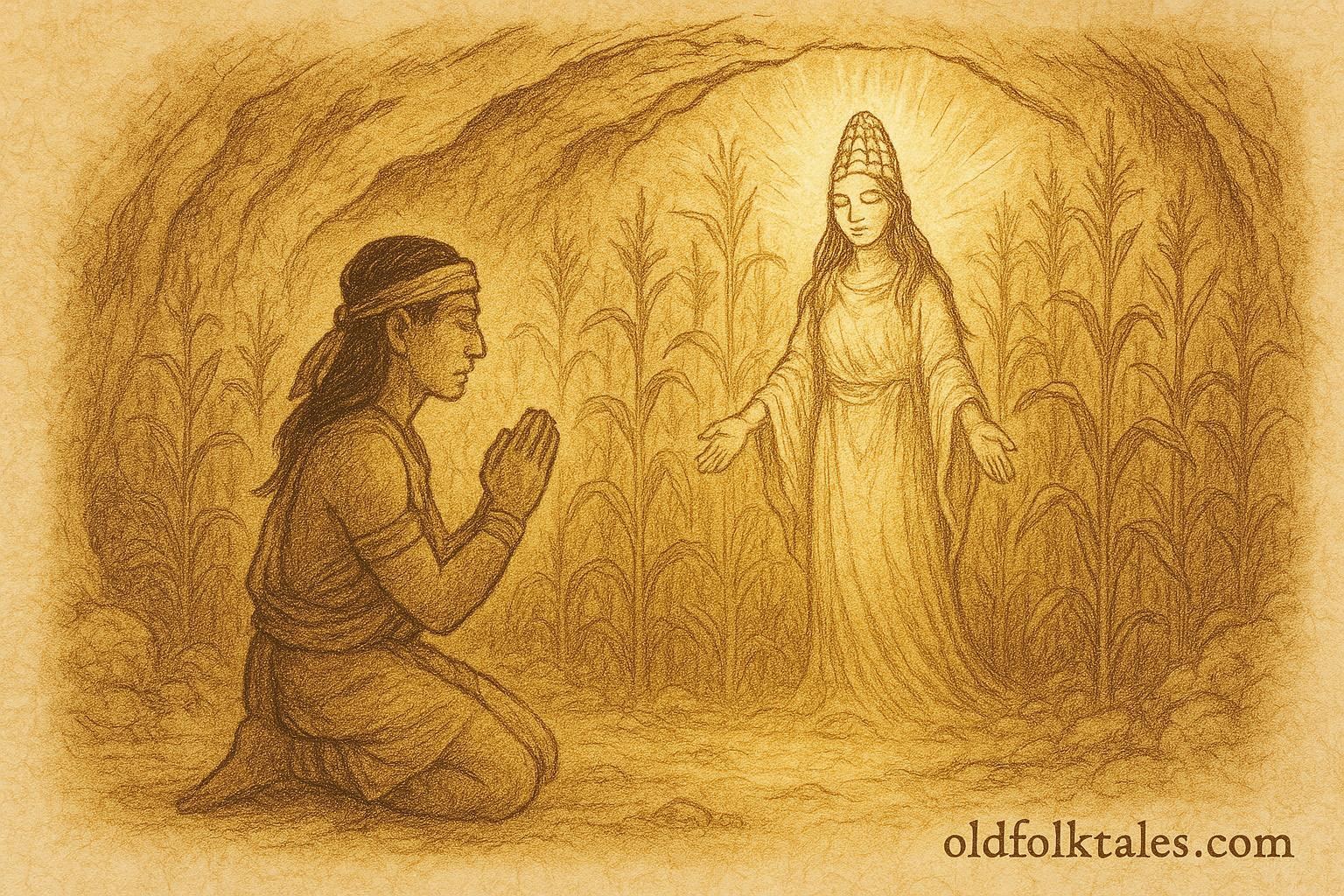
Beneath its roots lay the entrance to a hidden cave, just as the Corn Mother had promised. Inside, the air shimmered with a sacred light, and the scent of earth and flowers filled the air.
There she stood again, the Corn Mother, her presence radiant and serene. Around her grew living stalks of maize, glowing like torches in the darkness.
“Ahkin,” she said, “you have shown faith where others showed fear. I will teach you the secret of life’s renewal. Take these three kernels of maize, white, yellow, and red, and plant them with reverence. Sing to the earth, feed it with your heart, and it will feed your people.”
The boy knelt, overwhelmed by her grace. “But Mother,” he asked, “how will I know the right song?”
“The song is in your breath,” she smiled. “It is the sound of gratitude. Sing it, and I shall be near.”
With that, the Corn Mother vanished into a shower of golden dust, and the cave dimmed until only the glow of the three kernels remained in Ahkin’s hand.
He returned home and told the villagers what he had seen. Some laughed; others scoffed at a child’s dream. But the elders, remembering the old stories, nodded with solemn eyes. Together, they followed Ahkin to a patch of dry earth where he knelt and pressed the three sacred seeds into the soil.
He sang, not a grand song, but a humble melody of hope and thanks. The people watched in silence as he watered the seeds with the few drops left from the village’s last gourd.
Days passed. Then one morning, as the sun rose over the eastern hills, a miracle appeared. From the barren soil sprouted three strong green shoots. They grew and grew until the field shimmered with maize once again, golden and tall, whispering in the wind.
The people rejoiced, for the famine was over. They harvested the maize, grinding it into masa and baking it into warm tortillas. Each meal began with a prayer of thanks:
“To the Corn Mother, who gave her heart that we might live.”
Ahkin became known throughout the land as the Keeper of the Maize Song. He taught others to plant with reverence, to sing to the earth, and to offer gratitude for each grain harvested.
In time, the village flourished, and the people built a small shrine near the ceiba tree where Ahkin had first found the Corn Mother. To this day, the Maya tell the story of the boy who followed his dream and brought life back to his people, a story of faith, humility, and the sacred bond between humans and the earth.
Moral of the Story
True gratitude gives life. When humans remember to honor the earth and give thanks for its gifts, abundance returns. Faith and humility can restore balance even in the hardest of times.
Knowledge Check
- Who is the Corn Mother in Maya mythology?
The Corn Mother, or Ix’kanil, is a divine spirit representing maize, fertility, and the nurturing power of the earth in Maya folklore. - What did the boy Ahkin learn from the Corn Mother?
She taught him to plant maize with reverence and gratitude, restoring abundance to his famine-stricken village. - What is the main moral of “The Corn Mother’s Gift”?
The story teaches that faith, humility, and gratitude toward nature bring renewal and sustenance. - What do the three maize kernels symbolize?
The white, yellow, and red kernels symbolize life, diversity, and the sacred unity between humans and the earth. - How does the story reflect Maya agricultural beliefs?
It mirrors the traditional Maya reverence for maize as the source of life, linking human survival to spiritual respect for the land. - From which cultural tradition does “The Corn Mother’s Gift” originate?
The tale comes from the K’iche’ and Yucatec Maya peoples of Mexico and Guatemala.
Source: Adapted from Legends of the Maya by Adrián Recinos & Delia Goetz (1950)
Cultural Origin: K’iche’ and Yucatec Maya – Mexico and Guatemala