Long before the sun rose upon the fifth age of the world, when the gods still walked among mortals and the stars sang across the firmament, there lived a young goddess of the heavens named Mayahuel.
Her beauty was radiant like the morning star. Her laughter, they said, rippled through the sky like the sound of water over smooth stone. She dwelled among the celestial beings, her grandmother among the tzitzimime, the star demons who shone in the night sky but harbored envy toward the earth below.
For though they sparkled in heaven’s dark mantle, they could not taste the sweetness of the world, the warmth of sunlight, the perfume of flowers, the joy of human song.
Mayahuel, gentle and curious, would look down upon the land and watch the people build fires and sing to the gods. Her heart stirred with longing. “They are so small,” she whispered to herself, “and yet they love so greatly. I wish to walk among them, if only once.”
The Descent with Quetzalcóatl
It was then that Quetzalcóatl, the Feathered Serpent, god of wind, wisdom, and creation, looked upon Mayahuel and heard her yearning. His eyes, bright as jade and kind as rain, met hers across the expanse of stars.
“Come with me,” he said softly. “Descend to the earth, and together we shall bring joy and comfort to humankind.”
So Mayahuel, trusting his voice, took his hand. Wrapped in a whirlwind of feathers and starlight, they descended to the world below, landing among the quiet hills where agaves grew wild and the wind whispered through cactus and rock.
There, they found refuge in the branches of a tall tree, whose twin limbs twined together like lovers embracing. The goddess and the serpent took form as two slender vines curling around those branches, hidden from the eyes of the heavens.
But their union did not go unnoticed.
The Wrath of the Star Demons
Mayahuel’s grandmother, the fierce leader of the tzitzimime, looked down from the celestial darkness and discovered her granddaughter missing. Her fury blazed like a comet’s tail.
“She has betrayed her kin!” the demon cried. “She has gone to the world of mortals, to defile herself with love!”
Summoning the other star demons, she tore through the skies like a storm of fire, searching the earth below. The tree that sheltered Mayahuel and Quetzalcóatl trembled as their shadows passed over it.
“Hide,” whispered Quetzalcóatl. “Be still, beloved.”
But the grandmother’s power was great. She saw the intertwined vines and struck the tree apart with her claws. In that violent moment, Mayahuel’s body was torn from Quetzalcóatl’s, and she fell to the earth, lifeless.
The tzitzimime seized her remains, scattering them upon the ground, then vanished back to the stars, leaving the Feathered Serpent weeping among the broken branches.
The Birth of the Maguey Plant
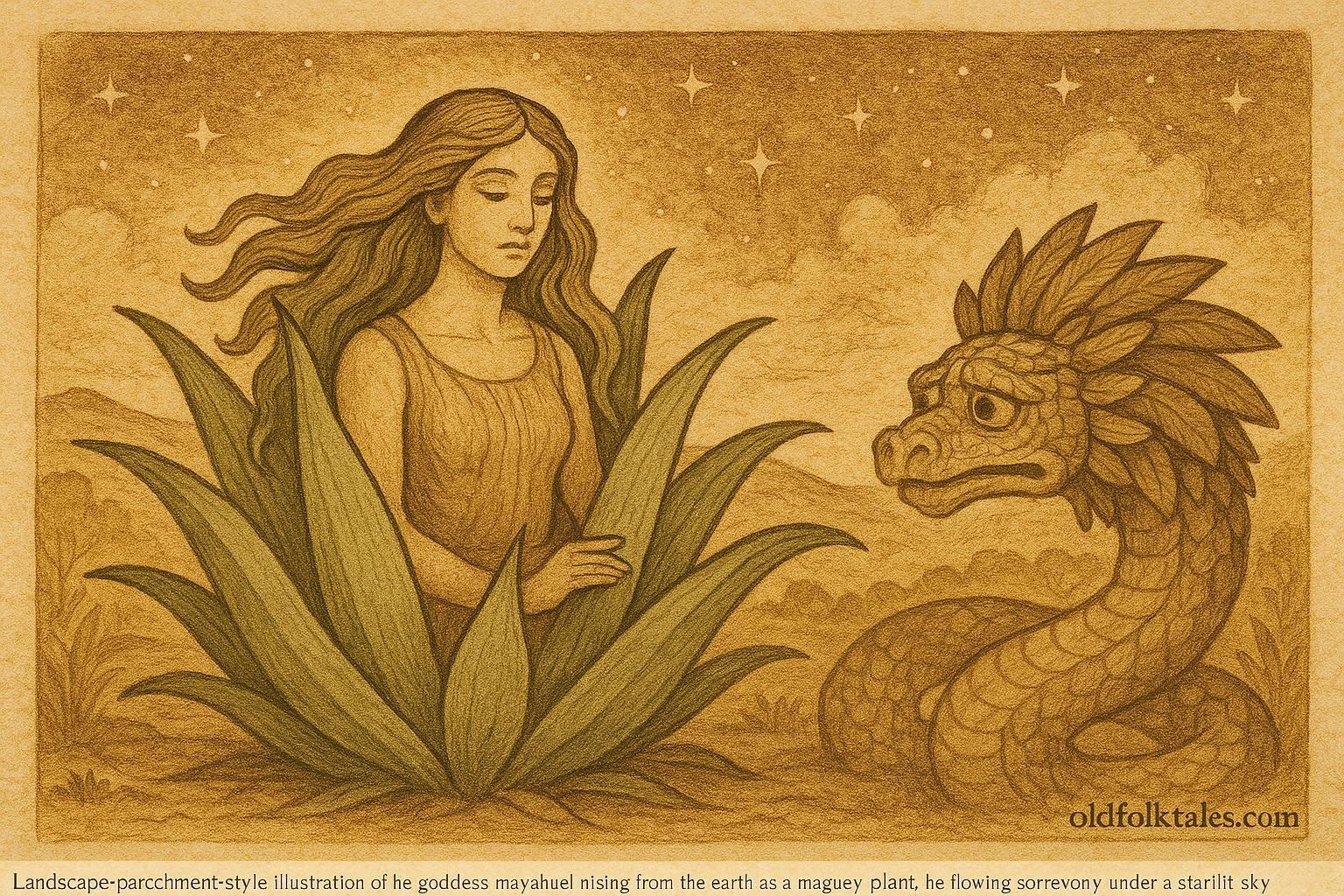
For many nights, Quetzalcóatl mourned, his tears soaking the soil where Mayahuel had fallen. He sang to her spirit, his voice moving through the valleys like the breath of the wind. The earth, listening to his sorrow, softened in compassion.
From the place where her body had rested, a new plant began to grow, long green leaves rising from the soil, their tips edged with silver spines, their hearts filled with sweet white sap.
It was the maguey, sacred gift of Mayahuel.
When the wind rustled its leaves, it sounded like her laughter once again.
Quetzalcóatl understood the meaning of this miracle. “You have not died, beloved,” he said. “You have transformed, your spirit now feeds the earth, and through your gift, the people shall rejoice.”
He gathered the sap that flowed from the maguey’s heart and offered it to humankind. When they drank it, they felt warmth and courage, and their hearts lifted in song.
“This is octli,” he told them, the divine nectar that brings communion between gods and mortals. In later ages, it came to be called pulque, the sacred drink of life, fertility, and celebration.
The Sacred Drink of Communion
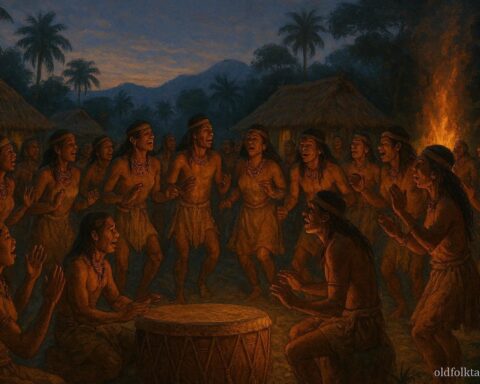
The people honored the maguey as a holy mother, her body both nourishment and symbol of sacrifice. They made offerings of flowers and sang to her at festivals, thanking her for the drink that healed sorrow and joined families in laughter.
Priests taught that Mayahuel’s spirit lived within every cup of pulque. When the white foam rose to the surface, it was her breath; when the sweet taste filled the mouth, it was her love.
Yet they also warned: the drink was divine, a bridge, not a toy. Those who consumed it with reverence found joy and strength; those who drank with greed or disrespect invited madness and shame.
In every ritual, before the first sip was taken, a small portion was poured to the ground, “For the Earth, for Mayahuel,” they said, returning a part of her gift to the soil from which it came.
The Goddess in the Sky
When Quetzalcóatl finally ascended once more to the heavens, he looked down upon the maguey fields, their leaves gleaming under the moonlight. He saw that humankind had learned gratitude, that through loss, they had discovered communion.
He took his flute and played a song for Mayahuel, and the stars shone more gently that night. The tzitzimime, hearing the melody, wept in remorse, for they saw that the maiden’s love had brought beauty even out of destruction.
And so, in the sky, Mayahuel was set among the constellations, her spirit eternally young, watching over the fields that bear her name.
When the people harvest the maguey, they still whisper her story:
“From love came sacrifice, from sacrifice came life, and from life came joy.”
Moral Lesson
The legend of Mayahuel teaches that true love transforms even death into renewal. What is given in devotion is never lost; it changes form, nourishing those who remain. Her story is a reminder of the sacred cycle, that life and loss, sorrow and celebration, are threads of the same divine fabric.Through Mayahuel’s gift, the maguey became a living symbol of humility, fertility, and gratitude, the eternal bond between the heavens and the earth.
Knowledge Check
- Who is Mayahuel in Aztec mythology?
Mayahuel is the Aztec goddess of the maguey plant and pulque, representing fertility, nourishment, and divine transformation. - What is the maguey plant’s symbolic meaning?
It symbolizes life born from sacrifice,a sacred bridge between gods and humans through the pulque it produces. - Why did Mayahuel descend from heaven?
She followed Quetzalcóatl to the earth to bring joy and love to humankind, defying her celestial guardians. - What caused Mayahuel’s death?
Her grandmother, leader of the star demons (tzitzimime), killed her for betraying the heavens by loving a god of the earth. - How did pulque originate according to this legend?
It emerged from the sap of the maguey plant that grew from Mayahuel’s body,a divine gift of nourishment and joy. - What is the moral of the story of Mayahuel and the maguey?
Love and sacrifice create lasting blessings; through death and devotion, new life and connection are born.
Source: Florentine Codex, Book XI, “Earthly Things,” by Fray Bernardino de Sahagún (1577).
Cultural Origin: Aztec (Mexica) — Central Mexico.