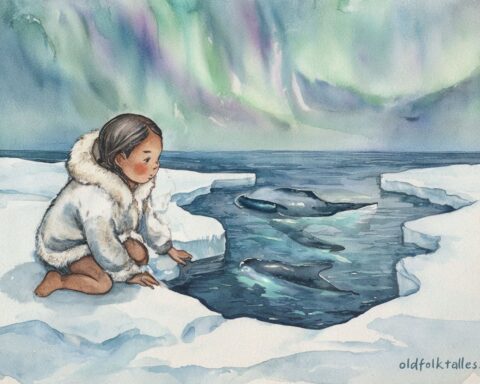
In the beginning, when the world was still young and the sky had no stars, the Inuit people lived beneath a long, endless twilight. The sea shimmered in pale light, and the ice stretched far into the horizon. Every day was the same, without night or dawn, and the people lived in quiet balance with the spirits of the earth.
Among them was a young woman named Silla, known for her gentleness and her wisdom. She moved through the village like the wind, calm and steady, helping the elders gather food and tending to the children when storms howled through the ice fields. Her laughter was said to bring warmth to even the coldest day.
Silla had an older brother named Aningan. He was strong, skilled, and brave, a hunter whose arrows never missed and whose courage was praised in every gathering. The two were close, sharing everything food, stories, and dreams. But as the years passed, Aningan’s pride grew. He began to boast that his strength alone kept their people alive, forgetting that it was Silla’s kindness that kept peace among them.
One winter, as the wind howled through the cliffs, a great hunger came upon the land. The seals vanished beneath the ice, and the whales stayed far from shore. The hunters returned with empty hands, and the children cried through the night.
Explore the ancestral legends of Canada, Mesoamerica, and South America’s Indigenous tribes.
The people turned to Aningan, saying, “You are the mightiest among us. Go to the edge of the world and ask the spirits why they have turned their backs.”
Aningan agreed. He took his kayak and his spear and set out across the frozen sea. For many days he traveled, until the horizon melted into a wall of mist. Within that mist, he found a cave glowing with light. Inside sat the ancient spirit of the moon, pale and luminous, surrounded by pools of frozen tears.
The moon spirit spoke, its voice echoing like wind through snow. “You come seeking food, yet your people have forgotten gratitude. The sea grows weary of giving when no one offers thanks.”
Aningan bowed his head but said nothing. Instead, he thought to himself, If I could capture this light, my people would honor me above all others.
The moon spirit saw his thought and sighed. “Pride will blind you, young hunter. Take care, for light belongs to all, not one.”
But Aningan ignored the warning. He dipped his spear into the pools of frozen tears, stealing a shard of the moon’s light, and carried it home wrapped in sealskin. When he returned, the village rejoiced, for wherever the shard shone, warmth followed. The people hailed Aningan as savior, praising his courage and cleverness.
Only Silla saw the sorrow in his eyes. “Brother,” she said softly, “you took what was not yours. Light cannot be stolen without cost.”
Aningan turned away. “You speak like the elders, sister. Always warning, never daring. Without me, the people would have starved.”
That night, a strange glow filled the village. The shard of light began to grow, brighter and brighter, until it burned through the sealskin that held it. It rose into the sky, calling softly, and Aningan felt its pull. He tried to hide it, but the light followed him wherever he went, whispering his name.
Silla went to him once more. “Brother, you must return what you took. The spirits do not forget.”
Aningan’s pride faltered. “If I return it, what will become of my honor?”
Silla placed her hand on his shoulder. “Honor is not in what others say of you, but in what truth remains when the light fades.”
But Aningan refused. In his fear, he fled across the tundra, the glowing light chasing him like a spirit of flame. Silla followed, calling his name through the snow. The wind howled, the ice cracked, and the sky itself began to open.
As Aningan stumbled, the light rose higher, swirling above him like a living being. “You cannot keep what belongs to the heavens,” it said. Then, in a flash, it drew Aningan upward. Silla cried out and ran to catch him, but the light pulled her too. Together they rose into the sky, one chasing the other across the vast dark.
From that night onward, the people saw two shapes moving through the heavens. The first was bright and radiant, the Moon, who wanders endlessly, searching for his sister. The second was gentler, glowing softly, the Woman Who Became the Moonlight, who guides the lost and watches over the sleeping earth.
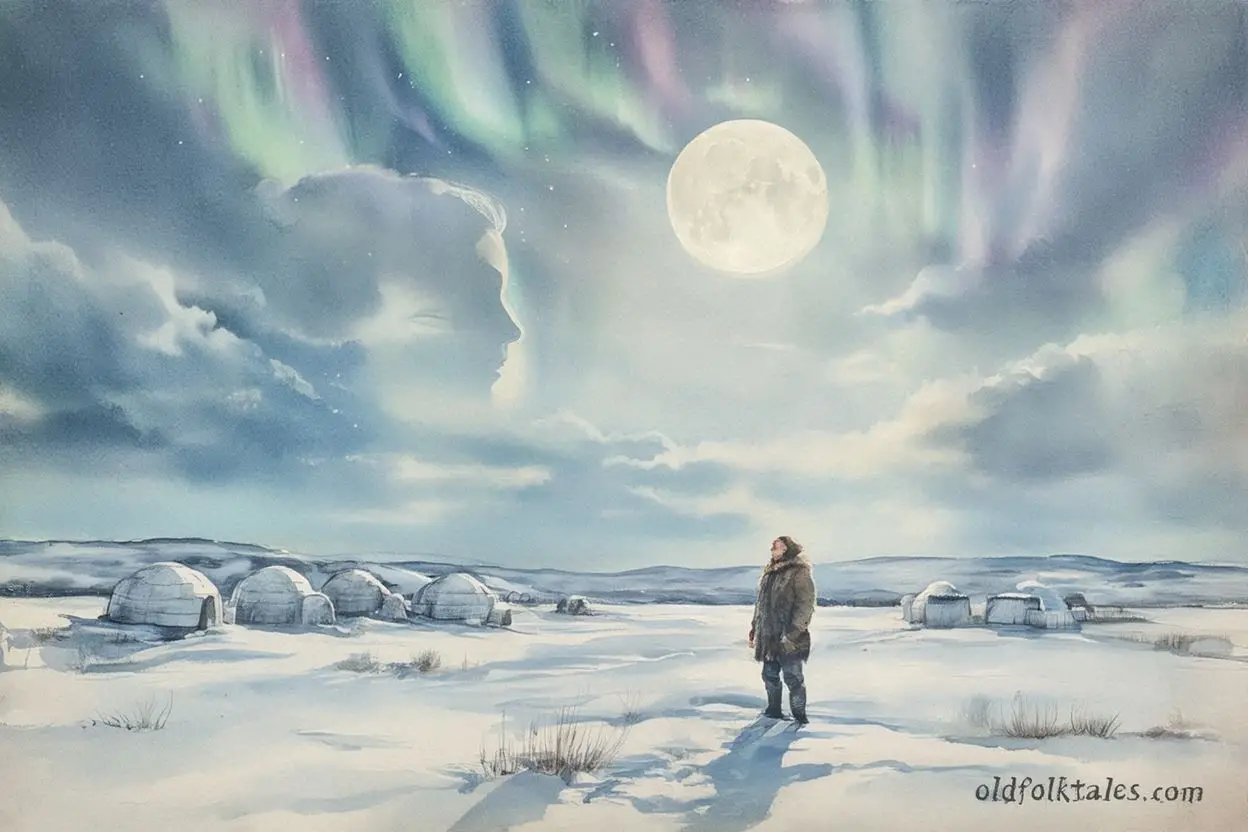
In the stillness of the Arctic night, her face can be seen in the round of the moon, calm and luminous. When the moon grows full, the Inuit say that is when Silla forgives her brother once more, shining her light upon the world below.
Aningan still chases her, night after night, across the sky. Sometimes he grows tired, and the moon fades. Then Silla rests, and darkness fills the land. But when he draws near again, her light returns, reminding the people that forgiveness and love are the truest forms of light.
Through generations, the story of Silla and Aningan was told around the lamps, teaching that even the proud may find redemption, and even the wronged may show mercy. And so, when the northern lights dance, the people remember the moment when the sister and brother rose into the sky, their love turned into eternal light.
Moral Lesson
True honor does not come from pride or power, but from kindness, humility, and forgiveness. The light of the soul shines brightest when it is shared, not taken.
Knowledge Check
1. Who are the main characters in the story?
Silla, a gentle woman of wisdom, and her brother Aningan, a proud and brave hunter.
2. Why did Aningan go on a journey?
He went to find out why the sea spirits had stopped providing food for the people.
3. What did Aningan take from the moon spirit?
He stole a shard of moonlight, hoping to bring warmth and honor to his people.
4. What happened when Aningan refused to return the light?
The light grew stronger, chased him, and eventually carried both him and Silla into the sky.
5. What do the Inuit say about the moon and moonlight today?
They believe the moon is Aningan chasing his sister Silla, whose light brings peace to the world.
6. What message does the story teach about pride?
That pride can blind a person, while humility and forgiveness bring lasting harmony.
Source: Adapted from Inuit oral traditions in Echoes of the Sky Spirits by Kalla Pitsiulak (1972), Nunavut: Polar Mythic Archives.
Cultural Origin: Inuit (Northern Canada and Greenland)