Once, in the time when animals still spoke the language of men and walked the mountain paths as neighbors, there lived a fox named Atuq in the high valleys of the Andes. Atuq was known throughout the region for two things: his insatiable appetite and his cunning nature. His belly was always empty, and his mind was always scheming about how to fill it, usually at someone else’s expense.
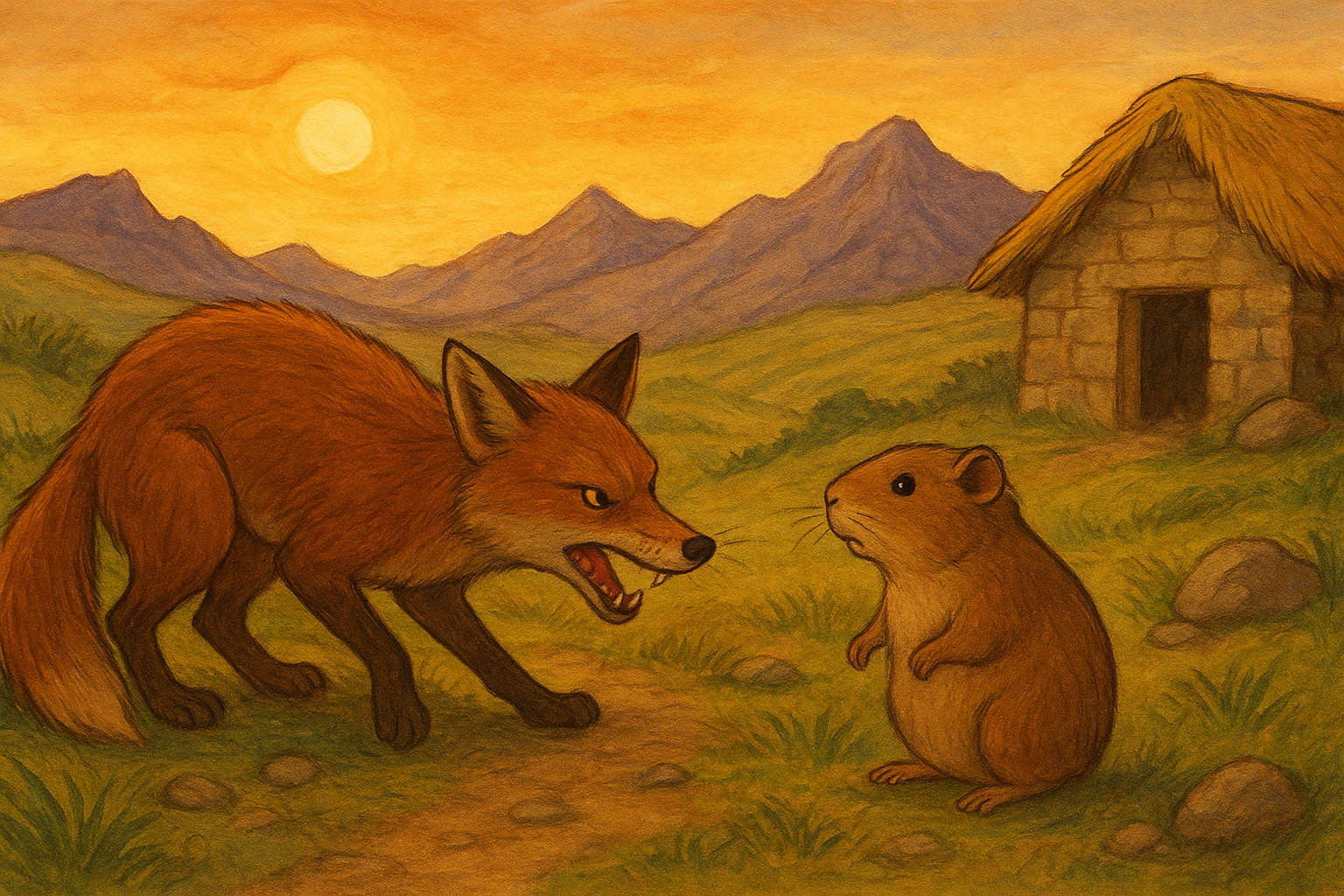
One day, as Atuq prowled along a rocky trail searching for his next meal, he came upon Cuy, the guinea pig. Now Cuy was small, barely larger than a man’s fist, with soft brown fur and bright, intelligent eyes that missed nothing. He was gathering seeds near his burrow when the fox’s shadow fell across him.
Click to read all Andean Highland Folktales — echoing from the mountain peaks of Peru, Bolivia, and Ecuador.
“Ah, my dear friend Cuy!” Atuq called out, his voice dripping with false warmth like honey from a broken jar. “How fortunate to find you here! I have wonderful news, I know where we can get a fat chicken for dinner. We shall share it, you and I, as true companions should.”
Cuy stopped his work and looked up at the fox with those keen eyes. He had heard many stories about Atuq’s “generosity” from other animals stories that always ended with the fox’s belly full and his “friends” left with nothing but regrets. The guinea pig’s whiskers twitched thoughtfully.
“A fat chicken?” Cuy asked, keeping his voice innocent and eager. “That sounds wonderful, Atuq! Where is this chicken?”
The fox’s eyes gleamed with satisfaction. The foolish guinea pig was falling right into his trap. “In the farmer’s house at the edge of the valley,” Atuq said. “But we must be clever about it. I’m too large to sneak inside without being seen, so you shall go in and steal it while I wait outside. Then we’ll feast together in my den. What do you say, little friend?”
Cuy pretended to consider this, scratching behind his ear with one tiny paw. “Very well,” he agreed finally. “It seems like a fair plan. Lead the way!”
The fox could barely contain his glee as they made their way down the mountain path toward the farmer’s house. Already he was imagining how delicious the plump guinea pig would taste alongside the chicken or perhaps instead of the chicken, if it came to that. After all, why share when you could have everything for yourself?
When they reached the farmer’s house, a sturdy stone building with a thatched roof, Atuq positioned himself behind a large rock where he could watch without being seen. “Go on now,” he whispered to Cuy. “Be quick about it, and don’t eat any without me!”
“Of course not,” Cuy replied solemnly. “Wait here.”
But the clever guinea pig had no intention of stealing anything for the greedy fox. Instead, he scurried up to the farmer’s window and let out a series of loud, urgent squeaks. The farmer, who was just sitting down to his evening meal, came to the window in confusion.
“What’s this?” the farmer muttered, peering out.
Cuy darted back and forth, squeaking frantically and gesturing with his small body toward the rock where Atuq was hiding. “The fox!” his movements seemed to say. “The fox is waiting to eat your hens!”
The farmer understood immediately. He grabbed a thick wooden stick from beside his door and stormed outside, his face red with anger. “You thieving fox!” he bellowed. “I’ve lost three hens this month already! Come out from behind that rock!”
Atuq barely had time to register what was happening before the farmer was upon him, stick raised high. With a yelp of terror, the fox bolted from his hiding place and ran as fast as his legs could carry him, the farmer’s curses and the whistling of the stick following him down the path.
Meanwhile, Cuy slipped through the open door of the farmhouse. The farmer’s wife, who had seen what the brave little guinea pig had done, smiled and placed a generous portion of their dinner on the floor for him—roasted potatoes, fresh corn, and yes, even some pieces of chicken. Cuy ate his fill, his tiny belly growing round with satisfaction, then bowed politely to the farmer’s wife before departing.
Days passed, and Atuq nursed his bruises and his wounded pride. He had been made a fool by a creature no bigger than his paw! The humiliation burned worse than the farmer’s stick. But more than anything, he wanted revenge.
One afternoon, Atuq found Cuy near the riverbank, drinking from the clear mountain water. The fox’s lips pulled back in a snarl of triumph. “Ah, little traitor,” he growled, blocking the guinea pig’s escape route. “Did you think I wouldn’t find you? Did you think you could trick Atuq the fox and live to boast about it? Now you’ll pay for your cleverness!”
Cuy’s heart raced, but his mind raced faster. The river rushed past them, swift and cold with snowmelt from the peaks above. An idea formed.
“Wait!” Cuy cried, his voice trembling though whether with fear or suppressed laughter, the fox couldn’t tell. “Before you eat me, you should know you’re about to miss the greatest opportunity of your life!”
The fox paused, suspicious but curious despite himself. “What are you babbling about?”
“The river god!” Cuy exclaimed, pointing toward the water with one paw. “He’s passing through today, and he’s throwing gold coins into the water for any creature brave enough to dive down and collect them. I was just about to jump in when you arrived. But if you eat me now, you’ll never know the riches you could have had!”
Atuq’s ears pricked forward. Gold? His mind filled with visions of treasure, of never having to scheme for his meals again. “Gold, you say? How much gold?”
“More than you could carry!” Cuy assured him earnestly. “The riverbed is covered with it bright, shining gold coins! But you must hurry. The river god won’t stay long, and once he’s gone, the current will wash all the gold away downstream.”
The fox looked at the rushing water, then back at the guinea pig, then at the water again. His greedy nature warred with his suspicious one, but greed, as it always did with Atuq, won.
“If you’re lying…” the fox growled.
“I’m not lying!” Cuy insisted. “Look I’ll even show you!” And with that, the clever guinea pig picked up a flat, golden-colored pebble from the shore and tossed it into the water, where it glinted in the sunlight before sinking. “See? There’s one now!”
That was all the proof Atuq needed. With a great leap, he launched himself into the river, his jaws open to catch the “gold coins” he was certain filled the water below.
The current seized him immediately. The river, swollen with spring melt, was far stronger than the fox had realized. He thrashed and struggled, but the water pulled him under, spinning him like a leaf, carrying him away downstream faster than he could swim. His cries for help were swallowed by the roar of the rapids.
Cuy watched from the safety of the shore as the fox disappeared around the bend, swept away by his own greed. The guinea pig sat back on his haunches and cleaned his whiskers with his paws, quite satisfied with the morning’s work.
“So it is said,” he murmured to himself, “the guinea pig may be small, but his wit feeds him better than the fox’s teeth ever could.”
And from that day forward, whenever the animals of the Andes told stories around their fires, they would speak of clever Cuy who outsmarted greedy Atuq not once but twice. The tale became a favorite among the Quechua people, who knew well that in the harsh mountain environment, intelligence and quick thinking were worth far more than size or strength.
As for Atuq? Some say he survived his journey down the river and crawled out many valleys away, wiser but no less hungry. Others say he’s still searching the riverbeds for the river god’s gold. But everyone agrees on one thing: he never bothered Cuy the guinea pig again.
Discover the sacred tales of llamas, condors, and gods who guard the Andes
The Moral of the Story
This delightful trickster tale teaches us that intelligence and quick thinking can overcome brute strength and greed. Cuy the guinea pig, though physically small and vulnerable, survives through his cleverness and ability to turn his opponent’s own vices against him. The story shows that Atuq’s downfall came not from Cuy’s strength, but from the fox’s own character flaws his greed, his dishonesty, and his willingness to believe what he wanted to be true rather than thinking critically. The tale reminds us that those who live by deception and greed will eventually be deceived themselves, and that wit, honesty, and resourcefulness are more valuable than size or power. In the challenging environment of the Andes, where survival often depends on cleverness rather than force, this lesson held particular importance for the Quechua people.
Knowledge Check
Q1: What are the main character traits of Atuq the fox and Cuy the guinea pig?
A: Atuq the fox is greedy, cunning in a selfish way, and dishonest always scheming to fill his belly at others’ expense. Cuy the guinea pig is clever, quick-thinking, and resourceful, using his intelligence to protect himself and outwit those who would harm him.
Q2: How did Cuy escape the fox’s trap at the farmer’s house?
A: Instead of stealing the chicken as the fox expected, Cuy alerted the farmer to Atuq’s presence by squeaking and gesturing. The angry farmer chased the fox away with a stick, while Cuy was rewarded with a meal by the grateful farmer’s wife.
Q3: What lie did Cuy tell to escape when the fox cornered him by the river?
A: Cuy told the fox that the river god was passing through and throwing gold coins into the water for anyone brave enough to dive in and collect them. He even threw a golden-colored pebble into the water as “proof.”
Q4: What happened to Atuq when he jumped into the river?
A: The strong current of the mountain river, swollen with snowmelt, seized Atuq immediately and swept him away downstream. He was carried away by the rapids, unable to swim against the powerful flow.
Q5: Why is this story considered a “trickster tale” in Quechua folklore?
A: It’s a trickster tale because it features a clever, smaller character (Cuy) who uses wit and deception to outsmart a larger, more powerful antagonist (Atuq). The weak protagonist survives through intelligence rather than strength, which is a common trickster tale pattern.
Q6: What cultural significance does the guinea pig have in Andean society?
A: Guinea pigs (cuy) are both an important food source and cultural symbol in Andean societies. In folklore, the cuy represents resourcefulness and intelligence qualities highly valued in the challenging highland environment where cleverness often mattered more than physical strength for survival.
Source: Adapted from Quechua oral traditions documented in M. Arguedas, Mitos, Leyendas y Cuentos del Perú (1949) and César Itier, Fábulas Quechuas del Perú (Quechua Fables of Peru, 2003).
Cultural Origin: Quechua peoples, Andean Highlands of Peru and Bolivia