Long before the great empire rose to dominate the Andes, before the terraced fields climbed the mountainsides like green staircases to heaven, before the stones of Sacsayhuamán were cut and fitted without mortar, there existed only wilderness rugged mountains, deep valleys, and scattered peoples who knew nothing of unity or destiny.
But the time had come for change. Deep within the earth, in the mysterious Cave of Pacaritambo, the “House of Dawn” a miracle was taking shape. This sacred cavern, nestled in the mountains south of what would become the greatest city of the Andes, was no ordinary cave. It was a womb of creation, a doorway between the divine world and the world of mortals.
Click to read all Andean Highland Folktales — echoing from the mountain peaks of Peru, Bolivia, and Ecuador.
From this cave emerged four brothers and four sisters, born not of human parents but fashioned by Viracocha himself, the great creator god who had shaped the world from the waters of Lake Titicaca. These were the Ayar siblings, chosen to bring civilization to the highlands and to establish a kingdom that would unite all peoples under one divine rule.
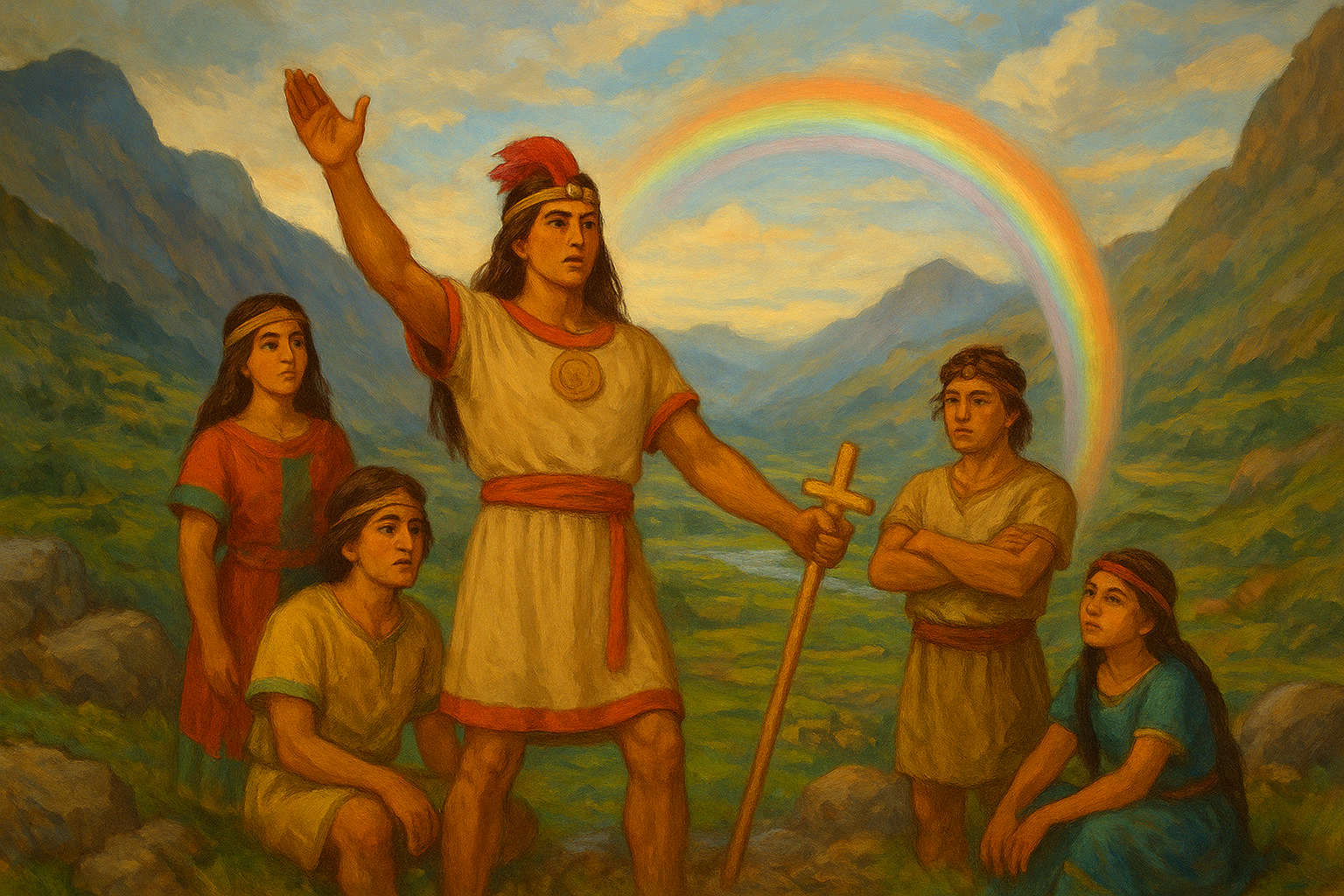
The eldest brother was Ayar Manco, wise beyond measure and strong in both body and spirit. His bearing was noble, his judgment sound, and his heart set firmly on the task Viracocha had given them. He carried with him Tapac-Yauri, the golden staff that would mark the place where their city should rise.
The second brother, Ayar Cachi, was mighty and fierce, possessed of supernatural strength that could split mountains and level hills with a single throw of his sling stones. But with this great power came great pride. He was boastful and mocking, quick to demonstrate his superiority and slow to show humility.
The third brother, Ayar Uchu, was devoted to the sacred rituals and ceremonies that connected the mortal world to the divine. He understood the language of offerings and prayers, the proper way to honor the gods and ensure their favor.
The fourth brother, Ayar Auca, was a warrior, bold and restless, always eager to prove his courage and expand their influence through conquest and dominance.
Beside each brother walked a sister Mama Ocllo, Mama Huaco, Mama Cora, and Mama Rahua women of equal divine origin, each contributing her own gifts of wisdom, strength, fertility, and vision to the sacred mission.
Together, these eight siblings set forth from the Cave of Pacaritambo, leading a small band of followers who had been drawn to their divine light. Their quest was clear: to find the fertile land where the sun would smile upon them most favorably, where the earth would yield abundant crops, and where they could establish the navel of the world, a capital city from which civilization would spread like ripples on a sacred lake.
The journey was long and arduous. They crossed rushing rivers swollen with snowmelt from the peaks. They climbed passes where the air grew thin and cold, where condors circled overhead like dark omens. They descended into valleys thick with vegetation and ascended again to plateaus where the wind sang mournful songs through the ichu grass.
But as they traveled, jealousy began to poison the brotherhood. Ayar Cachi’s supernatural strength made him arrogant and insufferable. He would demonstrate his power at every opportunity, hurling stones with such force that they carved new valleys into the mountainsides. He mocked his brothers, calling them weak and questioning why he should follow Ayar Manco’s leadership when his own strength was so obviously superior.
“I could flatten these mountains with my sling,” Ayar Cachi would boast. “I could divert these rivers with a gesture. Why should I defer to brothers who possess but a fraction of my power?”
The other brothers grew fearful. They saw how Ayar Cachi’s pride was growing, how his demonstrations of strength were becoming more violent and destructive. They worried that his arrogance would destroy their mission before it could be fulfilled, that he would seek to rule alone or, in his recklessness, would bring divine punishment upon them all.
In secret, they conspired together even noble Ayar Manco, though it pained him greatly. They devised a plan born of fear and justified by necessity, though history would long debate whether treachery in the name of a greater good could ever be truly righteous.
One evening, as they camped near a deep cave, Ayar Manco approached his powerful brother with false humility. “Brother Cachi,” he said, “we have left behind in the Cave of Pacaritambo certain sacred tools and ceremonial objects that we need for the founding of our city. Your strength is unmatched would you return and retrieve them for us? Only you have the power to make such a journey quickly.”
Ayar Cachi, flattered by the acknowledgment of his superiority and eager to demonstrate his abilities once more, agreed without suspicion. He entered the cave, descending deep into its darkness in search of the sacred objects that did not exist.
The moment he disappeared from sight, the remaining brothers sealed the cave entrance with an enormous rock so massive that even Ayar Cachi’s legendary strength could not move it. From deep within the earth came his cries of rage and betrayal, echoing through the mountain like thunder. His voice called out curses and accusations, but slowly, inexorably, those cries faded and ceased. The great Ayar Cachi, mightiest of the brothers, had been turned to stone, trapped forever in the darkness as punishment for his pride.
The remaining siblings continued their journey, though a shadow of guilt traveled with them. They crossed more valleys and climbed more peaks, always testing the earth with the golden staff Tapac-Yauri, searching for the place where it would sink into the fertile soil and refuse to be withdrawn.
At last, they reached the valley of Huanacauri, and there they witnessed a sign that made their hearts sing with recognition. A sacred rainbow arched across the sky, its colors more vivid and pure than any they had seen before, stretching from mountain to mountain like a bridge between earth and heaven. The light seemed to concentrate on one particular spot in the valley below a place where several streams converged and the soil was rich and dark.
Ayar Manco took up the golden staff and thrust it into the earth at that sacred spot. It sank smoothly, easily, as if the soil welcomed it like a long-lost friend. When he tried to pull it back out, it would not budge. The staff had taken root. The earth had claimed it. The sign was unmistakable.
“Here,” Ayar Manco proclaimed, his voice ringing with authority and relief, “shall rise our city. Here, in this blessed valley, we shall build Qosqo the navel of the world, the center from which our civilization shall spread to all corners of the four quarters of the earth.”
And so they began. Stone by stone, terrace by terrace, they built the city that would become Cusco, capital of the mightiest empire the Americas had ever known. Ayar Manco became Manco Cápac, the first Sapa Inca, the divine ruler whose lineage would stretch forward through generations of kings until the coming of the bearded strangers from across the sea would bring an end to that golden age.
The other Ayar brothers fulfilled their own destinies in the founding of the empire. Some say Ayar Uchu transformed into a sacred stone at Huanacauri, becoming an object of pilgrimage and worship. Others tell that Ayar Auca sprouted wings and flew to claim lands for the empire, turning to stone at the boundaries of their territory. Each brother, in his own way, became part of the sacred geography of the Inca world.
Even now, when the morning mist lifts over the valley of Cusco and the first rays of Inti the sun god touch the ancient stones, the people say the spirits of the Ayar brothers still guard the city. In the great fortresses, in the temple walls, in the very foundations of the empire they founded, their presence endures a reminder that from divine origins and through sacrifice and determination, great civilizations can rise.
The Cave of Pacaritambo remains a sacred site, honored by pilgrims who remember that from its darkness came the light of the Inca Empire and that within its depths, the mighty Ayar Cachi still sleeps in stone, a cautionary tale about the price of pride and the thin line between strength and arrogance.
Discover the sacred tales of llamas, condors, and gods who guard the Andes
The Moral of the Story
This foundational myth teaches us that great achievements require unity and that individual pride, no matter how justified by genuine ability, can threaten the success of collective missions. Ayar Cachi’s supernatural strength made him valuable, but his arrogance and lack of humility made him dangerous to the greater good. The story illustrates the difficult truth that sometimes leaders must make hard choices even morally questionable ones to protect their mission and their people. It also reminds us that every gift comes with responsibility, and that power without wisdom or humility leads to downfall. The founding of Cusco required not just strength but cooperation, sacrifice, and the ability to recognize and follow divine signs rather than personal ambition.
Knowledge Check
Q1: Who were the Ayar brothers and where did they come from?
A: The Ayar brothers were four divine siblings Ayar Manco, Ayar Cachi, Ayar Uchu, and Ayar Auca—created by the god Viracocha. They emerged from the Cave of Pacaritambo (the “House of Dawn”) along with four sisters, chosen to found a great kingdom.
Q2: What was Ayar Cachi’s special ability and fatal flaw?
A: Ayar Cachi possessed supernatural strength so great he could split mountains and level hills with his sling stones. His fatal flaw was his overwhelming pride and arrogance, he constantly boasted of his superiority and mocked his brothers, making him a threat to their mission.
Q3: How did the other brothers deal with Ayar Cachi’s pride?
A: Fearing his power and arrogance would destroy their mission, the brothers tricked Ayar Cachi into entering a cave under the pretense of retrieving sacred objects. Once inside, they sealed the entrance with an enormous rock, trapping him inside where he eventually turned to stone.
Q4: What was the golden staff Tapac-Yauri and what was its purpose?
A: Tapac-Yauri was a sacred golden staff carried by Ayar Manco. Its purpose was to test the earth—when thrust into the ground, it would mark the location where their city should be founded. When it sank into the earth and couldn’t be withdrawn, it signaled they had found the right place.
Q5: How did the brothers know they had found the right place to build Cusco?
A: They witnessed a sacred rainbow arching across the valley of Huanacauri, concentrating light on one particular spot. When Ayar Manco thrust the golden staff into the earth there, it sank easily and refused to be pulled back out—a clear divine sign they had found the location.
Q6: What did Ayar Manco become after founding Cusco?
A: Ayar Manco became Manco Cápac, the first Sapa Inca (divine emperor) and founder of the Inca dynasty. He was considered the father of the Inca people, and his lineage ruled the empire for generations until the Spanish conquest.
Source: Adapted from Narrative of the Incas by Juan de Betanzos (1551) and History of the Incas by Pedro Sarmiento de Gamboa (1572).
Cultural Origin: Inca Empire, Quechua peoples, Cusco region of Peru