Long before this world began, before the warmth of the sun or the whisper of wind upon the mountains, there were other worlds, other ages. The Aztecs tell us that four suns had already risen and fallen, each one ruling over an era that ended in cataclysm. Each world was born from divine power and destroyed by divine judgment, one by jaguars, another by wind, a third by fire, and a fourth by floods.
Now, the universe lay in darkness once more. The old suns were gone, their light extinguished, their people scattered to dust. The gods gathered upon the sacred plain of Teotihuacán, “the place where gods are made,” to decide the fate of creation.
They spoke among themselves: “Who will become the new sun? Who will rise and bring light to the world once again?”
The question echoed across the heavens. For this was not a choice of glory, but of sacrifice. To give light to others, a god would have to leap into the sacred fire and be consumed, giving his life to illuminate the earth.
The Two Volunteers
Two gods stepped forward.
The first was Tecuciztécatl, the proud and wealthy god. He was adorned with shimmering feathers and jewels that glowed like stars. He spoke boldly: “I will be the sun.”
The second was Nanahuatzin, a humble, modest god, covered in sores and clothed in rags. He bowed low before the others and said quietly, “I will do what is needed.”
The gods nodded. “Then both of you shall prepare for the trial of fire,” they declared.
At the center of Teotihuacán, a great bonfire of divine flame was built, its light flickering against the obsidian sky. Around it, the gods performed sacred rites, laying down offerings, jade, feathers, blood, and prayer.
For four nights, the two chosen gods fasted and purified themselves. Each made offerings to the fire.
Tecuciztécatl offered precious things, quetzal feathers, gold, and glittering gems.
Nanahuatzin offered simple gifts, his own blood, thorns soaked with his sacrifice, and the ashes of his humility.
Though their offerings were different, both prepared for the same fate: to cast themselves into the fire so that the world might live again.
The Trial of Fire
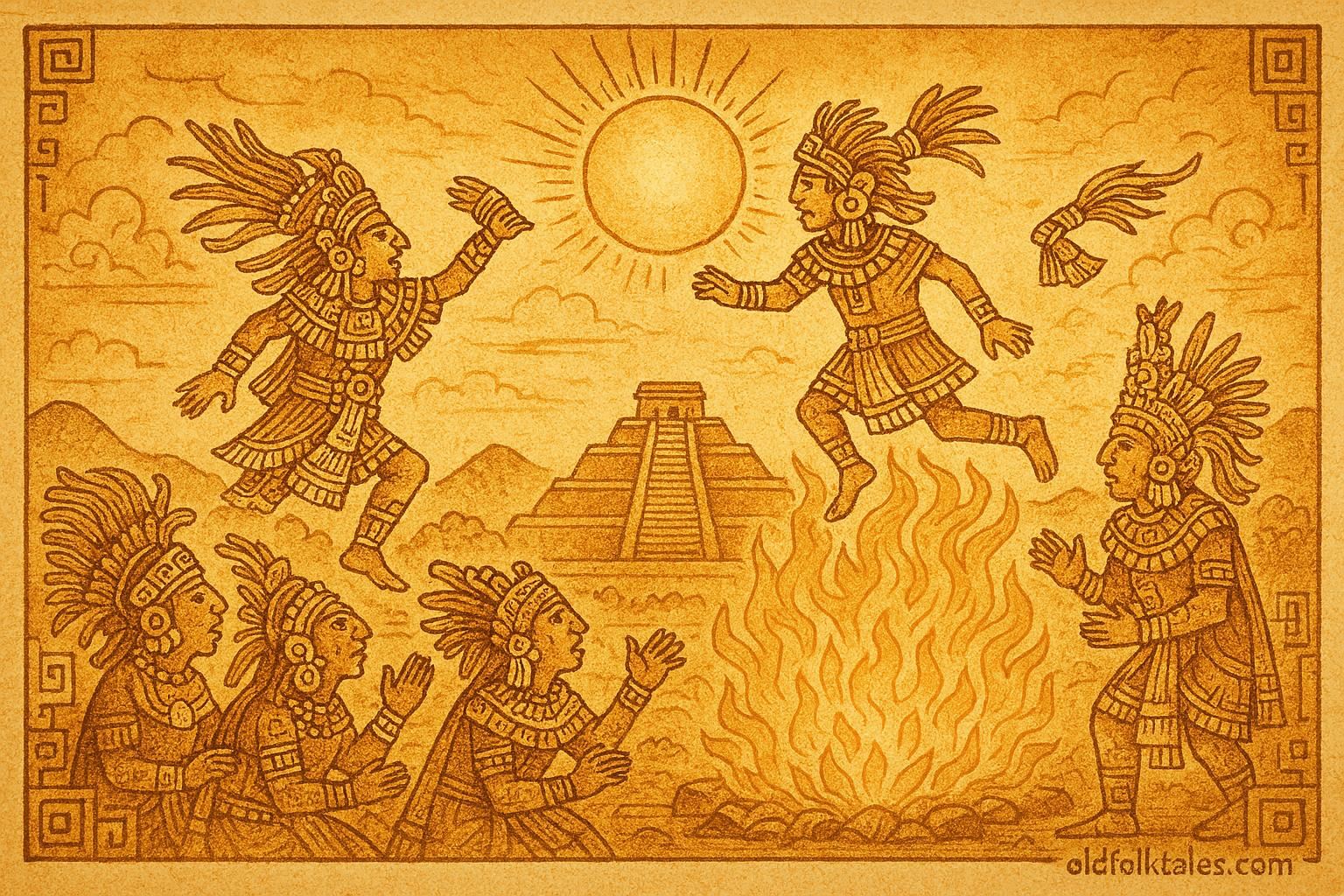
At last, the night of destiny arrived. The gods gathered around the blazing pyre. The flames leapt high into the heavens, their heat fierce enough to make the mountains tremble.
The priests of the gods called out: “Let the first volunteer leap into the fire!”
Tecuciztécatl stood before the blaze. The fire roared, red and gold, demanding courage. But when he felt its heat against his jeweled skin, fear gripped him. He stepped back. Once, twice, thrice he tried, and each time, he faltered.
Then the gods turned to Nanahuatzin.
His sores glistened in the firelight, his body weak and trembling. Yet his heart was steady. He whispered a prayer and closed his eyes.
Without hesitation, Nanahuatzin leapt into the sacred fire.
The flames roared higher, swallowing him whole. The fire became so bright that the gods shielded their eyes. For a moment, the night turned to dawn.
Shamed by Nanahuatzin’s courage, Tecuciztécatl followed, hurling himself into the fire after him.
The Birth of the Fifth Sun
The world fell silent.
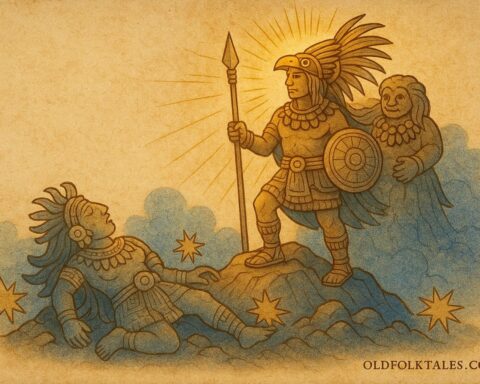
Then, from the horizon, a new light began to rise. From the east came Nanahuatzin, now transformed, his sores gone, his body radiant, his face the shining orb of the Fifth Sun.
Behind him came Tecuciztécatl, also shining, but pale and cold beside the glory of Nanahuatzin. The gods looked upon the two suns and said, “There cannot be two.”
So, one of the gods took a rabbit and hurled it into Tecuciztécatl’s face, dimming his light. From that moment, he became the Moon, forever chasing the Sun across the sky, never overtaking him.
Nanahuatzin’s light, however, did not yet move. The sun stood still at the edge of the heavens, unmoving and silent.
Then the gods understood, for the world to live, for the sun to travel across the sky, they too must sacrifice.
One by one, the gods offered themselves. Their divine blood fell upon the earth, and through their selfless act, the Sun began to move, giving warmth, light, and life to all things.
Thus began the Fifth Age, the world we now inhabit, the age of the Fifth Sun, born from humility and kept alive by sacrifice.
The Lesson of the Fifth Sun
The Aztecs taught that the Fifth Sun shines only through continual sacrifice. The light that sustains the world was born not from pride or wealth, but from humility and courage. The story of Nanahuatzin reminds all who hear it that greatness comes not from power or appearance, but from the willingness to give of oneself for the good of others.
Explore the land of La Llorona, trickster coyotes, and magical realism in Mexican folklore
Moral Lesson
True strength lies in selflessness. While pride hesitates, humility acts. The sun itself, the giver of life, was born from the heart of one who expected nothing in return. The world continues to thrive through the same balance of courage, humility, and sacrifice.
Knowledge Check
1. What is the central event in “The Creation of the Fifth Sun”?
The gods gather at Teotihuacán to create a new sun through divine sacrifice.
2. Who are the two gods that volunteer?
Nanahuatzin, the humble god, and Tecuciztécatl, the proud and wealthy god.
3. What happens when Tecuciztécatl hesitates?
Nanahuatzin leaps into the fire first, becoming the radiant Fifth Sun.
4. Why does Tecuciztécatl become the Moon?
Because he followed Nanahuatzin out of pride, and his light was dimmed by a rabbit, symbolizing humility’s triumph over arrogance.
5. Why did the other gods sacrifice themselves after the sun’s creation?
Their sacrifice set the sun in motion, bringing warmth and movement to the new world.
6. What is the story’s moral message?
True light and renewal are born through humility, courage, and selfless sacrifice.
Source: Historia de los Mexicanos por sus Pinturas (translated from Nahuatl codices), compiled c. 1540–1560.
Cultural Origin: Aztec (Mexica) – Central Mexico