High on a frost-bitten ridge above a small Pennsylvania valley stood an old wooden shack that most folks pretended not to notice. It was gray and weathered, its boards warped by years of snow and mountain wind. Yet on certain winter nights, when the moon cast a silver path across the hills, a faint orange glow would flicker from within. Those who lived nearby claimed it was just lantern light from someone checking livestock. But deep down, everyone knew better.
In that shack sat a still, a copper contraption coiled and humming like a sleeping serpent, hidden away from the eyes of lawmen and tax collectors. Its owner, Amos Heller, was a quiet farmer who had fallen on hard times. His corn fields had yielded poorly for three seasons, and his cattle were thin from a summer drought. To keep his family fed, Amos turned to the one trade his father and grandfather had whispered about: making spirits in secret.
Amos worked the still by night, hauling sacks of grain up the hill, careful to leave no tracks in the snow. He’d mash the grain with creek water, then heat the mix until the sweet, sharp scent of alcohol filled the air. Down in the valley, neighbors might catch that smell on the cold wind, sharp as vinegar and warm as bread, but they’d look away, pretending not to notice.
For months, the still brought quiet prosperity. Amos sold his liquor to nearby farms, trading jars of golden corn whiskey for eggs, milk, or winter grain. Folks said his brew could “warm your belly and your bones in one sip.” But secrets never stay hidden long in a small farming town.
It began with old Mrs. Danner, who claimed she saw Amos’s lantern swinging through the trees after midnight. Then young Billy Tate found wet footprints near the spring, even though the temperature had dropped below freezing. Before long, whispers spread through the church pews and over fence posts: “Someone’s still working that hill again.”
At first, the villagers didn’t mind. Times were hard, and a few bottles of corn whiskey made the long winters bearable. But trouble came when a stranger rode into town, a sharp-eyed man claiming to be a peddler but asking too many questions. He bought a jar from a neighbor and tasted it with a smirk. “Good work,” he said. “Almost too good for farm hands.” Folks began to suspect he was from the government.
Word reached Amos that a raid might be coming. He decided to shut down the still, at least for a while. But on the very night he planned to empty the mash and dismantle the coil, a storm rolled in. Snow fell thick and fast, and by midnight, the ridge was blanketed in white. Amos went anyway, wrapping his scarf tight and carrying a lantern low.
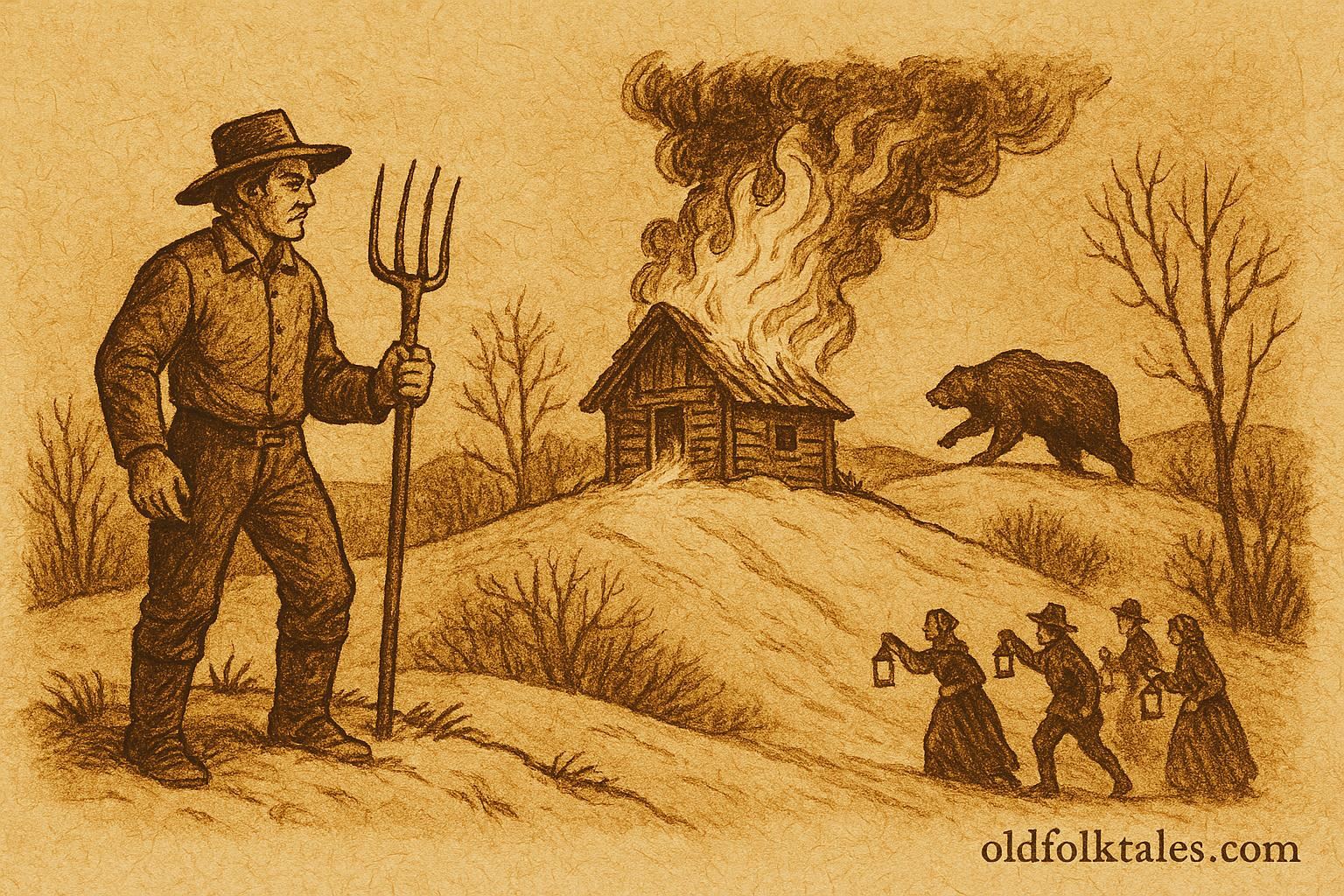
As he worked, he heard a rustle behind the shack, the crunch of boots on snow. He doused his light, heart pounding. “Who’s there?” he whispered. Out of the darkness came a grunt and a flash of fur. It wasn’t a man but a bear, drawn by the scent of mash. The animal shoved against the door, knocking over the kettle. Hot liquor spilled onto the floor, hissing into steam.
Panicked, Amos ran for the door just as the bear tore through the wall. Lantern oil spilled, and in seconds, the shack was aflame. From the valley below, villagers saw the fire bloom like sunrise on the ridge.
By morning, all that remained was a blackened heap and the twisted gleam of copper. The bear had vanished, and Amos sat in the snow, his face soot-streaked but alive. When the men from the village climbed the hill, they found him shivering beside the ruins.
“Amos,” said one of them quietly, “we reckon you’ve learned enough of this night.”
Amos nodded. He’d lost his still, his secret, and nearly his life. The sheriff, who had come with the others, looked at the burned wreck and sighed. “Ain’t no need for reports,” he said finally. “Fire took care of the law’s business.”
The villagers helped Amos down the hill, and though no one spoke of the still again, the tale spread through the valley like smoke. In every telling, someone would add a new detail, how the bear was seen later licking frozen mash off the rocks, or how the hill still smelled faintly of whiskey after rain.
Years later, folks would look up at that ridge and remember the man who tried to outwit hardship and the fire that taught the valley its lesson: no secret stays safe when it’s built on temptation.
Immerse yourself in Latin America’s stories of passion, transformation, and spirit.
Moral Lesson
This tale teaches lessons on honesty, community trust, and the dangers of secrecy. In small towns, survival depends not just on one’s craft, but on one’s character, for deceit, however quiet, always finds its way into the open.
Knowledge Check
-
Who owned the hidden still in the story?
Amos Heller, a struggling Pennsylvania farmer, secretly operated the still on the hill. -
Why did Amos build the still?
To earn extra income during hard farming seasons when his crops and cattle failed. -
What caused the still to be destroyed?
A bear, drawn by the smell of mash, knocked over a lantern and started a fire. -
What theme does the story emphasize?
It teaches lessons on secrecy, honesty, and the moral tension between survival and law. -
What role does the community play?
The villagers’ silence protects Amos until his secret brings consequences for everyone. -
What is the cultural origin of this story?
It originates from the Pennsylvania mountain folk tradition, part of Appalachian rural folklore.
Source: Adapted from the Pennsylvania Fireside Tales collection by Jeffrey R. Frazier.
Cultural Origin: United States (Pennsylvania mountain / Appalachian farm folklore)