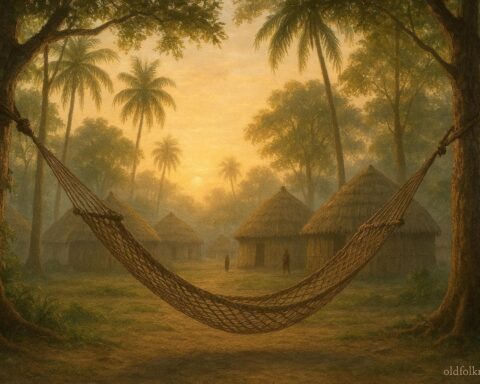
In the center of a small Taíno village, on an island where the warm sea breeze carried the scent of salt and flowers, stood a giant Ceiba tree. Its roots spread far and wide, gripping the red earth with ancient strength, while its trunk rose high into the clouds. The people of the village called it the Great Tree. It had been there for as long as anyone could remember, older than the grandparents of their grandparents, and it was said that the spirits of the ancestors rested within its heart.
The Ceiba was no ordinary tree. The elders told stories that its branches reached toward the heavens where the gods dwelled, and its roots touched the underworld where the souls of the departed lived in peace. To the Taíno, it was a sacred bridge between worlds, standing as a living reminder that all life was connected.
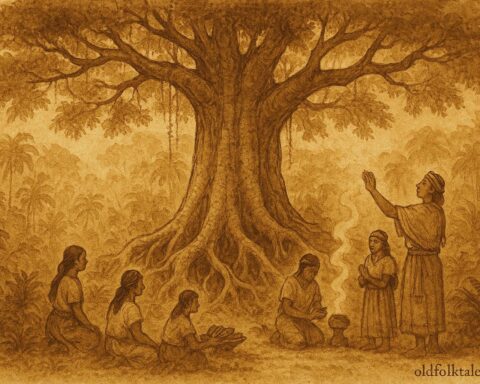
Every morning, the elders came to the Ceiba to give thanks. They placed fresh cassava bread and fruit near its roots, and they burned tobacco so the smoke would carry their prayers upward through the leaves. The youngest among them, a kind old woman named Yaya, often sat beneath the tree and spoke softly as though conversing with an unseen friend. She said the Ceiba listened to the voices of the people, especially those who spoke with humility.
Explore French-Canadian legends and First Nations myths in our Canadian Folktales collection
The children of the village were curious. They often watched from a distance as the elders performed their rituals, whispering among themselves and wondering if the stories could be true. The Ceiba was so tall that its top disappeared into the clouds, and when the wind moved through its branches, the sound was like the voice of the sea.
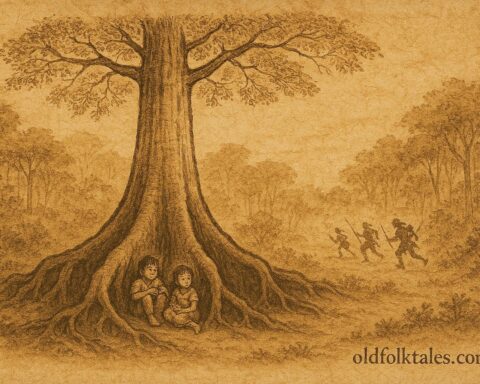
As the seasons passed, the children began to play closer and closer to the Great Tree. They ran around its roots, chasing one another in games, and sometimes climbed partway up the lower branches. The elders warned them, “Do not play near the Ceiba. The spirits that dwell there are strong and easily angered.”
But the children laughed, believing the warnings were only tales meant to keep them from wandering too far. One boy among them, named Kabo, was especially bold. He was known for his daring nature and loud laughter. He told his friends that the tree was only wood and leaves, not a spirit.
One bright morning, as the sun rose over the village, Kabo led his friends to the tree again. “Watch,” he said, “I will prove there is nothing to fear.” He picked up a small stick and struck the trunk. The sound that came back was deep and hollow, as though the earth itself had answered.
Suddenly, the wind shifted. It blew strong and hot, carrying with it a sound that none of them had ever heard before. The branches of the Ceiba swayed though no storm clouds were in the sky. The roots seemed to tremble. The children froze in fear. Then, as quickly as it began, everything went still again.
When they turned to run back to the village, they realized Kabo was gone. They searched among the roots and called his name, but there was no answer. The ground was smooth, the air heavy, and only the rustle of leaves replied. Terrified, the children ran home and told the elders what had happened.
The villagers gathered at the Ceiba before sunset. They carried torches, singing and calling out for the boy. They searched the riverbanks, the forest paths, and the nearby caves, but Kabo could not be found. The old woman Yaya stood silently before the tree, her eyes closed. “The spirit has taken him,” she said at last. “The Great Tree has claimed what was disrespected.”
The village mourned through the night. Mothers wept for Kabo, and fathers sat in silence, fearful of the power that had awakened. The next morning, Yaya gathered the people together. “We have forgotten our respect,” she said. “We take the shade of this tree for granted, yet we forget that its roots reach the world of our ancestors. We must make peace with the spirit that protects us.”
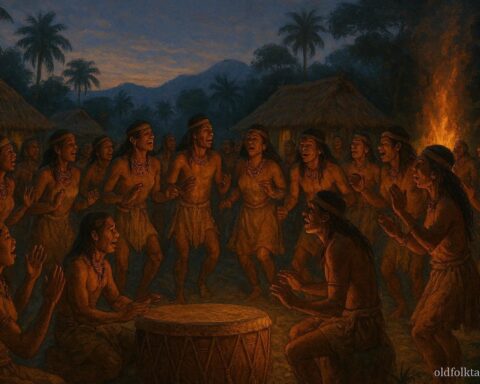
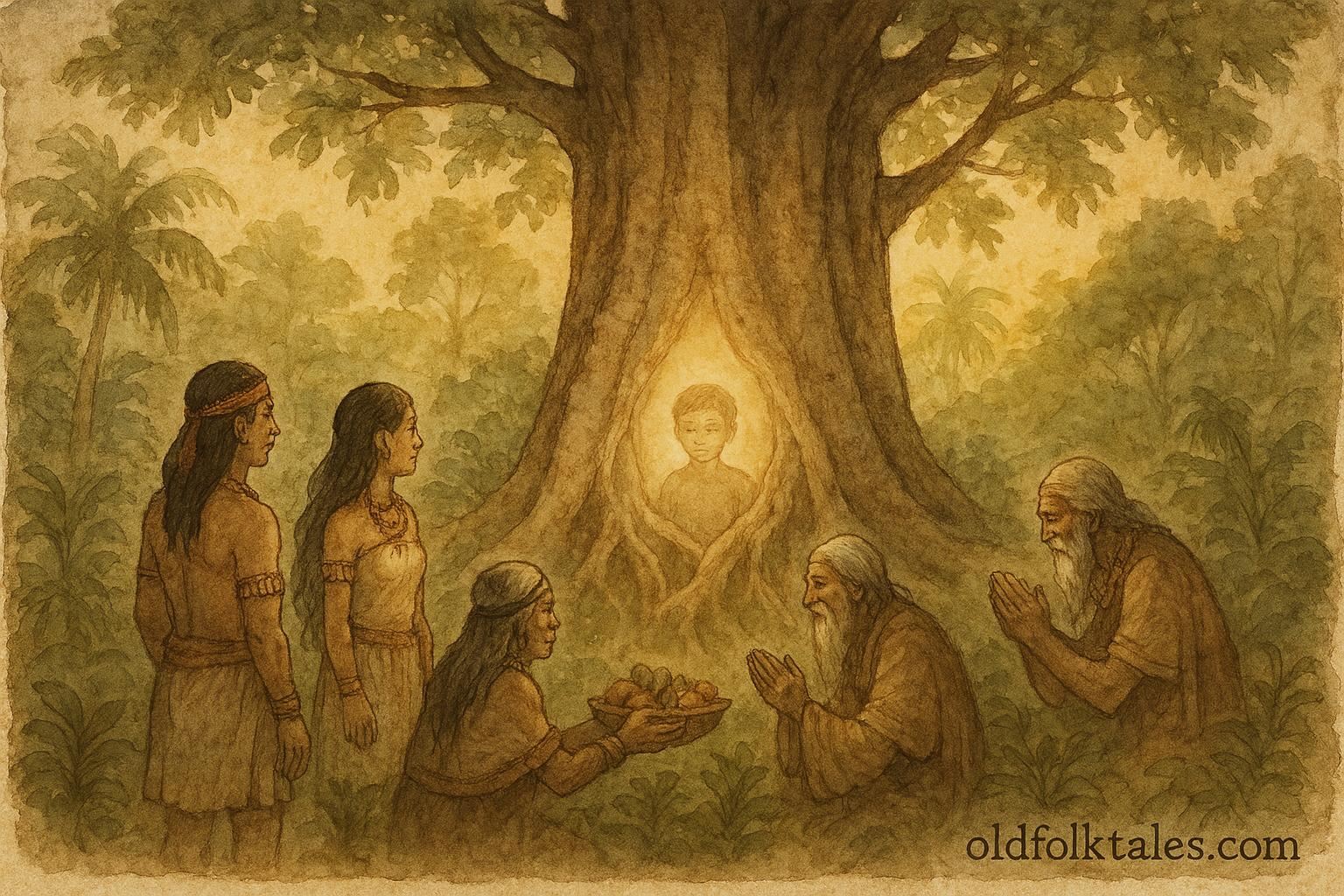
At dawn, the people prepared a great offering. They brought cassava bread, honey, fruit, tobacco, and clear water from the sacred spring. The air filled with the sweet scent of smoke and song. The men played drums carved from hollowed logs, and the women sang the ancient melodies that spoke of life and renewal.
As the voices rose, a soft wind moved through the branches of the Ceiba. The leaves shivered as though listening. A low hum seemed to come from within the trunk itself, steady and deep. The people felt warmth pass through the ground and into their hearts. Even the birds grew quiet.
When the song ended, Yaya stepped forward and placed her hand on the bark. “We remember you,” she whispered. “Forgive us. We will honor you forever.”
The wind blew once more, this time gentle and cool. The roots no longer trembled, and the light that filtered through the branches grew golden and calm. The spirit had accepted their apology.
The villagers built a circle of stones around the Ceiba and promised to care for it as the heart of their land. Each moon, they left offerings beneath its roots, and each new season, they sang songs of gratitude for the life the tree shared with them.
Years passed, and Kabo was never seen again, but sometimes at night, when the moon shone bright and the forest was quiet, the villagers claimed to hear faint laughter rising from within the trunk of the Ceiba. It was not a sound of sorrow, but of peace, as if the boy had become part of the spirit he once doubted.
And so the people remembered that the Ceiba was more than wood and leaves. It was the breath of the ancestors and the soul of the island itself. Through it, the people learned again that every living thing deserves honor, for the spirit of the earth lives within them all.
Discover ancient tales passed down by the Indigenous peoples of the Americas.
Moral Lesson
Respect is the root of harmony. When humans forget that nature is alive and sacred, they lose their connection to life itself. The spirits of the earth, like those within the Ceiba, remind us to walk with care, listen to wisdom, and live in gratitude for the world that sustains us.
Knowledge Check
-
What made the Ceiba tree sacred to the Taíno people?
It was believed to connect the heavens, the earth, and the underworld, serving as a bridge between living people and ancestral spirits. -
Why did Kabo strike the tree?
He did not believe the elders’ warnings and wanted to prove that the stories were not true. -
What happened after Kabo struck the tree?
The wind rose, the tree trembled, and Kabo disappeared, teaching the people the cost of disrespect. -
How did the villagers make peace with the spirit?
They brought offerings, sang sacred songs, and promised to honor the tree from that day forward. -
What lasting change did the villagers make?
They built a stone circle around the Ceiba and held regular ceremonies to remember the spirit. -
What is the deeper message of this story?
True wisdom lies in respect for nature and in listening to the guidance of elders who understand the balance between humans and the spiritual world.
Source:
Adapted from Taíno sacred lore in The Sacred Ceiba Tree: Caribbean Myth and Meaning by Antonio Stevens-Arroyo (1988), New York, Paulist Press.
Cultural Origin: Taíno, Cuba and the Dominican Republic.