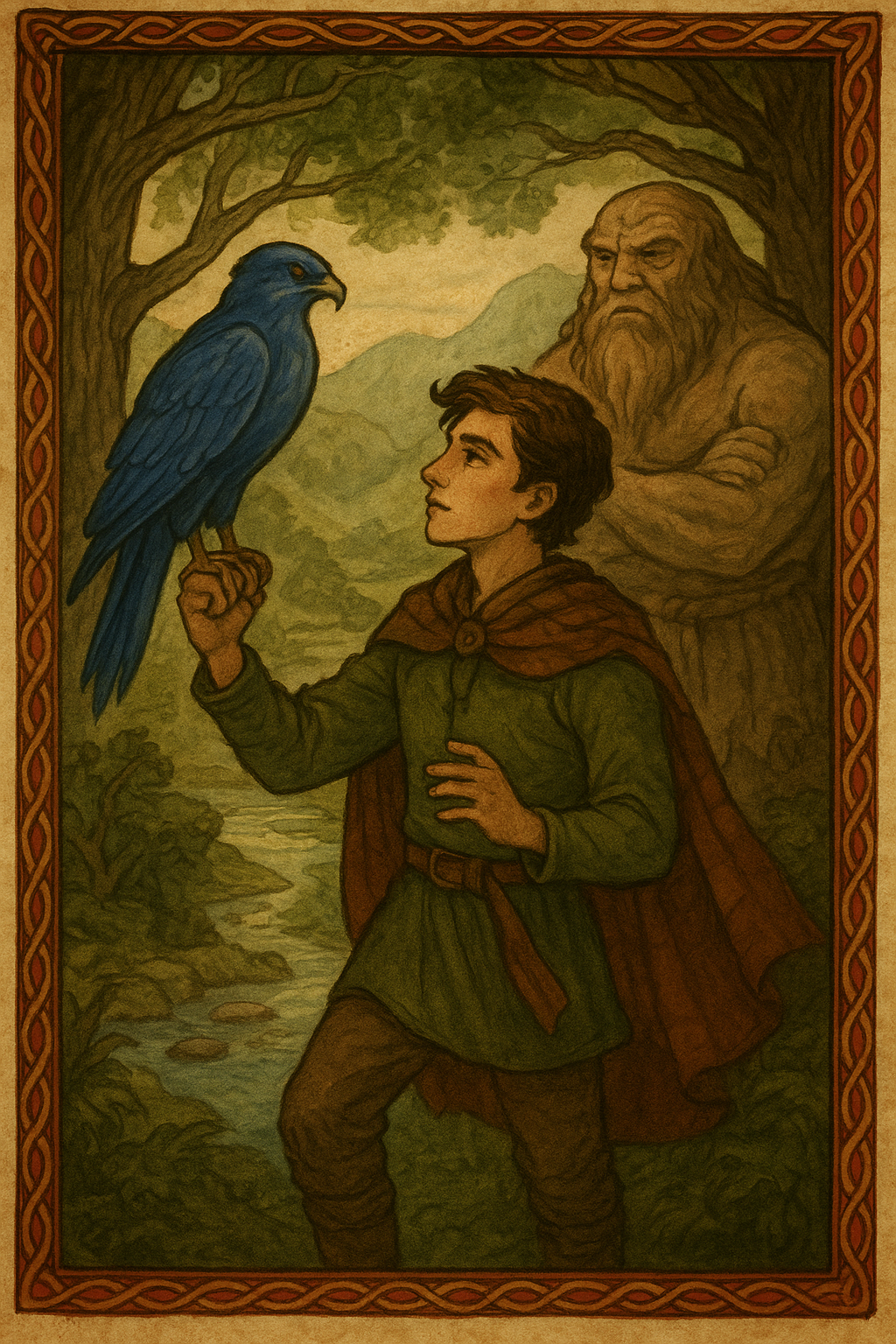
In a time when magic still whispered through the glens and mystery cloaked the mountains, there lived a young man named Ian Direach in a remote corner of the Scottish Highlands. His home was a simple stone cottage nestled among towering hills where eagles soared and hidden lochs lay like jewels in the folds of the earth. Ian was neither the strongest nor the wealthiest of men, but he possessed something far more valuable, a clever mind, a determined spirit, and a heart that refused to accept defeat.
The land in those days suffered under a shadow of sorrow. A strange sickness had crept into the villages, weakening the old and stealing the bloom from the young. Healers tried their remedies of herbs and poultices, but nothing seemed to halt the creeping malady. Hope was fading like mist before the sun, and despair settled over the people like a cold fog.
Click to read all Andean Highland Folktales — echoing from the mountain peaks of Peru, Bolivia, and Ecuador.
It was then that Ian heard whispers of an ancient legend tales of a mystical blue falcon that dwelt in the deepest, most forbidden parts of the forest. This was no ordinary bird, the stories said. Its song could heal the sick and mend broken spirits. Its feathers shone with a radiance like the morning sun breaking over the mountains, each one holding power beyond mortal understanding. Many brave souls had ventured into the forest seeking this miraculous creature, but none had ever returned to tell their tale.
Most men would have turned away from such a grim warning, but Ian Direach was not most men. As he watched his neighbors grow weaker and saw children lose their laughter, he felt a fire kindle in his heart. He would find the blue falcon, or he would die trying. At dawn the next day, he packed his leather satchel with oatcakes, dried meat, and a flask of clear spring water. He took his father’s walking staff and his mother’s blessing, and set off toward the ancient forest where few dared to tread.
The journey took him across wild moors where the wind sang mournful songs and through valleys where streams ran cold and clear as crystal. He climbed rocky passes where mountain goats watched him with knowing eyes, and descended into shadowed glens where the trees grew so thick that daylight barely touched the ground. For three days and three nights he traveled, guided only by the tales he remembered and an instinct he could not name.
At last, on the fourth morning, he entered the heart of the deepest forest. The trees here were ancient beyond reckoning, their trunks as wide as houses and their branches forming a canopy that turned the world below into perpetual twilight. The air was thick with the scent of moss and earth, and silence pressed against his ears like a living thing. Then, through the gloom, he saw it a massive rock jutting up from the forest floor like a throne, and perched upon its peak, gleaming with ethereal light, was the blue falcon.
But between Ian and his goal stood a figure that made his blood run cold. A giant, towering and terrible, sat before the rock with arms crossed and eyes burning like coals. His skin was rough as bark, his beard tangled with thorns and moss, and his voice when he spoke rumbled like distant thunder.
“Many have come seeking the falcon,” the giant growled, his words shaking the leaves from the trees. “All have failed. What makes you think you will succeed where warriors and wizards have perished?”
Ian swallowed his fear and stood tall, though his legs trembled. “I come not with strength of arms or spells of power,” he said clearly, “but with determination and whatever wit the gods have granted me. I seek the falcon not for glory or gold, but to heal my people who suffer.”
The giant’s eyes narrowed, studying the young man before him. “Noble words are cheap as air,” he rumbled. “If you would approach the falcon, you must first complete three tasks. Fail in even one, and your bones will join those who came before you.” He gestured to the shadows where, indeed, Ian could see the gleam of old skeletons half-buried in the earth.
“First,” declared the giant, “you must build a bridge from silver that spans the ravine behind you. Second, you must fill this enchanted bag with water from the spring that no bucket can hold. Third, you must answer three riddles that have confounded even the wisest minds in all the land. Only then may you approach the falcon’s rock.”
Ian’s heart sank as he looked at the tasks before him. He had no silver to build a bridge, no understanding of how to fill a bag from an impossible spring, and no guarantee his mind could match the giant’s riddles. But he had not come this far to surrender. He took a deep breath and began.
For the first task, he approached the ravine the giant had indicated, a deep chasm with a rushing river far below, its waters shining silver in the dim light. Ian studied it carefully, walking along the edge, thinking and observing. Then he noticed something the giant had not mentioned: beneath the surface of the silver water, barely visible, were stepping stones that crossed the ravine like a natural bridge. The giant had said to build a bridge from silver, not of silver. With careful steps, Ian crossed the ravine by hopping from stone to stone across the silver river.
The giant watched with grudging approval. “Cleverness, not strength. Perhaps you are different. But the second task will surely defeat you.”
The enchanted bag hung from a tree branch, and beside it flowed a spring whose water seemed to leap and dance, never staying still long enough for any vessel to catch it. Ian tried with his hands, but the water slipped through his fingers like quicksilver. He tried with his flask, but the water evaded it as if alive. He sat by the spring, thinking hard, when morning came and with it, the dew.
Inspiration struck like lightning. Ian went through the forest collecting leaves heavy with morning dew, squeezing each precious drop into the bag. The dew was water from the spring, it came from the same earth, the same sky but transformed into something that could be gathered. Drop by patient drop, he filled the enchanted bag until it bulged with water.
The giant’s expression shifted from contempt to something like respect. “Two tasks completed through wit alone. But my riddles have broken minds far greater than yours, young man. Are you prepared?”
“Ask your riddles,” Ian said steadily, though his heart hammered in his chest.
The giant’s first riddle came like a challenge: “What flies without wings, strikes without hands, and is felt but never seen?”
Ian thought of the wind that had accompanied him on his journey, that moved through the glens and bent the trees. “The wind,” he answered.
The giant nodded slowly. “What can run but never walks, has a mouth but never talks, has a bed but never sleeps?”
Ian remembered the streams he had crossed, the rivers that carved through stone. “A river,” he said.
The giant’s eyes blazed brighter. “Final riddle, and the hardest: I am always hungry and must always be fed. The finger I touch will soon turn red. What am I?”
Ian recalled the campfires he had built on his journey, how they consumed wood endlessly and left burns on unwary hands. “Fire,” he declared.
For a long moment, the giant said nothing. Then, slowly, he rose to his full height and stepped aside. “You have proven yourself worthy through cleverness, patience, and wisdom. Approach the falcon, Ian Direach, and let us see if your heart matches your mind.”
With legs weak from relief and tension, Ian climbed toward the rock where the blue falcon perched. As he drew near, the magnificent bird fixed him with eyes that seemed to see straight through to his soul. Its feathers shimmered with colors that shifted from deep azure to brilliant turquoise to the pale blue of a summer sky. When it spoke, its voice was like wind moving through ancient pines, both gentle and powerful.
“Many seek me for power, for wealth, for fame,” the falcon said. “Only the pure of heart may take my feather and use its magic. Tell me, Ian Direach, why do you seek me?”
Ian bowed low before the magnificent creature. “Great falcon, I seek your power not for myself but for my people who suffer from a sickness that no healer can cure. I promise before all the powers of earth and sky that I will use your gift only to heal, never to harm, and only for as long as there is genuine need. When my people are well, I will return your feather to this sacred place.”
The falcon regarded him with ancient, knowing eyes. Then, in a movement like liquid grace, it descended and alighted upon Ian’s shoulder. Its weight was barely there, yet he felt the significance of the moment like a stone. One brilliant blue feather drifted down and fell into his open hand. It was warm to the touch and seemed to pulse with inner light.
“You have proven yourself through cleverness, perseverance, and respect for the natural world,” the falcon said. “Use this gift wisely, Ian Direach, and know that true power lies not in the feather itself, but in the heart that wields it.”
Ian carefully placed the feather inside his shirt, close to his heart, and bowed again. The giant had vanished, and the forest seemed lighter somehow, less forbidding. The journey home took less time than the journey out, as if the land itself wished to speed his return.
When Ian arrived in his village, he found the sick gathered in the square, their families watching with hollow eyes. He took out the blue falcon’s feather, and it began to glow with that morning-sun radiance. As he moved among the afflicted, the feather’s light washed over them like a healing wave. Color returned to pale cheeks. Strength flowed back into weakened limbs. Children sat up and laughed. The old smiled with eyes clear and bright once more.
The sickness was banished, and hope bloomed again in the highland villages. True to his word, when all were healed and the threat had passed, Ian returned to the deep forest and climbed the rock where he had first found the falcon. The magnificent bird was waiting, and when Ian offered back the feather, the falcon bowed its head in acknowledgment of a promise kept.
Tales of Ian Direach’s courage and cleverness spread across the highlands like wildfire. He became a living legend, a symbol of how wit and wisdom could triumph where brute force failed, and how respect for nature’s wonders and keeping one’s word mattered more than any treasure. And whenever sickness threatened the land again, it was said the blue falcon would remember Ian’s pure heart and send its blessings once more.
Discover the sacred tales of llamas, condors, and gods who guard the Andes
The Moral Lesson
The tale of Ian Direach teaches us that true heroism requires intelligence and integrity more than physical strength. Ian succeeded where warriors and wizards failed because he approached each challenge with thoughtful observation rather than force, found creative solutions instead of direct confrontations, and maintained humility and honor throughout his quest. Most importantly, he understood that power should serve others rather than elevate oneself, and that keeping one’s promises even when no one would know if you broke them is the mark of genuine character. His story reminds us that the greatest victories come through clever thinking, patient effort, and a pure heart.
Knowledge Check
Q1: Who is Ian Direach in Scottish Highland folklore?
A: Ian Direach is a clever and determined young man from the Scottish Highlands who embarks on a quest to find the mystical blue falcon to save his village from a mysterious sickness. He represents the hero who succeeds through wit and integrity rather than physical strength.
Q2: What magical powers does the blue falcon possess in this Celtic legend?
A: The blue falcon has the power to heal the sick and mend broken spirits through its song and feathers. Its feathers shine with radiance like the morning sun, and each one contains healing magic that can cure illnesses that ordinary remedies cannot touch.
Q3: What three impossible tasks does the giant set for Ian Direach?
A: The giant demands that Ian build a bridge from silver spanning a ravine, fill an enchanted bag with water from a spring that no bucket can hold, and answer three riddles that have confounded even the wisest minds.
Q4: How does Ian Direach demonstrate cleverness in completing the giant’s tasks?
A: Ian shows cleverness by crossing stepping stones hidden beneath the silver river (interpreting “from silver” creatively), collecting morning dew to fill the bag (finding water in a gatherable form), and solving the riddles through thoughtful observation of nature rather than scholarly knowledge.
Q5: What is the symbolic meaning of the blue falcon in Scottish mythology?
A: The blue falcon symbolizes divine healing power, the rewards of pure intentions, and the bridge between the natural and supernatural worlds. It represents wisdom that must be earned through character rather than taken by force, and the responsibility that comes with great power.
Q6: What Highland values does the story of Ian Direach emphasize?
A: The story emphasizes cleverness over brute strength, perseverance in the face of impossible odds, keeping one’s word even when it requires personal sacrifice, respect for nature and its magical creatures, using power to serve the community rather than oneself, and the belief that true nobility comes from character rather than birth or wealth.
Source: Adapted from Scottish Highland folklore traditions, particularly versions found in Popular Tales of the West Highlands by John Francis Campbell (1860-1862)
Cultural Origin: Celtic Scotland, Scottish Highlands and Gaelic-speaking regions