Long ago, when the earth was still young and the mountains whispered ancient secrets to the stars that burned in the endless night sky, the Aymara people made their home in the high plains of the Altiplano. This was a land where the air grew thin and cold, where icy winds swept across the barren valleys like invisible rivers, and where rain came so rarely that each precious drop was celebrated as a miracle.
Life in those days was hard beyond measure. The stony soil yielded little to the patient farmers who worked it from dawn until the sun disappeared behind the snow-capped peaks. A few hardy potatoes grew if the people were fortunate. Some bitter herbs could be gathered from rocky crevices. But these meager offerings were never enough. Hunger walked among the people like an unwelcome guest who never left, sitting at every table, dwelling in every home. Children cried at night with empty bellies. The elderly grew weak and thin. Even the strongest warriors felt their energy drain away like water through cracks in stone.
Click to read all Andean Highland Folktales — echoing from the mountain peaks of Peru, Bolivia, and Ecuador.
The gods who dwelt in the sacred peaks of the Andes looked down upon their people with hearts heavy with compassion. They saw the suffering, heard the prayers that rose like smoke from cooking fires, and felt the quiet desperation that had settled over the villages like morning frost. After much deliberation in their celestial halls, the gods decided to send help to the struggling Aymara.
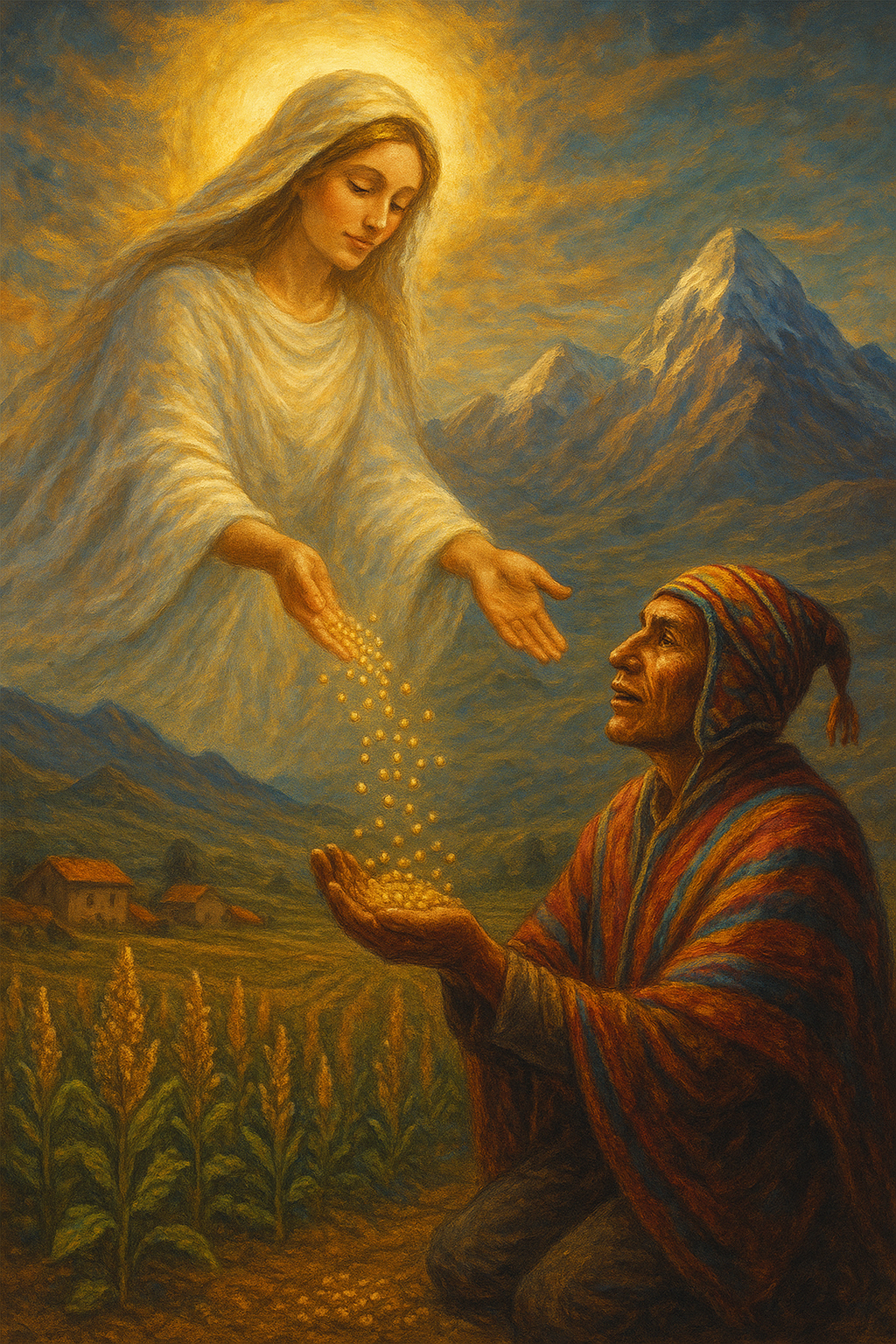
One morning, when the first light of dawn painted the mountain peaks in shades of rose and gold, a spirit descended from the heavens. She took the form of a radiant woman whose beauty made the sunrise seem dim by comparison. Her skin shimmered and glowed like the reflection of dawn on fresh snow covering the highest peaks. Her cloak appeared to be woven from the clouds themselves, shifting and flowing around her like mist, sometimes white as new wool, sometimes golden as sunlight breaking through storm clouds. When she moved, the very air seemed to sing.
This celestial being made her way to a humble village and sought out a farmer a man known throughout the community for his kind heart and his devotion to the old ways. He tended his small plot of land with love despite its stubbornness, speaking gentle words to the earth and offering thanks even for the smallest potato that emerged from the soil.
The radiant woman appeared before him as he prepared to work his field in the thin morning light. He fell to his knees, recognizing immediately that she was no ordinary visitor. Her presence filled him with both awe and peace, like standing before something holy and ancient beyond understanding.
“Rise,” she said, and her voice was like water flowing over smooth stones. “I have come to feed your people. The gods have heard your suffering and sent me with a gift that will sustain you and your children and their children after them.”
The farmer stood, his weathered hands trembling, his eyes unable to look away from her luminous face.
“But you must remember,” the woman continued, her expression growing serious, “this gift comes with a sacred responsibility. You must treat the earth with respect. Feed her with your care. Sing to her with your gratitude. Water her not just with rain but with your prayers. And never, never take more than you need. The earth gives generously, but only to those who honor the balance.”
Then the radiant woman opened her hands, palms facing upward toward the brightening sky. From them fell small golden seeds, hundreds upon hundreds of them, cascading like tiny stars tumbling from heaven. They gathered in a glowing pile at the farmer’s feet, each seed perfect and round, gleaming with inner light.
“Plant these in your soil,” the woman instructed. “They will grow into a sacred food, a grain that will nourish body and spirit alike. It will grow where other plants fail. It will sustain you through the harshest winters. This is quinoa the mother grain, the gift of the gods to their beloved people.”
With those words, the radiant woman began to fade, her form dissolving back into the morning mist, her cloak melting into the clouds that drifted past the mountain peaks. But her final words echoed in the farmer’s heart: “Remember the pact.”
The farmer obeyed with reverence and joy. He chose a field high above the village, where the land met the sky and the wind sang its eternal song. There, with hands that shook from emotion rather than cold, he planted the golden seeds one by one. He watered them not just with the precious water he carried from the distant stream, but with tears of gratitude that rolled down his weathered cheeks. Each morning before the sun rose, he climbed to the field and sang to the seeds old songs his grandmother had taught him, songs of thanks and hope and connection to the living earth.
The seeds responded to his devotion. Within days, tiny green shoots pushed through the soil, reaching eagerly toward the sun. The plants grew tall and strong, their leaves a vibrant green that seemed impossible in such harsh conditions. And at the top of each plant, clusters of tiny golden grains appeared, glowing in the mountain sunlight like treasures beyond price.
When harvest time came, the farmer gathered the village to see the miracle. The people tasted the quinoa and found it unlike anything they had ever eaten before. It was rich and sustaining, with a nutty flavor that satisfied hunger in a way their meager potatoes never had. A small bowl of quinoa porridge filled the stomach and gave strength to work all day. The children’s cries of hunger ceased. The elderly regained their vigor. The warriors felt power return to their limbs.
The farmer shared the seeds with every family, teaching them the rituals the radiant woman had commanded: sing to the plants, give thanks to the earth, take only what you need. And for a time a blessed, golden time the village flourished. No one went hungry. The people grew strong and healthy. Quinoa became the foundation of every meal, the sacred grain that had saved them from starvation.
But as generations passed and memories grew dim, something shifted in the hearts of the people. The young ones who had never known true hunger began to forget the old ways. They planted quinoa without songs, viewing it as mere crop rather than sacred gift. They harvested without offering thanks, taking the grain for granted as though it had always been there and always would be. They mocked the elders who insisted on maintaining the rituals, calling them superstitious and old-fashioned. Some even planted far more than they needed, seeking profit rather than sustenance, breaking the sacred balance the radiant woman had commanded them to preserve.
Then one night, when the moon was dark and the stars seemed to hide behind clouds, the sacred woman appeared again. But this time, she looked different. Her radiant skin was dimmed, almost gray. Her beautiful cloak of clouds was torn and tattered, hanging in shreds around her shoulders. Her eyes, once bright with joy and compassion, now overflowed with sorrow so deep it seemed to have no bottom.
She appeared in the center of the village, and her voice rang out like a bell tolling for the dead: “You have forgotten the pact. You have taken without giving. You have broken the sacred balance between earth and people.”
Before anyone could speak, before anyone could beg forgiveness or make excuses, she vanished. She dissolved into the stars, and where she had stood, only a scorch mark remained on the ground, a reminder of divine presence and divine disappointment.
The very next season, drought fell upon the land like a curse. The skies grew hard and refused to release rain. The quinoa plants withered in the fields, their leaves turning brown and brittle, their grain clusters remaining small and empty. Famine returned, hungrier than before, stalking the villages that had grown complacent. Once again, children cried with empty bellies. Once again, the people suffered.
The famine lasted for years terrible, lean years when the people remembered too late what they had lost. Finally, the eldest among them, those who still remembered their grandparents’ songs and stories, gathered the village together. “We must restore the old ways,” they declared. “We must revive the songs and the rituals. We must remember how to honor the earth.”
And so they did. They taught the young ones the songs of gratitude. They performed the planting ceremonies with renewed devotion. They took only what they needed and left offerings of thanks at the corners of their fields. They spoke to the earth as to a beloved mother, with respect and love.
Slowly, like trust rebuilding after betrayal, the quinoa began to grow again. The rains returned. The golden grain filled out once more. The people learned their lesson and vowed never to forget again.
To this day, Aymara farmers in the high Altiplano sing to their quinoa before the harvest, maintaining the ancient covenant. They teach their children the songs, pass down the stories, and remember always the sacred promise that exists between humankind and the earth a promise sealed in golden seeds that fell from the hands of a radiant woman who loved them enough to save them, and who loved them enough to let them learn from their mistakes.
Discover the sacred tales of llamas, condors, and gods who guard the Andes
The Moral of the Story
This Aymara legend teaches that gifts from the earth are sacred and must be treated with reverence, gratitude, and respect. The story emphasizes the importance of maintaining balance with nature taking only what we need and giving back through care, ceremony, and mindful stewardship. It warns against greed and complacency, showing that when we forget to honor the source of our sustenance, we risk losing it entirely. The tale reminds us that abundance is not guaranteed but must be earned through continued respect for the sacred contract between humanity and the natural world that sustains us.
Knowledge Check
1. Who was the radiant woman in the Aymara quinoa legend and what did she represent?
The radiant woman was a divine spirit sent by the gods of the Andes to help the suffering Aymara people. She represented the compassion of the deities and served as an intermediary between the divine realm and humanity. Her shimmering skin and cloud-woven cloak symbolized her celestial origin, while her gift of quinoa seeds represented the gods’ desire to sustain their people through harsh conditions in the Altiplano.
2. What conditions did the sacred woman require for the quinoa gift in the Andean legend?
The radiant woman established a sacred pact requiring the Aymara people to treat the earth with respect by feeding it with care, singing to it with gratitude, watering it with prayers, and most importantly, never taking more than they needed. These conditions emphasized the reciprocal relationship between humans and nature, teaching that abundance comes through reverence and balance rather than exploitation and greed.
3. How did the Aymara people initially respond to the gift of quinoa?
When the humble farmer first planted the golden seeds and followed the sacred rituals singing to the plants, offering tears of gratitude, and treating them with reverence the quinoa flourished. The people initially honored the pact, maintaining the ceremonies and sharing the seeds while teaching others the proper rituals. This obedience resulted in abundance, ending the famine and allowing their communities to thrive for generations.
4. Why did drought come to the Aymara lands in the quinoa story?
Drought came as a divine consequence when later generations forgot the sacred pact with the earth. The people became complacent, planting without songs, harvesting without gratitude, mocking the old rituals, and taking more than they needed out of greed. When the radiant woman returned and found the covenant broken, she withdrew the blessing, allowing drought and famine to teach the people the cost of forgetting their sacred responsibilities.
5. What is the cultural significance of quinoa to the Aymara people of Bolivia?
For the Aymara people of the Altiplano, quinoa is far more than just food it is considered a sacred gift from the gods, called the “mother grain.” This legend explains why traditional Aymara farmers still sing to their quinoa fields before harvest and maintain ceremonial practices around planting and harvesting. Quinoa represents the covenant between humans and the earth, embodying principles of respect, gratitude, and sustainable living that remain central to Aymara cultural identity.
6. What agricultural wisdom does this Andean legend teach about sustainable farming?
This legend teaches fundamental principles of sustainable agriculture that the Aymara practiced for millennia: care for the soil through proper treatment, express gratitude for what the earth provides, take only what is needed rather than exploiting resources for profit, maintain spiritual connection to the land through ritual and ceremony, and understand that abundance requires reciprocity. These ancient practices reflect sophisticated ecological wisdom about maintaining balance between human needs and environmental health.
Source: Adapted from Aymara oral tradition as retold by Maris Hawkins
Cultural Origin: Aymara people, Altiplano region (Andean highlands), Bolivia, Peru, and Chile