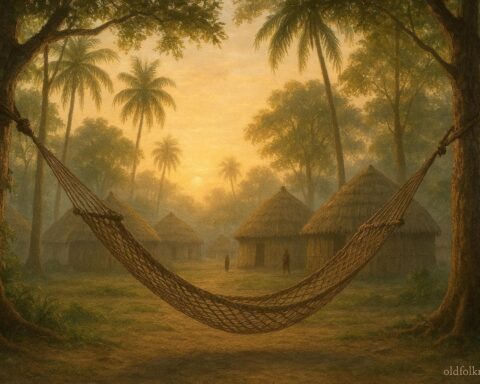
Long ago, in the time when the spirits still walked among humans and the islands of the Caribbean were young, there lived four brothers, the sons of Bayamanaco, the ancient spirit of fire, cassava, and wisdom. Among them, Deminan Caracaracol was the most curious and daring. He was known for his restless heart and the questions that burned brighter than the sun.
The brothers lived under the care and guidance of their father, Bayamanaco, who possessed the secret of cassava bread, the sacred food of life. From his spirit came nourishment and fire, and it was said that only through reverence and patience could one earn his blessings. Yet Deminan and his brothers, young and hungry for knowledge, wished to taste this divine gift before their time.
Discover the diverse storytelling traditions of Canada — from the icy North to the Maritimes
One morning, as the waves whispered against the shores of the Greater Antilles, Deminan spoke to his brothers:
“Why must we live in hunger while our father holds plenty? Are we not his sons too? Let us go to him and ask for cassava, for surely, he will not deny his own children.”
His brothers hesitated, fearing their father’s temper and power, but Deminan’s words stirred their bellies and their courage. Together they journeyed to Bayamanaco’s dwelling, a sacred cave filled with the smell of smoke and roasted cassava. There, the ancient spirit sat by the fire, his eyes gleaming like embers and his hair long as rivers.
The brothers bowed low before him. “Father,” they said, “we come in humility to ask for cassava, that we may know the taste of your gift and share in the strength of your spirit.”
Bayamanaco looked at them sternly, for he knew their hearts were impatient and their desire too bold. Still, he listened in silence, his lips curling into a faint, knowing smile. Then he rose and took a piece of cassava bread, not to share, but to test them. He placed it near the fire and spat upon it, chanting words of old power. When the chant was done, he turned to Deminan, the leader of the plea, and blew a powerful breath upon him.
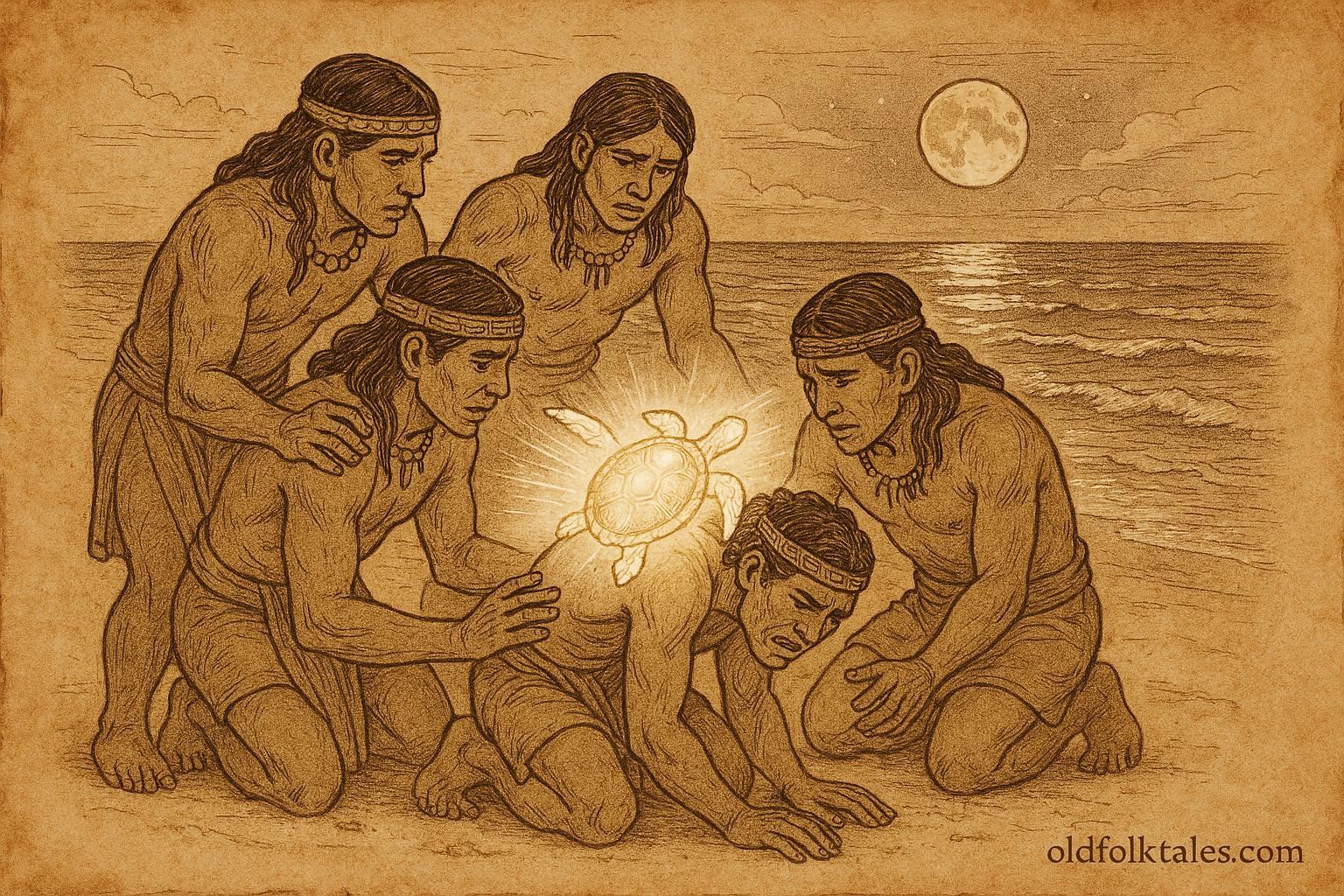
That breath carried more than air, it carried the essence of spirit. It struck Deminan’s back with force, and at once, pain shot through him. He fell to the ground, clutching his shoulders as his brothers cried out. From the place where Bayamanaco’s spittle touched him, his skin swelled, and his back began to change.
A great shell began to form, smooth and hard as stone, curving over his body. Deminan cried out in agony, “Father, what have you done to me?” But Bayamanaco only said, “You wished to take what is sacred before your time. Now you will carry the burden of what you sought.”
The brothers, frightened and sorrowful, lifted Deminan and carried him away from the cave. They brought him to the shore, where the sea’s salt breeze touched his wounds. For many days, they tried to heal him, washing his back with cool water and herbs. But the swelling grew, and the pain deepened.
Then, one night, as the moon shone upon the waves, a strange sound came from within Deminan’s shell, a hollow echo, like something knocking from the inside. The brothers watched in awe and fear as the shell cracked open. From the wound emerged a living creature, round, shining, and full of life. It was the first sea turtle.
The brothers stepped back, marveling as the turtle moved toward the sea, its flippers gliding through the sand. The moonlight reflected on its shell, and for a moment, it looked as though the ocean itself had come alive.
Deminan wept, not from pain, but from wonder. “From my suffering,” he said softly, “a new being is born. The sea shall remember this, and so shall we.”
From that day, the sea turtle became sacred to the Taíno people. They saw in its shell the memory of Deminan’s pain and in its steady movement the balance of life and spirit. It reminded them that even mistakes and disobedience could give birth to beauty, that the line between punishment and creation is sometimes thin and full of mystery.
As for Deminan, he was forever changed. The spirit’s touch had marked him, making him both human and divine, a bridge between the world of men and the mysteries of the sea. Wherever he went, people spoke his name with reverence and awe: Deminan Caracaracol, the Turtle Man.
Through him, the Taíno learned that every act of curiosity carries consequence, but also the seed of creation. To question the sacred is dangerous, yet it is through such daring that the world grows and new life begins.
Discover ancient tales passed down by the Indigenous peoples of the Americas.
Moral Lesson
The legend of Deminan Caracaracol teaches that curiosity, though sometimes punished, is part of the sacred cycle of learning and creation. Respect for the divine is vital, but even mistakes can lead to the birth of something beautiful, a reminder of balance, humility, and transformation.
Knowledge Check
- Who was Deminan Caracaracol?
Deminan Caracaracol was one of four brothers in Taíno mythology, known for his curiosity and for being transformed after disobeying the spirit Bayamanaco. - What did Deminan and his brothers ask Bayamanaco for?
They asked for cassava bread, the sacred food of life, which was not meant to be taken before its time. - How was Deminan punished by Bayamanaco?
Bayamanaco spat a magical substance on Deminan’s back, causing a turtle shell to grow painfully upon him. - What emerged from Deminan’s back wound?
From his back came the first sea turtle, symbolizing new life and the connection between humans and nature. - What does the turtle represent in this Taíno story?
The turtle represents creation born from suffering, the sacred bond between humans and the sea, and the cycle of transformation. - What is the moral of Deminan Caracaracol’s story?
That curiosity and disobedience bring consequences, but even pain can give rise to beauty and understanding in the natural world.
Source:Adapted from An Account of the Antiquities of the Indians by Ramón Pané (1498); retold in Mitología y Artes Prehispánicas de las Antillas by José Juan Arrom.
Cultural Origin: Taíno (Greater Antilles – Hispaniola, Puerto Rico, Cuba)