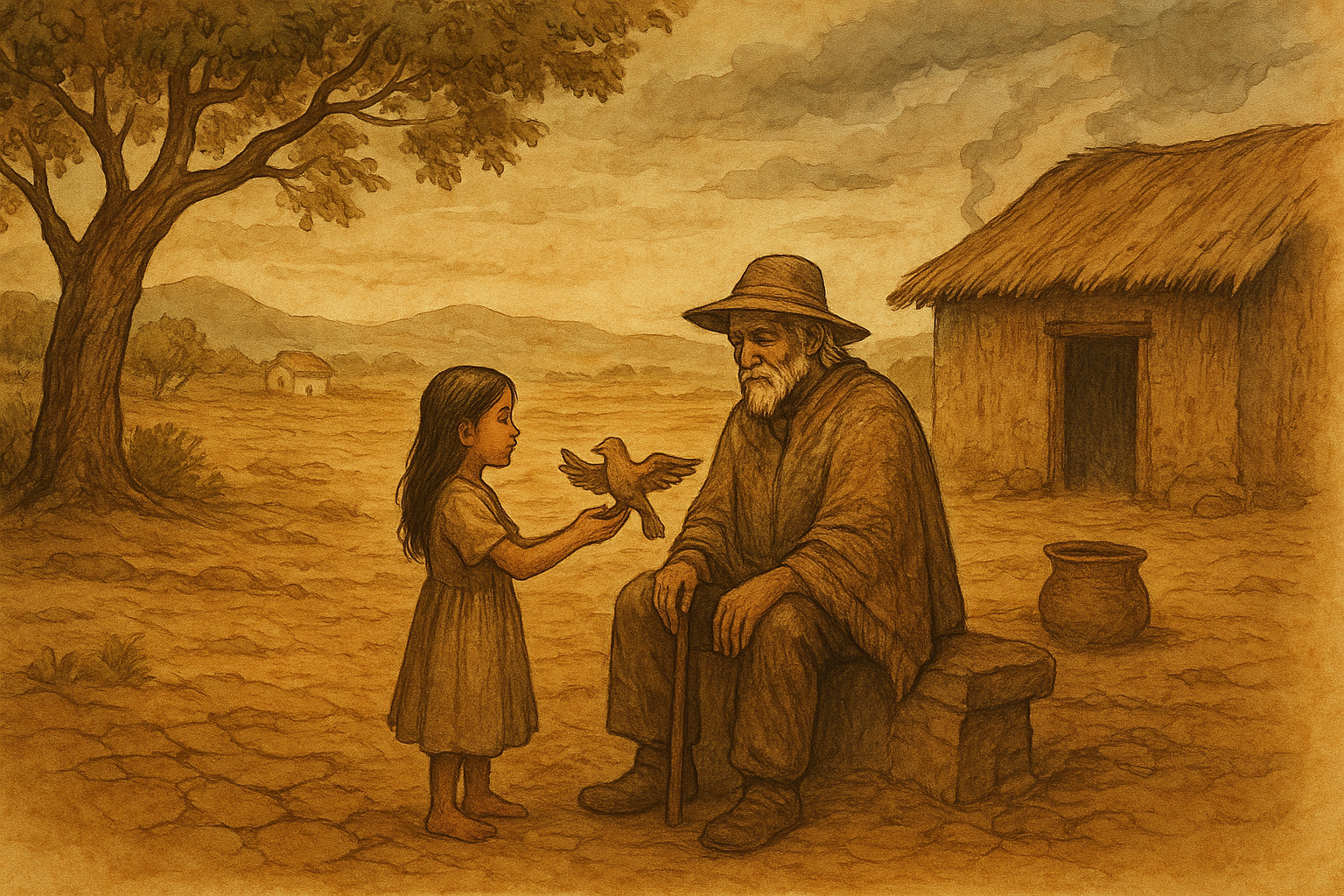
The sun rose each dawn like an unrelenting judge, glaring down on the cracked earth until even shadows wilted and faded. In the small settlement of Ejiro, nestled between the dry pampas and the withering forests of the Gran Chaco, hollow bellies and parched throats became the shared burden of every family. Children no longer raced through tall grasses to fetch water; instead, they watched their bundles of firewood swell with dust as they trudged farther each day to dry riverbeds that offered nothing but memories of flowing streams.
The elders sat motionless beneath ancient lapacho trees, their rosary beads sliding through gnarled fingers in silent lament. Their wrinkled faces told stories of abundance from years past when rains came in gentle curtains and manioc harvests filled every storehouse to bursting. There were murmurs that in the distant past, the sky once spoke directly through the rainmaker’s voice, sending rivers of silver across the golden grasslands. Now, however, his poncho was faded, his staff splintered, and the villagers could not remember a single drop falling from the heavens.
Click to read all South American Folktales — timeless stories from the Andes to the Amazon.
At midmorning, the village well would echo with confused emptiness a hollow click where water used to splash against earthen jugs. Mothers knelt on cracked stone, scooping up grains of sand to rinse corn, hoping against hope for even a trickle. Their hands trembled not from weakness alone, but from the weight of watching their children’s eyes grow dim with hunger and thirst.
Gauchos who passed through on their tired horses spoke in hurried whispers of famine sweeping across the region, of neighboring estancias reduced to dust, of crops withered before harvest. The small market plaza once filled with vendors selling chipá, fresh yerba mate, and carved ñandutí lace had become a skeleton of empty baskets and silent stools. Only the scent of sweat and parched clay lingered in the air where the aroma of fresh tortillas and grilled meat once perfumed every corner.
Yet the rainmaker still stood in his faded shelter at the edge of the settlement, chanting quiet pleas to distant spirits, never once turning away a soul in need of solace. His voice, though weakened by age and despair, carried the rhythm of ancient prayers passed down through Guaraní ancestors and mixed with the traditions brought by Spanish settlers. He knew the old ways the sacred dances, the offerings, the proper words to speak to Tupã, the god of thunder and rain but the heavens remained silent, locked behind clouds that refused to weep.
By midday, the procession to his dwelling grew solemn and short, as the scorching wind that swept across the pampas forced every pilgrim to hurry forward and hurry back. A lone fire pit, used in ancient ceremonies to call the water spirits, sat cold and black beside his dwelling. The air itself carried the memory of rain faint, distant, imagined and each person clung to that memory like a lifeline thrown across an impossible chasm.
The sacred drum made from hollowed quebracho wood remained motionless against the wall, its leather surface cracked from the relentless heat. The old prayer scrolls lay unopened beneath a thin film of dust, their wisdom seemingly powerless against the sky’s cruel indifference. Fear and resignation crept into every discussion around cooking fires and beneath shaded trees, but still someone remembered an old verse whispered by the abuelas: that only a heart offering its purest gift could bridge the mortal world and the waters above.
In hushed conversations around smoky cooking fires at night, where families gathered to share their meager portions of locro soup, the villagers spoke of a child whose kindness might yet turn the tide. There lived among them a young girl named Amina, known throughout the settlement for her generous spirit. While others hoarded their last grains of corn, she shared. When neighbors grew too weak to walk, she fetched what little water could be found. Her smile remained bright even as her own stomach cramped with hunger.
One evening, as the sun painted the dusty sky in shades of orange and crimson over the endless pampas, Amina approached the rainmaker’s shelter. In her small hands, she carried the only thing of value her family possessed—a carved wooden bird that had belonged to her grandmother. It was smooth from years of loving touch, its wings spread as if frozen mid-flight toward distant clouds, crafted by her grandfather’s skilled hands from precious palo santo wood.
“Wise one,” she said, her voice barely above a whisper, “I have nothing else to give. But if the spirits need proof of our hearts, perhaps this will speak for all of us.”
The rainmaker’s weathered eyes filled with tears. He had received many offerings silver coins, woven ponchos, even cattle that barely stood but none given with such pure intention. He took the wooden bird in his trembling hands and placed it upon the cold fire pit. Then, with Amina beside him, he struck the sacred drum three times, its boom echoing across the silent settlement like thunder remembered, calling to Tupã in the ancient way.
That night, the wind changed. Cool air swept across the pampas, carrying with it the scent of distant rain from the Río Paraguay. By morning, clouds had gathered over the settlement thick, dark, and heavy with promise. When the first drops fell, they hit the parched earth with a sound like celebration, and soon the skies opened fully. The drought had broken.
The rains came, and with them, life returned to the land. Fields greened, wells filled, and laughter once again rang through the market plaza. But the villagers never forgot what saved them not elaborate rituals or desperate bargaining, but one child’s selfless act of faith that moved the very heavens.
Explore myths and legends from Brazil, Peru, and Argentina rooted in spirit and survival.
The Moral Lesson
This story teaches us that genuine kindness and selfless giving hold power beyond material wealth. Amina’s willingness to sacrifice her most precious possession not for personal gain but for the good of her community demonstrates that purity of heart and intention can move even the heavens. True generosity requires offering what we treasure most when it matters most, trusting that such acts resonate beyond ourselves and can bring blessings to an entire community.
Knowledge Check
Q1: Who is Amina in “The Rainmaker’s Secret” folktale?
A1: Amina is a young girl from a Paraguayan settlement known for her generous and kind spirit. Despite facing the same drought and hunger as her neighbors, she continues to share what little she has and helps those too weak to care for themselves, embodying the communal values of Paraguayan culture.
Q2: What is the significance of the wooden bird in this Paraguayan story?
A2: The wooden bird represents Amina’s most precious possession a carved heirloom from her grandmother made of palo santo wood. Its offering symbolizes pure, selfless sacrifice, as Amina gives up something deeply personal and irreplaceable to help save her community from drought.
Q3: What role does the rainmaker play in the Paraguayan settlement?
A3: The rainmaker is the spiritual intermediary between the villagers and Tupã, the Guaraní god of thunder and rain. He performs sacred rituals, chants prayers combining Guaraní and Spanish colonial traditions, and maintains ancient ceremonies meant to bring rain, though his powers seem ineffective until Amina’s pure-hearted offering changes everything.
Q4: Why did Amina’s offering succeed when others failed in this South American tale?
A4: Amina’s offering succeeded because it came from a place of genuine selflessness and pure intention. Unlike other offerings motivated by desperation or bargaining, her gift represented true sacrifice without expectation of personal reward, which moved the spirits and Tupã to respond with life-giving rain.
Q5: What does the drought symbolize in this Paraguayan and Uruguayan folktale?
A5: The drought symbolizes collective hardship and the testing of community values in rural South American settlements. It represents how crisis reveals true character and demonstrates that material solutions alone cannot solve spiritual problems sometimes only pure-hearted generosity can restore balance between humans and nature.
Q6: What is the cultural lesson about community in “The Rainmaker’s Secret”?
A6: The story teaches that individual acts of selfless kindness can benefit an entire community, reflecting the strong communal traditions of Paraguayan and Uruguayan rural culture. It emphasizes that when one person acts with genuine generosity, the positive effects ripple outward to save everyone, honoring both Guaraní and gaucho traditions of mutual support.
Source: Adapted from Paraguayan and Uruguayan oral traditions
Cultural Origin: Paraguayan and Uruguayan folklore, combining Guaraní indigenous traditions with gaucho culture of South America