The legend of Jasy Jatere was not just a tale for dreamers in the village of Ka’aguy Poty. It was a story etched into the fears and hopes of every family, passed down through generations with the weight of truth behind each word. There were darker whispers that circulated among the adults stories of children who vanished during siesta, lured into the woods by sweet voices and promises of secret places where the rules of adults did not apply. Some returned days later, wandering out of the forest dazed and changed forever, their eyes holding memories they could not or would not share. Others were never seen again, becoming ghosts in their families’ hearts, their names spoken only in prayers.
One particularly harsh dry season, when rain had not kissed the earth for many long weeks, the village of Ka’aguy Poty found itself on edge. The rivers ran low, their beds exposed like old scars upon the land, revealing smooth stones that had not seen sunlight in years. The crops struggled in the stubborn heat, their leaves curling inward as if trying to protect themselves from the relentless sun. The air itself was brittle with worry, crackling with tension like dry kindling waiting for a spark.
Click to read all South American Folktales — timeless stories from the Andes to the Amazon.
Parents watched their children more closely than ever during this difficult time, keeping them within sight even during the sacred siesta hours. The elders gathered in anxious council beneath the sheltering branches of the sacred ceibo tree, its red flowers providing the only splash of color in a landscape bleached by drought. They spoke in low voices about the balance between the human world and the spirit world, wondering if their troubles were a sign that the old agreements had been forgotten.
It was during this tense time that two siblings Lucía and her little brother Tomás slipped away from their afternoon nap, drawn by the sound of laughter they heard drifting through the open window of their adobe home. The laughter was light and musical, unlike anything they had heard before, and it called to something wild and curious in their young hearts.
Tomás was mischievous and bold, always the first to climb the highest tree or chase the fastest lizard. Lucía, though only two years older, was gentle but fiercely protective of her little brother. She had heard her abuela’s warnings many times, spoken with trembling hands and serious eyes: never stray during siesta, and if you hear music in the woods, cover your ears and run home as fast as your feet can carry you.
But curiosity is stronger than caution when you are six years old, and the world seems full of adventures waiting to be discovered. Tomás darted toward the door with the quickness of a young deer, and Lucía, her heart already filling with worry, followed him along a secret path that led beyond the cornfields into the green world beyond. She told herself she was only going to bring him back, to keep him safe from whatever might lurk in the forest’s shadows.
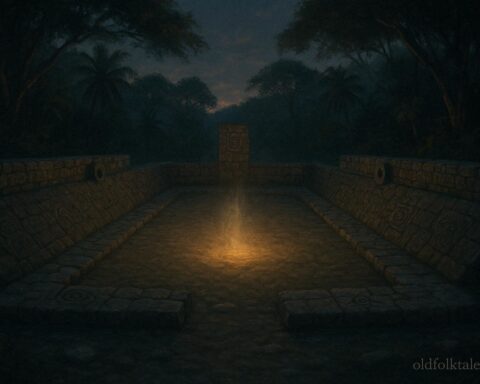
The forest was different in the hush of siesta quieter, stranger, as if the entire world were holding its breath and waiting for something to happen. The usual sounds of birds and insects had faded to nothing, replaced by a silence so profound it seemed to press against their ears. Shadows flickered at the edge of sight, moving in ways that had nothing to do with the wind. The children pressed on, their bare feet barely making a sound on the soft red earth, following the phantom laughter that always seemed just ahead, just out of reach.
Suddenly, without warning, the laughter stopped. The woods grew deeper and darker, the trees standing tall as silent judges looking down upon the two small intruders. Their trunks were thick and ancient, their bark weathered by countless seasons. Lucía felt a prickle of fear run down her spine like cold water. She called Tomás’s name, her voice sounding small and frightened in the oppressive quiet, but he had already vanished among the tall ferns that grew thick as walls.
Desperate now, her heart pounding in her chest, she ran after him. The world seemed to twist around her: familiar paths that should have led back to the village looped back on themselves impossibly, and branches arched overhead like arms barring the way forward. The forest had become a maze, and she was trapped within it. Just as panic threatened to overwhelm her completely, stealing her breath and making her legs weak, she stumbled into a clearing bathed in golden afternoon light.
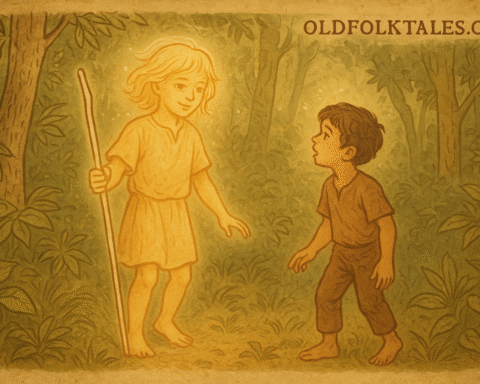
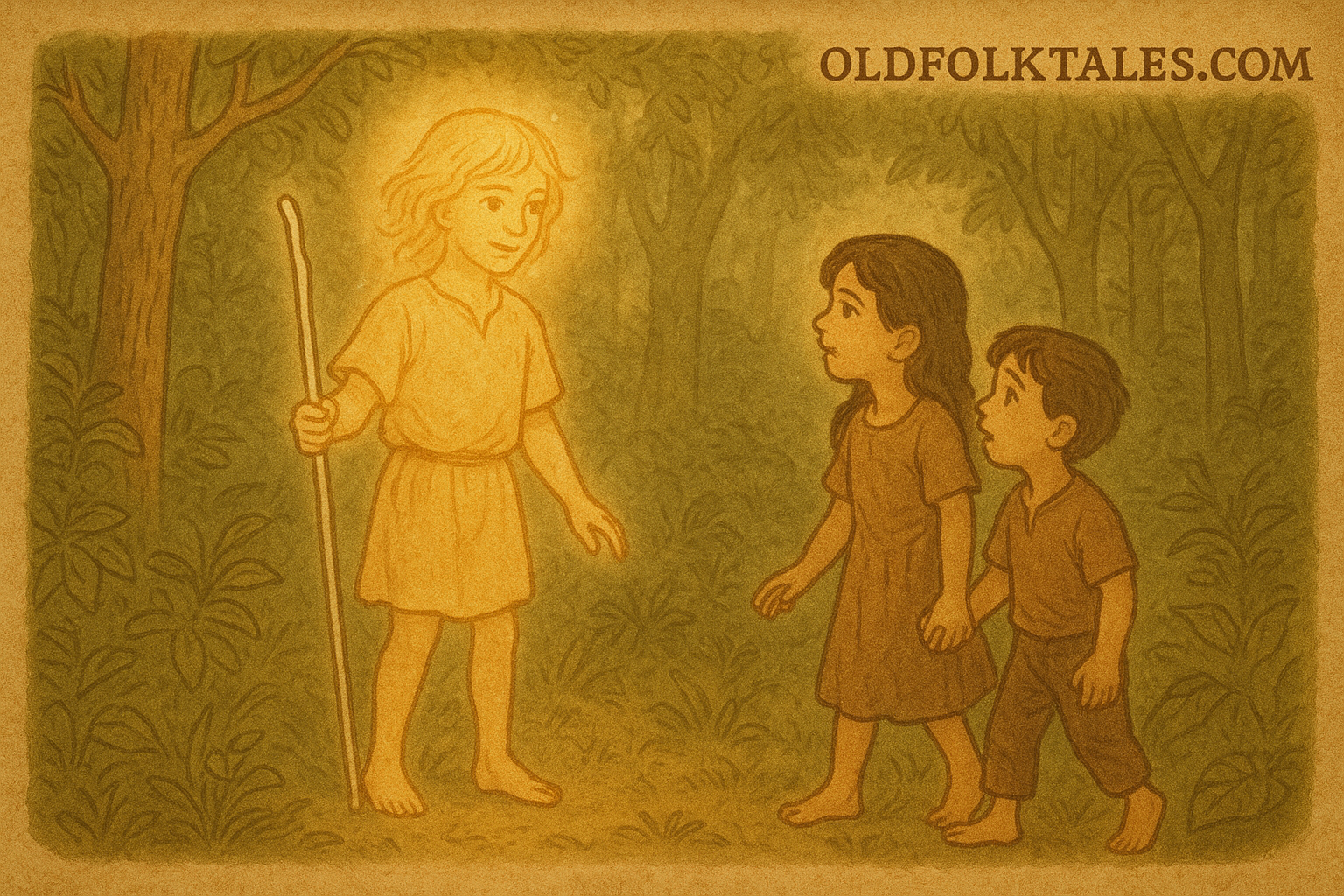
There stood Jasy Jatere, exactly as the stories had described him. His silver staff gleamed in his small hand, catching the sunlight and throwing it back in dazzling patterns. His golden hair seemed to hold its own light, and his eyes were the blue of the sky before a storm. He watched Tomás, who twirled in a slow circle in the center of the clearing, completely entranced by an invisible melody that only he could hear. The little boy’s eyes were distant and unfocused, as if he were dreaming while awake.
Jasy Jatere turned his penetrating gaze upon Lucía, and she felt as if those blue eyes could see straight through to her soul, reading all her fears and secrets. “Why do you seek your brother when all should be at rest?” he asked, his voice carrying the sound of wind through leaves and water over stones.
Lucía’s voice trembled, but she forced herself to speak with all the courage she could gather. Her hands clenched into small fists at her sides. “We got lost. Please, please let us go home. Our mother will be worried.”
The spirit studied her for a long moment that seemed to stretch into eternity. His expression was unreadable, neither kind nor cruel, simply ancient and knowing. “Those who respect the siesta are always welcome to return,” he said at last. “But those who do not listen ” He waved his silver staff through the air, and Tomás’s eyes suddenly cleared, confusion flickering across his small face as he seemed to wake from a trance.
Lucía immediately grabbed her brother’s hand, squeezing it tightly. “We’re sorry,” she said, the words tumbling out in a rush. “We didn’t mean to disobey. We heard the laughter and we were curious, but we know now that we should have listened to our abuela’s warnings.”
Jasy Jatere’s stern expression softened slightly, and he knelt down to their level, bringing his face close to theirs. His blue eyes were kind now, filled with an understanding that came from watching over children for countless generations. “The forest is both a gift and a test,” he said softly, his words carrying wisdom beyond measure. “You must remember its rules and honor its silence. The siesta is not just for rest it is a time when the worlds grow close, and those who wander without respect may find themselves lost between them.”
He reached out and plucked a single yerba mate leaf from a nearby bush, holding it delicately between his fingers. The leaf’s veins began to shimmer with golden light, pulsing gently like a tiny heartbeat. He placed it carefully in Lucía’s palm, and she felt its warmth spread through her hand. “This will help you find your way,” he said. “Follow its light, and remember what you have learned here today.”
The children hurried back through the woods, guided by the leaf’s gentle glow that cut through the confusing shadows and showed them the true path. The forest seemed to part before them now, branches moving aside and roots becoming smooth beneath their feet. When they finally reached the edge of the village, they ran straight into their mother’s arms, sobbing with relief and exhaustion.
Their mother held them close, tears streaming down her face, asking no questions about where they had been or what they had seen. Perhaps she already knew, or perhaps she simply understood that some experiences were too sacred and strange for words.
That night, Lucía tucked the magical leaf beneath her pillow, and it continued to glow softly in the darkness, casting dancing shadows on the walls. She dreamed of the gentle spirit who watched over children not to harm them, but to teach them the importance of respect, courage, and the hidden laws of nature that governed the world beyond the village.
From then on, every siesta became a time of reflection and peace for Lucía and Tomás. They would sit quietly with their abuela in the cool shade of their home, sipping mate from a shared gourd, its bitter taste a reminder of the forest’s lessons. They listened carefully to tales of the old spirits who walked the land, and they whispered thanks to Jasy Jatere for guiding them safely home and giving them a second chance to honor the sacred hours of rest.
Explore myths and legends from Brazil, Peru, and Argentina rooted in spirit and survival.
The Moral Lesson
The tale of Jasy Jatere and the lost children teaches us that rules and traditions exist for our protection, even when we don’t fully understand their purpose. Curiosity and adventure are natural parts of childhood, but they must be balanced with respect for wisdom passed down through generations. The story shows that mercy and second chances are given to those who acknowledge their mistakes with genuine humility and courage. Most importantly, it reminds us that the natural and spiritual worlds demand our respect, and those who learn to honor the boundaries between worlds will find guidance rather than danger, even in the darkest forests.
Knowledge Check
Q1: Why was the village of Ka’aguy Poty particularly anxious during this story? A: The village was experiencing a severe dry season with no rain for many weeks. Rivers ran low, crops struggled in the heat, and the air was filled with worry. Parents watched their children more closely, and elders gathered in council, concerned that the drought might be a sign that the balance between the human and spirit worlds had been disrupted.
Q2: What were the darker aspects of Jasy Jatere’s legend in the village? A: Beyond being a magical forest spirit, Jasy Jatere was feared because children who wandered during siesta could be lured into the woods and vanish. Some returned days later, changed forever by their experience, while others were never seen again, becoming permanent losses to their families.
Q3: How are Lucía and Tomás different in personality, and how does this affect the story? A: Tomás is mischievous and bold, quick to chase adventure without thinking of consequences, which leads him to follow the mysterious laughter. Lucía is gentle but fiercely protective, following her brother not out of disobedience but out of love and the need to keep him safe, demonstrating responsible concern even while breaking the rules.
Q4: What test does Jasy Jatere present to the children in the forest? A: Jasy Jatere tests whether the children understand and respect the sacred rules of siesta and the forest. He observes how they respond to being lost and entranced, and judges their humility and sincerity when they apologize and ask to return home, determining whether they deserve guidance back to safety.
Q5: What is the significance of the glowing yerba mate leaf? A: The glowing yerba mate leaf represents Jasy Jatere’s mercy and guidance for those who show genuine remorse and respect. Its golden light cuts through the confusing forest and shows the true path home, symbolizing how wisdom and respect for tradition can guide us safely through life’s challenges.
Q6: How does this encounter change Lucía and Tomás permanently? A: After their encounter, the siblings transform their attitude toward siesta and tradition. They begin sitting peacefully with their grandmother during rest hours, listening carefully to stories of the old spirits, and offering thanks to Jasy Jatere. They learn that respect for boundaries and traditions is not restrictive but protective.
Source: Adapted from traditional Guaraní oral folklore and mythology
Cultural Origin: Guaraní Indigenous People, Paraguay (with variations found in Argentina, Brazil, and Bolivia)