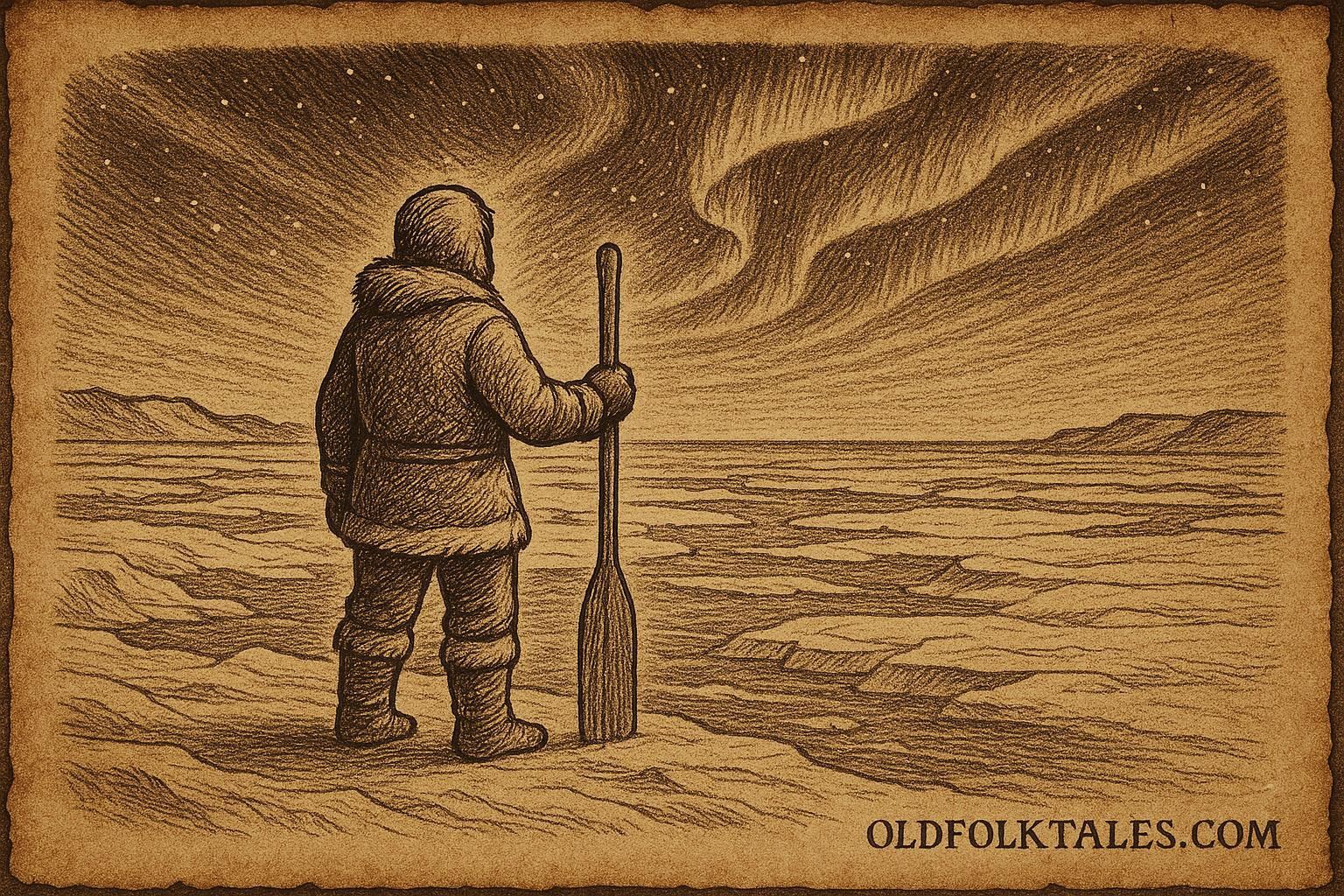
In the farthest reaches of the Arctic, where the land meets the frozen sea and the wind never truly rests, there lives a legend that has been told for countless generations. It is the story of Kiviuq, the eternal wanderer, the man who journeyed farther than any other and lived through trials that no ordinary person could survive. To the Inuit people, Kiviuq is not just a hero of the past. He is a reflection of life itself, of struggle, endurance, and the quiet wisdom that comes from listening to the world.
Long ago, the world was young and full of magic. People lived closely with the animals and the spirits of the land, who spoke in the voices of the wind, the waves, and the snow. Kiviuq was born into this world, strong and curious, but restless. He could not stay in one place for long. His heart belonged to the horizon, and wherever the sun touched the ice, he wished to follow.
Kiviuq’s journeys began when his village was struck by a great storm. The winds tore the tents apart, and the sea swallowed the hunters’ kayaks. When the storm cleared, Kiviuq found himself alone on a drifting piece of ice, carried far from home. He had only his paddle and his courage. As the current pulled him across the endless sea, he prayed to the spirits for strength.
Explore the land of La Llorona, trickster coyotes, and magical realism in Mexican folklore
The first beings Kiviuq met on his travels were a pair of giant women who lived by the shore. They were taller than trees and stronger than bears. When they saw him, they laughed and said, “Little man, you are far from home. We will crush you for sport.” But Kiviuq, who had learned from the wisdom of his ancestors, spoke softly and offered them songs instead of fear. His voice was calm and beautiful, and the giants, moved by his courage, let him live. They gave him food and told him stories of other lands beyond the horizon.
As Kiviuq traveled onward, he met animals that could speak. He met a fox who taught him how to move silently through the snow. He met a loon who showed him how to travel long distances without losing direction. He even met a seal who told him how to dive into the cold water and breathe through the stillness of the deep. From each of these encounters, Kiviuq learned something new about the world and about himself.
In one story, Kiviuq came upon a village that had been cursed by an evil spirit. The people there were trapped in darkness, unable to see the sun. Kiviuq listened to their cries and decided to help. He followed the sound of the spirit’s laughter to a cave at the edge of the world. There, a shadowy creature guarded a lamp made of ice. Kiviuq struck the creature down with his paddle and freed the light, returning it to the sky. The people rejoiced, calling him a hero and offering him gifts, but Kiviuq did not stay. He was not meant to rest. His path led ever onward.
As he continued his journey, Kiviuq faced betrayal and loss. He fell in love once with a woman who was not what she seemed. She was a spirit of the sea, and though she cared for him deeply, she belonged to another world. When she left him, Kiviuq wept upon the ice until his tears froze to his face. But even in sorrow, he rose again and walked forward.
The elders say that Kiviuq’s journey never truly ended. Some say he turned into a spirit himself, wandering still across the ice and snow. Others say he sleeps beneath the frozen sea, waiting for a time when his people will need him again. Whenever the wind howls across the tundra or the ice cracks beneath the stars, some believe it is Kiviuq’s voice, calling to the next generation to be strong, brave, and wise.
Through his travels, Kiviuq became more than a man. He became a bridge between the human world and the world of spirits. He carried the lessons of animals, the strength of the land, and the compassion of his people. Each hardship he faced reminded him that life in the Arctic was never about conquest, but about harmony. Those who listened to the stories of Kiviuq learned that courage was not found in fighting nature, but in respecting it.
Even today, Inuit elders tell the story of Kiviuq to remind the young of who they are. The ice, the sea, and the sky are not obstacles but teachers. Every challenge faced with patience and understanding is another step on Kiviuq’s endless path.
Some say that Kiviuq will return one day when the balance of the world is broken. He will rise from the sea ice, carrying his paddle and his old wisdom, to guide his people once more. Until then, his story continues in every hunter who braves the cold, in every traveler who watches the northern lights, and in every child who listens to the old tales and learns to endure.
Explore French-Canadian legends and First Nations myths in our Canadian Folktales collection
Moral Lesson
The legend of Kiviuq teaches that courage, wisdom, and respect for nature are the foundation of survival. The story reminds us that life’s challenges are not punishments but opportunities for growth. Through Kiviuq’s journey, we learn that true strength lies in perseverance and harmony with the world.
Knowledge Check
1. Who is Kiviuq in Inuit folklore?
Kiviuq is a great wandering hero who travels across land, sea, and ice, encountering spirits and animals that teach him wisdom.
2. What happens when Kiviuq is caught in a storm?
He becomes separated from his village and begins his long journey across the Arctic.
3. How does Kiviuq defeat the spirit that trapped the sun?
He fights the creature in its cave and frees the light, returning it to the people.
4. What lessons does Kiviuq learn from the animals he meets?
He learns patience, silence, endurance, and respect for the natural world.
5. Why is Kiviuq considered a symbol of survival?
Because his journey reflects the resilience, adaptability, and wisdom of the Inuit people living in a harsh environment.
6. What do the Inuit believe about Kiviuq’s fate?
Some believe he still wanders the world, while others say he will return when his people need him most.
Source: Unikkaaqtuat: An Introduction to Inuit Myths and Legends by Neil Christopher, Inhabit Media, 2011.
Cultural Origin: Inuit First Nations, Arctic Canada