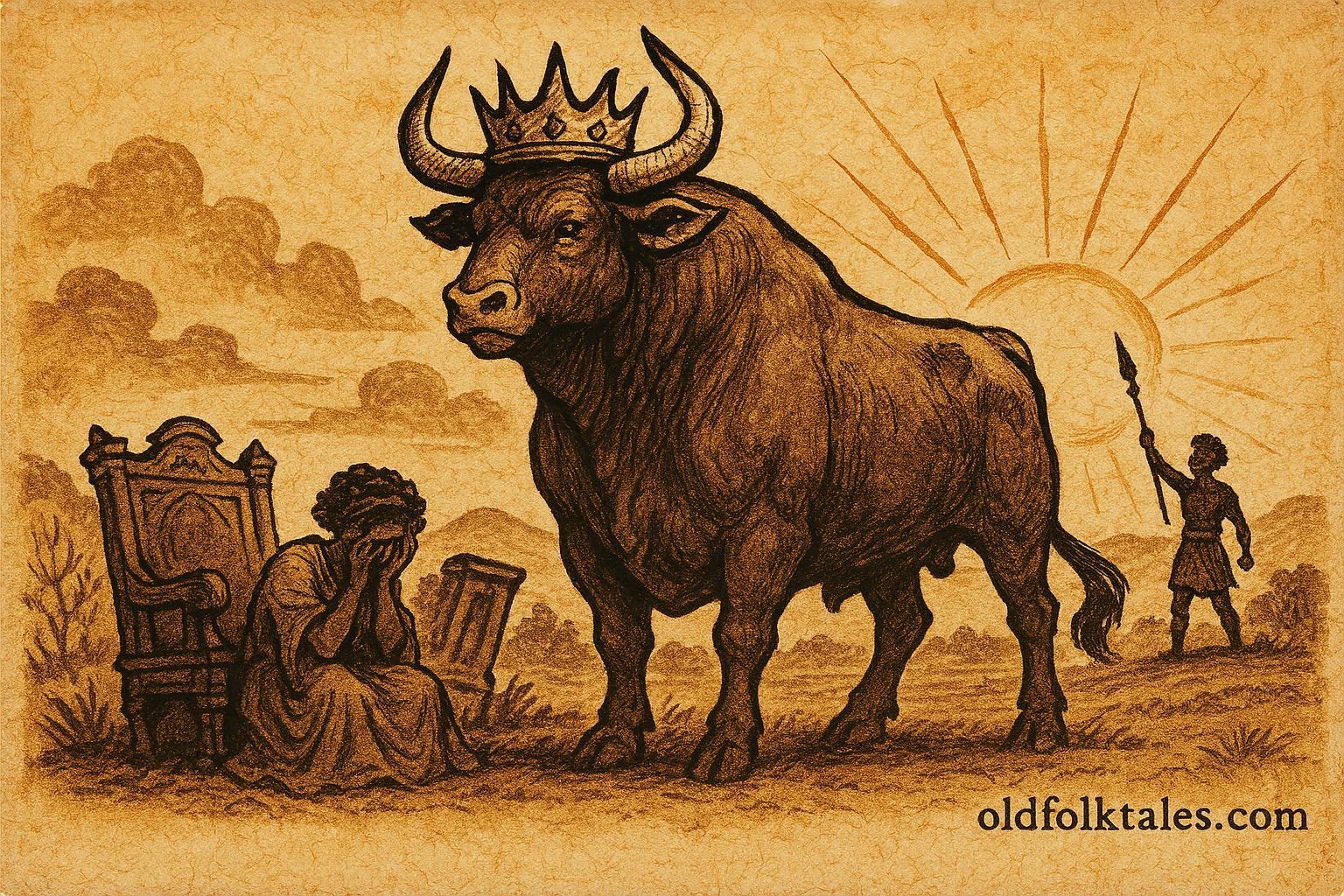
In the beginning, before the world had settled into the order we know, the island trembled beneath the hooves of a bull so mighty that even the earth seemed to obey him. His name was Bregantino Bregantín, a name that rolled like thunder across the plains.
He was no ordinary beast. His horns curved like silver crescents, his eyes glowed with red fire, and when he bellowed, the skies darkened. Some said he had come from the deepest part of the forest where spirits dwell. Others whispered he was born of vengeance itself, the offspring of pride and rage.
Discover ancient tales passed down by the Indigenous peoples of the Americas.
In that time, there was a prosperous kingdom ruled by a wise king and a gentle queen. The people lived in peace, their lives guided by rhythm, harvest, and the blessings of Olodumare. Men and women worked side by side, and songs filled the evenings. But balance never lasts forever when arrogance stirs in the shadows.
One day, the bull Bregantino Bregantín appeared at the gates of the royal palace. His hooves shattered the earth as he roared a challenge so fierce that even the king’s strongest warriors trembled.
“I will rule!” the bull bellowed. “No man shall stand before me!”
The king, proud and bound by duty, took up his spear and confronted the beast. But no mortal weapon could wound that hide. The bull charged, impaling the king upon his horns, and flung his lifeless body across the palace courtyard.
The kingdom fell silent. Bregantino Bregantín lifted his bloody horns and declared himself ruler over all. Then he did the unthinkable, he decreed that all men in the realm be put to death. Soldiers, farmers, and children alike vanished beneath his fury. The land became a kingdom of women, frightened, grieving, and enslaved to the will of the beast.
With savage cunning, the bull took possession of the royal palace. He sat upon the king’s throne, surrounded by gold and silks, and gave commands that twisted language itself. “From this day forward,” he declared, “no word shall carry the mark of manhood. You will speak only in the tongue of submission. No ‘he,’ no ‘king,’ no ‘lord.’ There is only Bregantino Bregantín.”
Even words bowed beneath his hoofprints.
The queen, once radiant with grace, was cast into a dark cell beneath the palace. He ordered her to be fed nothing but dust and bitterness, declaring, “No one shall speak her name. She is a relic of the world I have broken.”
Days became nights, and nights became seasons. The kingdom sank into despair. The fields grew wild. The laughter of children was gone. The women, once full of song, moved silently beneath the bull’s shadow, their eyes hollow.
And yet, life clings stubbornly to hope.
Hidden deep within the palace walls, a small boy had been spared, the queen’s own son, the last surviving male in the land. His nurse, risking everything, had concealed him from Bregantino Bregantín’s gaze. She fed him in secret, taught him the names of the old gods, and whispered stories of courage into his dreams.
Years passed. The boy grew strong, his heart burning with the memory of his mother’s suffering and his father’s death. He learned to wield the spear left behind by the fallen king. One night, as thunder rolled over the sea, he heard the voice of his mother in a vision, faint but clear.
“My son,” she whispered, “rise. The time has come to end the darkness. Only you can restore what has been lost.”
At dawn, he emerged from hiding and climbed the steps of the palace. The women, seeing him alive, fell to their knees in awe and terror. The bull, hearing the stir of defiance, stormed into the courtyard.
“So,” thundered Bregantino Bregantín, “a man dares to breathe in my kingdom?”
The young man raised his father’s spear. “You have ruled through blood and fear, but your reign ends today.”
The bull laughed, shaking the earth. “You are but a child before my power!”
Yet when the beast charged, the boy did not flee. He waited, calm and steady, and at the perfect moment, he thrust the spear deep between the bull’s eyes. The sound echoed like the splitting of the heavens. Bregantino Bregantín fell, his body trembling, his fire fading.
As his blood soaked into the ground, a wind swept across the land. The sun rose higher, the rivers sang again, and from the earth itself, men were born anew, fathers, sons, brothers returning to a world restored.
The queen, weakened from years of hunger, emerged from her prison to see her son standing tall. Tears filled her eyes, for she knew her sacrifice had not been in vain.
But she did not live long after that day. Her spirit, at peace, rose to join the ancestors. And so, under her son’s rule, the kingdom found balance again, neither man nor woman above the other, but joined as one under the gaze of the divine.
They say that, even now, in the hills of Cuba, when thunder rolls and cattle bellow in the night, you can hear the ghost of Bregantino Bregantín, a warning against tyranny and the folly of power without compassion.
Moral Lesson
Power without wisdom destroys both ruler and realm. Bregantino Bregantín teaches that domination, whether by strength or fear, always collapses under its own cruelty. True balance, between male and female, strength and compassion, is the foundation of justice and life.
Knowledge Check
- Who was Bregantino Bregantín?
A mighty bull who overthrew a human king and ruled the kingdom through fear and destruction. - What decree did Bregantino Bregantín make after taking power?
He banned all men and even masculine language, declaring himself the sole ruler. - What happened to the queen during his reign?
She was imprisoned, deprived of food, and left to waste away in sorrow. - Who defeated Bregantino Bregantín?
The queen’s hidden son, the last surviving male, rose up and killed the tyrant bull with his father’s spear. - What happened after the bull’s death?
Men were reborn, balance returned to the land, and harmony was restored between men and women. - What lesson does this Afro-Cuban tale teach?
That tyranny and imbalance destroy creation, while justice and unity restore life.
Source: Adapted faithfully from “Bregantino Bregantín” in Afro-Cuban Tales (Cuentos Negros de Cuba) by Lydia Cabrera, translated by Alberto Hernández-Chiroldes & Lauren Yoder, University of Nebraska Press, 2004.
Cultural Origin: Cuba (Afro-Cuban oral tradition)