High in the windswept plains of the Andean Altiplano, where the air grows thin and cold, where the sky stretches endlessly and blue above stark landscapes of tough grasses and hardy shrubs, there existed a village that knew the meaning of hardship. The people who made their lives in this unforgiving place were descendants of the Aymara, strong folk who had learned through countless generations how to coax life from reluctant soil and survive winters that could freeze the breath in your lungs.
But there came a season when even their accumulated wisdom and stubborn endurance were not enough. The winter arrived early that year, sweeping down from the peaks with unusual ferocity. Frost came in the night and killed the crops before they could fully ripen. The potatoes in the ground froze solid. The quinoa stalks turned black and brittle. The few animals the village kept, llamas and alpacas, whose wool and meat sustained them, grew thin, for the grazing was poor and fodder scarce.
Click to read all South American Folktales — timeless stories from the Andes to the Amazon.
Hunger settled over the village like a heavy blanket, smothering hope and joy. Children cried with empty bellies. The elders grew quiet and drawn, rationing what little remained, knowing it would not be enough to see everyone through to spring. The people prayed to the apus, the mountain spirits, and to Pachamama, the earth mother, but the cold continued and the storehouses remained nearly empty.
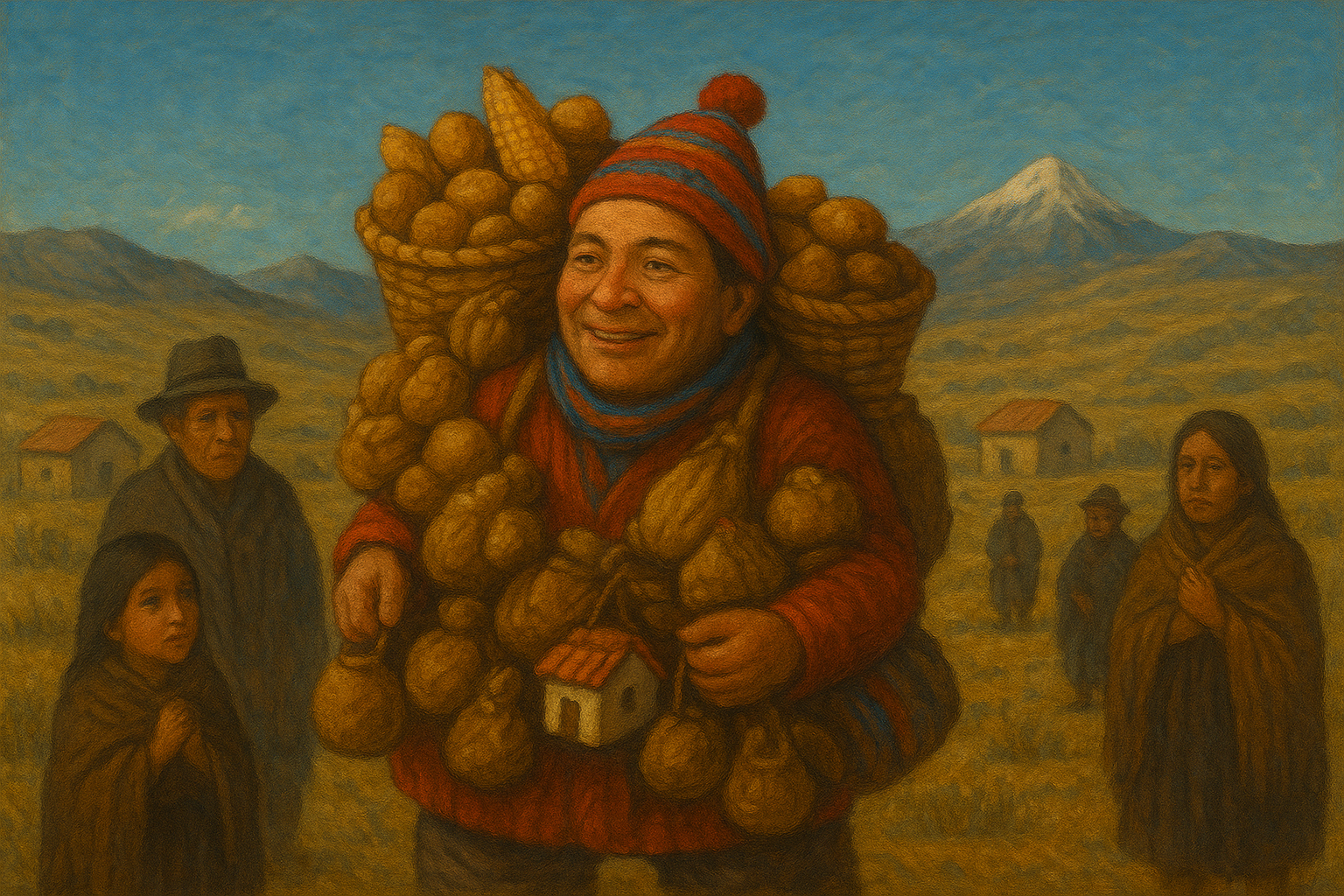
It was during this darkest time that something extraordinary happened. On a morning when the frost lay thick and white across everything, coating the world in crystalline despair, the villagers discovered a figure standing in the center of their plaza, a small man, no taller than a child, but clearly no child at all.
This was Ekeko, though they did not yet know his name. His appearance was remarkable, almost comical if circumstances had been less desperate. He was a stout little figure with a jovial, round face that seemed incapable of frowning, his cheeks ruddy as though he had just come in from pleasant work rather than brutal cold. But what truly amazed the villagers was what he carried or rather, what was loaded upon him.
Ekeko was covered, absolutely laden, with baskets and bundles and bags. Food spilled from containers strapped to his back corn with kernels like golden teeth, potatoes in rainbow hues, dried meat and grains. Small sacks that clinked with the sound of coins hung from his arms. Miniature tools, tiny bundles of cloth, little representations of all the necessities and comforts of life were tied and tucked into every available space on his person. He looked like a walking storehouse, a mobile market, a living embodiment of plenty in the midst of their deprivation.
The villagers approached cautiously, uncertain whether this strange visitor was spirit or human, blessing or trick. Ekeko smiled at them a warm, genuine smile that reached his eyes and seemed to chase away some of the cold that had settled in their bones. When he spoke, his voice was kind but carried an unmistakable authority.
“I am Ekeko,” he said, “and I have come because your need is great and your hearts, though tested by hardship, remain good. I offer you a promise: abundance in return for respect and sincerity. But understand this the abundance I bring is not mine to give freely. It must be earned through proper recognition, through community care, through balance between receiving and giving.”
He explained how they could invoke his blessing. They should create miniature versions of whatever they needed or desired tiny llamas if they needed animals, little fields of corn if they needed harvest, mini-homes if they needed shelter. These offerings should be presented to him with sincere hearts, not with grasping greed but with humble hope. And most importantly, they should remember always to share whatever abundance came to them, for prosperity hoarded becomes poverty of the spirit.
The villagers, desperate and willing, followed his instructions. With cold-numbed fingers, they fashioned small figures from clay and straw and bits of precious wool. They made tiny replicas of the things they needed to survive animals, food, warm clothing, sturdy homes. They placed these miniature offerings before Ekeko with prayers that mixed hope and desperation in equal measure.
And Ekeko, true to his word, brought them through the winter. The little god’s magic worked in subtle ways a storehouse they thought empty yielded one more sack of grain. A llama they had feared would die gave birth to healthy offspring despite the season. Traders appeared unexpectedly with goods to exchange. Small miracles accumulated into survival, and survival blossomed into relief, and relief eventually transformed into genuine abundance as spring finally arrived and the land responded to their renewed planting with unexpected generosity.
But Ekeko’s lessons had only begun. As the village prospered, as their storehouses filled and their herds multiplied, the little god watched to see what his people would do with their newfound plenty. Some remembered his teachings and shared freely with neighbors, welcomed strangers, gave thanks for their blessings. These families found that their abundance continued and even grew.
But others, intoxicated by prosperity after such deprivation, began to forget. They made offerings to Ekeko that were hollow miniatures created without sincerity, presented without genuine gratitude, accompanied by prayers that were lists of wants rather than expressions of thankfulness. They ignored those in need, hoarding their wealth and turning away from the community bonds that had sustained them through hardship.
These families learned Ekeko’s other lesson, the one about consequences. Their gifts began to vanish like morning mist under the sun. A full storehouse would somehow empty overnight. Coins counted and recounted came up short. Animals wandered away and couldn’t be found. The abundance that had come with such blessing disappeared with equally mysterious speed, leaving only bewilderment and the bitter taste of having possessed and lost.
The village elders understood. They gathered the people and reminded them of Ekeko’s original promise and its conditions. Abundance required respect and sincerity. Prosperity came to those who balanced receiving with giving, who remembered community over individual greed, who maintained reciprocity between themselves and the divine forces that sustained them.
From that time forward, the people established a festival to honor Ekeko properly the Alasitas, a celebration of miniatures and wishes. The festival came to be held on different dates in different places the first of May in Peru, late January in Bolivia but its purpose remained constant. During Alasitas, the people would gather in markets filled with tiny versions of everything imaginable. Artisans crafted miniature houses with perfect little doors and windows, tiny cars with wheels that turned, small suitcases packed with tinier clothes, diminutive bags of rice and sugar and coca leaves.
People would purchase these miniatures and present them to statues or images of Ekeko still depicted as that jovial little man loaded down with baskets and bundles, his face eternally cheerful, his arms perpetually full. They would place their tiny wishes before him and pray that in the coming year, these miniature desires would manifest in full size. A miniature house offered this year might become a real home next year. Tiny currency might transform into actual wealth. Small representations of livestock could herald the growth of real herds.
But those who truly understood Ekeko’s teachings knew the festival was about more than acquiring things. The miniatures served as reminders of what they valued, yes, but also as acknowledgments that all abundance ultimately came from sources beyond their individual control from the earth, from the sky, from the community, from the divine. The act of offering miniatures to Ekeko was an exercise in humility, a recognition that humans must ask rather than demand, must receive with gratitude rather than take with entitlement.
And woven through all of Ekeko’s blessings was that essential lesson about giving. The little god with his impossible load of provisions modeled the truth that prosperity is meant to be shared, not hoarded. His jolly face reminded them that abundance should bring joy, not anxiety about losing what you have. His willingness to help the village in their desperate winter demonstrated that the divine responds to genuine need accompanied by sincere hearts.
The people learned that greed was the enemy of abundance. The more tightly you grasped at wealth, the more quickly it slipped through your fingers like water. But the more freely you shared, the more generously you gave to those in need, the more you maintained the bonds of community and reciprocity the more abundance flowed back to you, reliable as the seasons, steady as the mountains.
Ekeko became more than just a god of material prosperity. He became a teacher of balance, a reminder that true wealth encompasses more than possessions. A village where people helped one another was richer than a village of isolated hoarders, even if those hoarders had larger storehouses. A family that shared its meals with neighbors was wealthier than a family that ate alone behind closed doors, even if those closed doors were made of finer wood.
To this day, Ekeko remains a beloved figure throughout the Andean Altiplano. His image appears in homes and businesses, markets and festivals. People still buy miniatures during Alasitas and present them with hope and prayer. And those who understand his teachings recognize that when they place a tiny house or a miniature car or a small bag of abundance before his statue, they are not simply asking for things they are participating in a ancient covenant that binds individual prosperity to community generosity, that ties material abundance to spiritual balance, that reminds them that the greatest wealth is not what you accumulate but what you share.
Explore myths and legends from Brazil, Peru, and Argentina rooted in spirit and survival.
The Moral Lesson
The legend of Ekeko teaches that true abundance comes not from accumulation but from balance between receiving and giving. It emphasizes that prosperity requires sincerity, respect, and genuine gratitude rather than hollow greed or selfish hoarding. The tale shows that material wealth disconnected from community generosity becomes meaningless and unstable, while abundance shared freely creates lasting prosperity for all. Most profoundly, Ekeko’s story reminds us that the relationship between humans and the sources of prosperity whether divine, natural, or communal must be reciprocal, built on humility and acknowledgment that we are part of an interconnected system where true wealth is measured not by what we possess alone but by what we can give to others.
Knowledge Check
Q1: Who is Ekeko and what makes his appearance distinctive in Andean folklore? A: Ekeko is the Andean god of abundance and prosperity, depicted as a small, jovial man no taller than a child with a perpetually cheerful, ruddy face. His most distinctive feature is that he is laden with baskets, bundles, and bags containing food, coins, tools, and all manner of goods, a walking embodiment of plenty. He originated from the Aymara people of the Altiplano region spanning Bolivia and Peru.
Q2: Under what circumstances did Ekeko first appear to the village in this folktale? A: Ekeko appeared during a particularly harsh winter when the village faced desperate hardship and potential starvation. Early frost had killed crops before they ripened, potatoes froze in the ground, quinoa turned black, and animals grew thin from poor grazing. The people’s prayers seemed unanswered until Ekeko mysteriously appeared in their plaza, offering hope during their darkest time.
Q3: What conditions did Ekeko attach to his promise of abundance? A: Ekeko promised abundance in return for respect and sincerity. He required people to create miniature versions of their needs and present them with genuine, humble hearts not grasping greed. Most importantly, he taught that recipients of abundance must share their prosperity with others and maintain community bonds, as prosperity hoarded becomes poverty of spirit.
Q4: What is the Alasitas festival and how do people participate in it? A: Alasitas is a festival honoring Ekeko, celebrated on May 1st in Peru and in late January in Bolivia. During this festival, markets fill with miniature versions of everything imaginable houses, cars, food, livestock, money. People purchase these tiny items and present them to Ekeko statues or images, praying that their miniature wishes will manifest in full size during the coming year.
Q5: What happened to villagers who forgot Ekeko’s teachings about generosity? A: Villagers who became greedy after prosperity arrived, who made hollow offerings without sincerity, who hoarded wealth and ignored those in need, found their abundance mysteriously vanishing. Their full storehouses would empty overnight, counted coins came up short, and animals disappeared. Ekeko’s magic withdrew from those who violated the principle of reciprocity and community sharing.
Q6: What deeper meaning does Ekeko represent beyond material prosperity? A: Ekeko represents the principle that true wealth encompasses more than possessions it includes community bonds, generosity, balance, and spiritual reciprocity. He teaches that prosperity is a covenant between individuals and their community, between humans and divine forces, requiring humility and acknowledgment of interconnection. His legend emphasizes that the greatest abundance comes not from what we accumulate but from what we share, and that material prosperity disconnected from generous spirit becomes hollow and unsustainable.
Source: Adapted from “Ekeko” , Andean oral traditions of the Altiplano region.
Cultural Origin: Aymara and other indigenous peoples of the Andean Altiplano region, primarily Bolivia and Peru