Under the golden Caribbean sun, the earth shimmered with heat, and the scent of ripening fruit drifted through the fields. Near a small Surinamese village, a farmer tended his lush melon patch, the pride of his garden. The vines wound like green rivers, heavy with round, sun-glossed melons that seemed to hum with sweetness.
Now, not far away, Anansi the Spider, small, sly, and endlessly hungry, skittered through the tall grass. His belly rumbled like thunder. “Ah,” he said, licking his lips, “what a fine day for a feast! I can smell something delicious.”
Following the scent, Anansi found himself at the edge of the farmer’s field. His eyes widened with delight at the sight of so many melons, big as gourds and glistening with dew. “Well, well,” he whispered, “the farmer has worked hard. It’s only fair that I help him enjoy the fruits of his labor.”
Discover South America’s folktales filled with magic, transformation, and ancestral wisdom
He slipped between the vines, careful not to disturb the leaves. When he came to the biggest melon of all, he tapped it lightly. Thok! Thok! It rang full and ripe. “Perfect,” he said, “and just my size for breakfast.”
He nibbled a tiny hole in the rind and squeezed himself inside. Once within, the sweetness overwhelmed him. He ate until his legs could barely move, until his belly bulged like a drum. Satisfied, Anansi leaned back against the cool melon wall and sighed. “Ah, what a life. A fine meal and shade from the sun.”
But when he tried to crawl out, he realized he couldn’t move. His round belly wedged tightly against the hole. “Oh, bother!” he groaned, pushing and squirming. “Perhaps… after a nap, I’ll fit again.”
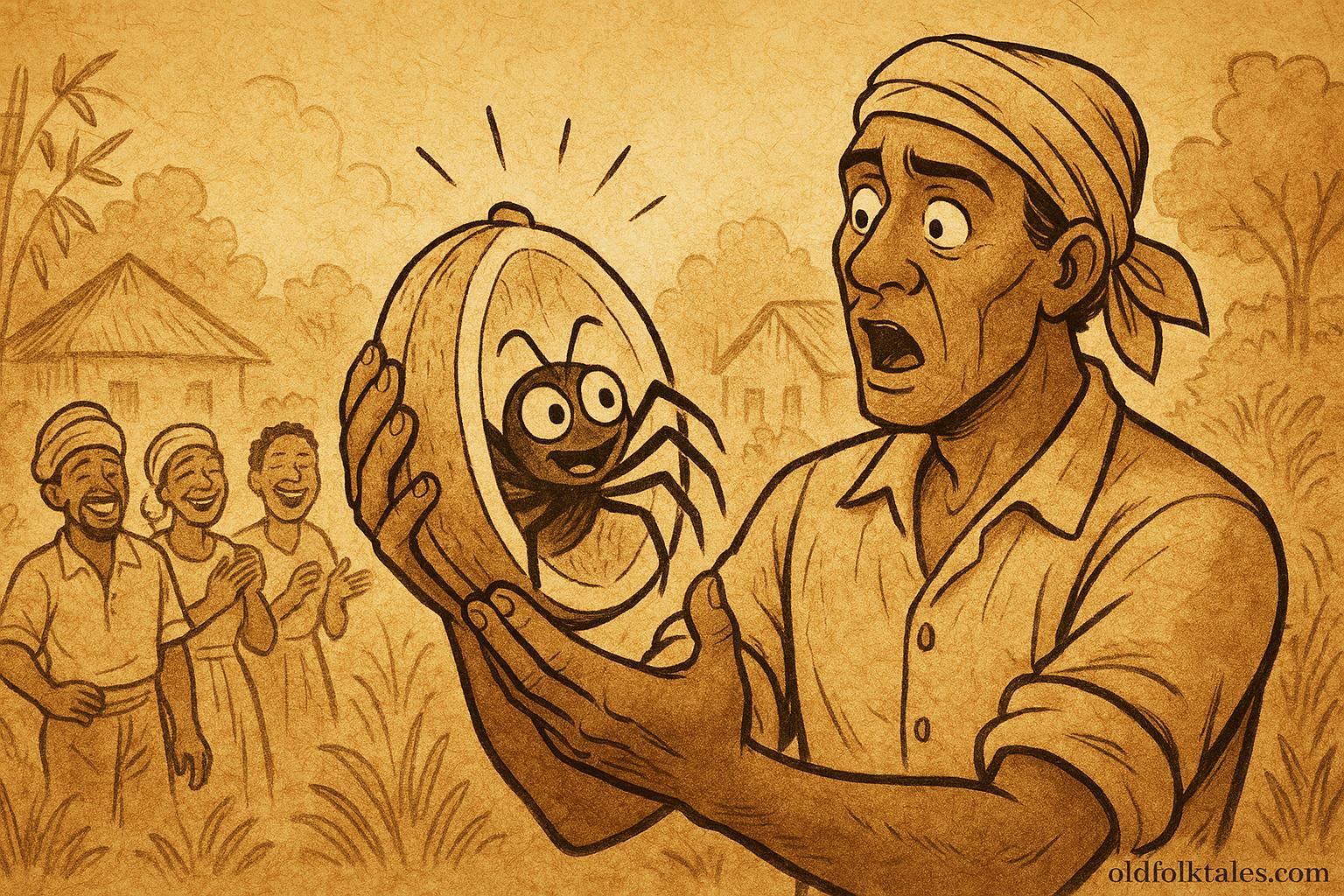
By the time the farmer arrived, the morning light had grown warm and the fields buzzed with insects. He inspected his melons with pride. “What fine fruit I’ve grown,” he said. “This one looks perfect for the chief’s table.” He stooped and lifted the very melon that held the drowsy spider.
Just then, Anansi, annoyed at being jostled, muttered from inside, “Do you mind? I was sleeping!”
The farmer froze. He turned the melon over, eyes wide. “Who said that?”
“I did,” came the muffled reply. “The melon you’re holding!”
The farmer dropped it in fright. “A talking melon!” he gasped. “This must be a miracle!”
He dashed toward the village, clutching the strange fruit in trembling hands. “Everyone, come see! My melon speaks!”
The villagers gathered, whispering and laughing nervously. The chief, a tall man with a proud bearing, stepped forward. “You claim this melon talks? Let’s hear it.”
The farmer bowed. “Yes, my lord. It spoke clear as you and I!”
“Then ask it a question,” the chief commanded.
The farmer cleared his throat. “Good melon, please greet our noble chief.”
From inside, Anansi’s voice rang out boldly, “Good morning, chief! You’re looking fatter than last week!”
The crowd gasped. Some covered their mouths; others burst out laughing. The chief’s face reddened. “What insolence! How dare a melon insult me?”
“It’s bewitched!” the farmer cried.
The chief frowned and leaned closer. “Who taught you to speak, melon?”
“You did, chief,” Anansi said smoothly. “You talk so much nonsense every day that even the melons learned from you!”
Laughter exploded through the crowd. The chief’s anger burned hotter than the noon sun. “This is no ordinary fruit!” he declared. “Take it to the king. Let him decide its fate!”
And so the farmer, embarrassed and sweating, carried the talking melon across hills and streams to the royal palace. Villagers followed, whispering about the wonder they’d witnessed.
In the king’s courtyard, Anansi continued his mischief. “Is this the royal melon market?” he shouted. “Because I’d like to sell some fine insults!”
The king blinked. “Did that melon just talk?”
“Yes, Your Majesty,” the farmer stammered. “It mocks everyone!”
The king stroked his beard. “Perhaps it’s a wise spirit in disguise. Melon, what wisdom do you have for me?”
Anansi chuckled. “Wisdom? Only that a wise king shouldn’t listen to foolish fruit!”
The court burst into laughter so loud that even the parrots in the trees joined in. But before the king could respond, the melon began to tremble. Anansi, shaking with laughter himself, had made the rind quiver. Suddenly, crack! the melon split wide open.
Out tumbled Anansi, sticky and giggling. The crowd gasped in astonishment as he scurried away shouting, “Thank you for the ride! Next time, I’ll bring dessert!”
By the time the farmer and king realized they had been tricked, Anansi had vanished into the tall grass, his laughter echoing on the wind.
From that day on, the story of Anansi and the Talking Melon spread across the Caribbean and beyond, carried by storytellers who loved a clever hero with a quick tongue.
Immerse yourself in Latin America’s stories of passion, transformation, and spirit.
Moral Lesson
This Afro-Surinamese folktale teaches lessons on cleverness, humor, and the triumph of intelligence over authority. Anansi’s wit reminds us that words, when used wisely, can turn even the smallest creature into the most powerful one.
Knowledge Check
1. Who is Anansi in the folktale “Anansi and the Talking Melon”?
Anansi is a clever spider and trickster figure from West African and Afro-Caribbean folklore known for using intelligence to outsmart others.
2. What happens to Anansi inside the melon?
He eats so much that he gets stuck inside the melon, leading to a series of comical events when the farmer finds it.
3. How does the talking melon trick the farmer and villagers?
Anansi speaks from inside, pretending the melon is talking, causing chaos and laughter among the people.
4. What lesson does “Anansi and the Talking Melon” teach?
The story teaches lessons on cleverness, humor, and how wit can overcome power or pride.
5. Where does this version of the Anansi tale originate?
It comes from Afro-Surinamese and Guyanese oral traditions, descended from Akan-Ashanti tales brought by enslaved Africans.
6. What cultural meaning does the talking melon hold?
It symbolizes the power of voice, creativity, and resilience, traits that reflect African diasporic storytelling traditions.
Source: Adapted from Afro-Surinamese and Guyanese oral folklore as recorded in African & Caribbean Folktales, Myths & Legends by Wendy Shearer (2021).
Cultural Origin: Afro-Surinamese / Afro-Caribbean (West African Akan influence).