On the high mesas of northeastern Arizona, where the Hopi people have cultivated corn and maintained their ancient ceremonies for more than a millennium, the relationship between ritual and survival is not metaphorical but direct and essential. In this arid landscape where rain is the difference between life and death, the ceremonial dances performed throughout the year are understood not as entertainment or cultural preservation but as vital work that maintains balance between the human world and the forces that sustain it.
The Hopi ceremonial calendar is complex and precise, with different dances performed at specific times according to an understanding refined over countless generations. These are not performances in the modern sense, but prayers made visible through movement, song, and costume. Each dancer who participates does so as part of something larger than themselves representing their clan, their village, their people’s relationship with the clouds, the corn, the spirits who bring rain to the thirsty earth.
Click to read all South American Folktales — timeless stories from the Andes to the Amazon.
Among the many dances that mark the Hopi year, the rain dances hold particular importance. In the villages perched atop the mesas, where summer heat beats down relentlessly and the sky often stretches blue and cloudless for weeks, the ceremonies that call the clouds and bring moisture to the fields are matters of communal survival. Every participant understands that they dance not for personal glory but for the corn growing in the terraced fields below, for the children who need water to drink, for the entire web of life that depends on the precious rain.
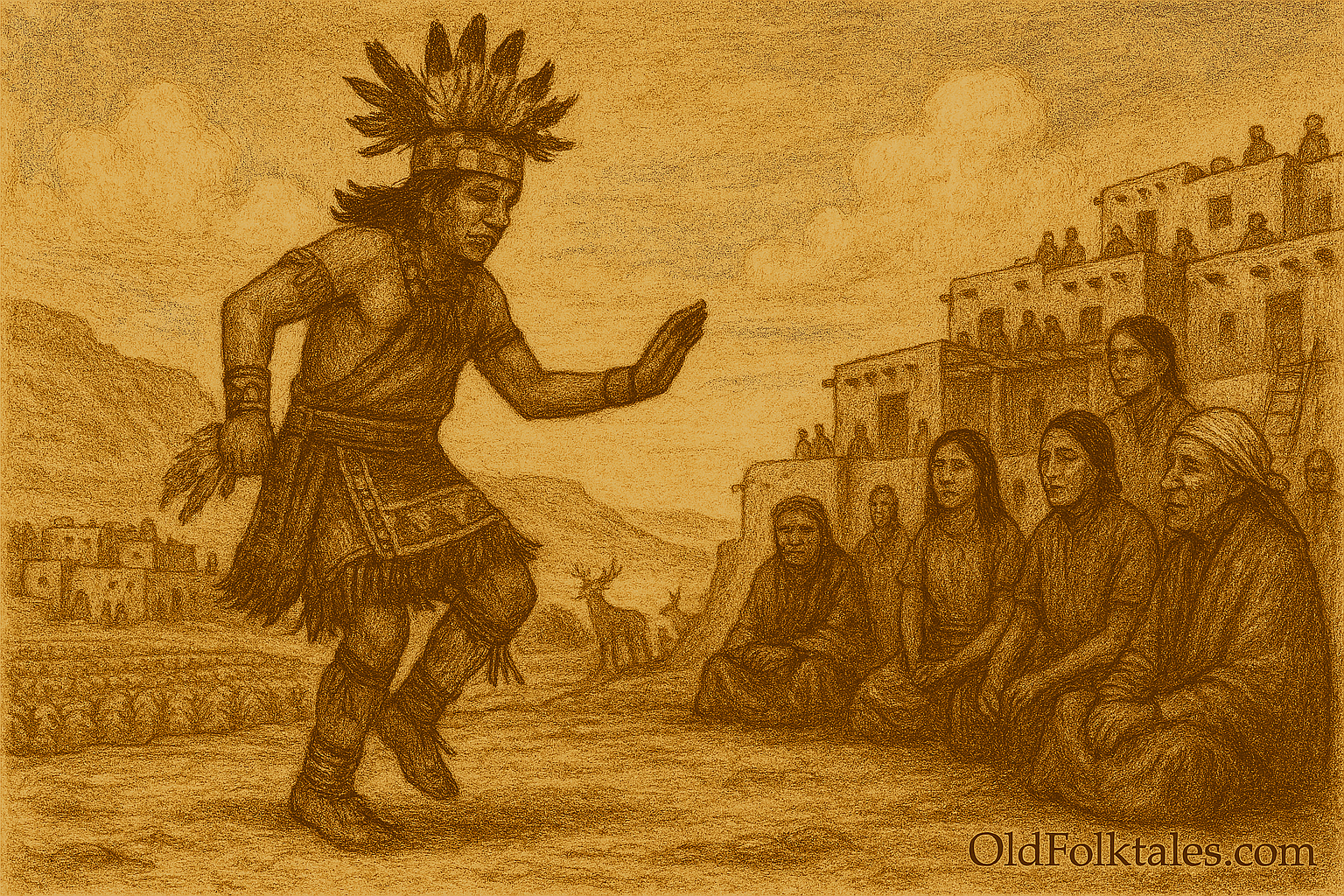
In one Hopi village, there lived a man named Honani, perhaps thirty years old, who had been initiated into one of the ceremonial societies and trained in the sacred dances since his youth. He was a skilled dancer his movements precise, his endurance impressive, his knowledge of the intricate patterns and songs comprehensive. When he danced, people noticed. His athleticism, his ability to maintain the demanding movements for hours under the burning sun, his elaborate costume that he maintained with meticulous care all of these drew attention and admiration.
And Honani had come to enjoy that attention perhaps more than he should have. Initially, like all dancers, he had approached the ceremonies with proper humility, understanding that he was merely one part of a collective prayer. But gradually, almost imperceptibly, his focus had shifted. He began to think about how he appeared to spectators. He spent more time perfecting his costume than the other dancers did, adding extra embellishments, ensuring that his appearance was more striking than necessary. During the dances themselves, he would position himself where he knew he would be most visible, where visitors from other villages and his own community members would be sure to notice him.
After ceremonies, Honani would linger in the plaza, hoping to hear praise for his performance. When people complimented his dancing, he would accept with false modesty that barely concealed his pleasure. When other dancers received attention, he felt a pang of jealousy. The purpose of the dance to bring rain, to maintain balance, to serve the community’s needs had become secondary in his mind to the personal satisfaction of being recognized as the best dancer, the most dedicated, the most impressive.
The elders noticed this shift, though they said nothing at first. They watched as Honani’s dancing became more about display than prayer, more about ego than service. They observed how he had subtly begun to treat the sacred ceremonies as opportunities for personal recognition rather than communal necessity. In their wisdom, they understood that such attitudes corrupt the very purpose of ritual and can have consequences that extend beyond the individual.
That year, as summer advanced and the time came for the rain dances that should bring the monsoon storms, Honani danced with his usual skill and even greater showmanship. He had added new elements to his costume, had practiced his movements until they were flawless, and positioned himself prominently throughout the ceremonies. After each dance, he awaited the praise he had come to expect and crave.
But the rain did not come. The ceremonies were performed correctly in their external forms the right songs sung, the right patterns danced, the right prayers spoken. Yet the clouds that should have gathered remained absent. The sky stayed a hard, bright blue. The corn in the fields below began to suffer, the leaves curling in the heat, the stalks growing stunted without adequate moisture.
Additional ceremonies were performed. The entire village participated with increasing desperation as days passed with no rain. But still the monsoons did not arrive. The situation grew critical. Water stores dwindled. The corn crop, essential for survival through the coming winter, was failing. Anxiety gripped the community as even the elders admitted they had never seen the ceremonies fail so completely to bring results.
Finally, one of the eldest men in the village, a leader of one of the ceremonial societies, called for a gathering of the initiated members. They met in the kiva, the underground ceremonial chamber where the most important discussions and rituals took place, away from casual observation. There, in the cool darkness lit only by a small fire, he spoke about what he had observed.
“The ceremonies are being performed correctly in form,” he said, his ancient voice carrying weight in the enclosed space. “The songs are right. The movements are proper. The timing is correct. Yet the rain does not come. This tells us that something essential is missing not in the actions themselves, but in the spirit with which they are performed.”
His gaze settled on Honani, who felt a cold understanding beginning to dawn. “When we dance,” the elder continued, “we do not dance for ourselves. We do not dance to be admired or praised. We do not dance so that others will notice our skill or our dedication. We dance for the corn. We dance for the children. We dance for the clouds and the rain spirits who respond not to our technical perfection but to the purity of our intention. A dance performed for ego, no matter how beautiful in appearance, is not a prayer. It is merely movement, and movement alone does not bring rain.”
The elder explained that the ceremonial dances-maintained balance through an exchange the community offering devotion, humility, and service in return for the blessings of rain and growth. But when a dancer approached the ceremony with self-serving motives, seeking personal recognition rather than communal benefit, the exchange was corrupted. The prayers became hollow. The connection to the forces that bring rain was severed, not because those forces were punishing ego but because ego by its nature breaks the relationship the ceremonies are meant to maintain.
“You have great skill, Honani,” another elder added, not unkindly. “But skill without proper spirit is like a beautiful pot with a crack it cannot hold what it was made to hold. You must examine your heart and remember why we dance.”
Honani felt shame wash over him as he recognized the truth in their words. He had become so focused on his own performance, on being seen and admired, that he had forgotten the actual purpose of what he was doing. The dances were not about him at all. They never had been. He was merely an instrument, a vessel through which the community’s prayer was expressed. By making himself the center, he had rendered himself useless for the true purpose.
He spent days in solitary contemplation, fasting and praying, working to strip away the ego that had accumulated like dust obscuring a mirror. He examined his motivations with painful honesty. He remembered his earlier years when dancing had felt like pure service, before the praise and attention had seduced him into self-focus. He understood now that he had to return to that original spirit, to dance with the same anonymity of intention as a corn plant growing in the field serving its purpose without thought of recognition.
When the next rain ceremony was scheduled, Honani participated differently. He deliberately wore a simpler costume, no more elaborate than necessary. He positioned himself not prominently but wherever he was needed in the pattern of the dance. Most importantly, he released all thought of how he appeared to others. Instead, he focused entirely on the purpose of the dance calling the clouds, serving the corn, offering himself as part of the community’s collective prayer.
As he danced, something shifted within him. The movements became not performance but prayer, not display but offering. He felt himself dissolving into the larger whole, his individual identity less important than the collective intention. For the first time in months, he experienced the ceremonies as they were meant to be experienced as communal acts where individual egos disappeared into shared purpose.
That evening, clouds began to gather over the mesas for the first time in weeks. By nightfall, the smell of rain was in the air. And before dawn, the blessed moisture finally came gentle at first, then steady, soaking into the thirsty earth, reviving the suffering corn, filling the storage cisterns, bringing relief and joy to the entire village.
The rain continued periodically through the rest of the summer as the monsoons finally established themselves. The corn recovered and produced a sufficient harvest. The village survived. And Honani had learned a lesson that went beyond dancing that any service, any ritual, any work done on behalf of others loses its power when corrupted by ego, and that the greatest skill is worthless if not offered with humility and proper spirit.
Click to read all Andean Highland Folktales — echoing from the mountain peaks of Peru, Bolivia, and Ecuador.
The Moral Lesson
This Hopi tale teaches that sacred rituals and communal practices lose their essential power when performed for personal recognition rather than collective benefit. Honani’s technical skill as a dancer was never in question, but when his motivation shifted from service to ego, from community need to personal praise, the ceremonies became empty performances incapable of fulfilling their purpose. The story reminds us that in many spheres of life whether religious ritual, community service, leadership, or any work done ostensibly for others the spirit in which we act matters as much as the actions themselves. When ego becomes the driving force, even technically correct performance fails to achieve its intended purpose because the essential relationship between self and community, between human action and larger forces, has been corrupted. True effectiveness in service requires humility and the ability to subordinate personal recognition to collective need.
Knowledge Check
Q1: What is the purpose of ceremonial dances in traditional Hopi culture?
A1: In Hopi culture, ceremonial dances are not entertainment or cultural displays but vital work that maintains balance between the human world and the forces that sustain life, particularly rain in the arid Arizona landscape. These dances are prayers made visible through movement, song, and costume, performed at specific times according to an ancient calendar. Each dancer participates as part of something larger than themselves, representing their clan and village’s relationship with the clouds, corn, and rain spirits. The ceremonies are understood as essential for survival, with rain dances being particularly critical for bringing moisture to sustain crops.
Q2: How did Honani’s approach to ceremonial dancing change over time?
A2: Honani began with proper humility, understanding himself as one part of a collective prayer. However, he gradually shifted focus from the ceremony’s purpose to how he appeared to spectators. He spent excessive time perfecting his costume with unnecessary embellishments, positioned himself prominently during dances to be noticed, and lingered afterward hoping for praise. After ceremonies, he would seek recognition and feel jealous when other dancers received attention. The purpose of bringing rain and serving community needs became secondary to his desire for personal recognition as the best, most dedicated, and most impressive dancer.
Q3: What happened when Honani danced with ego-driven motivation?
A3: Despite ceremonies being performed correctly in their external forms with right songs, proper movements, and correct timing the rain did not come. The monsoons that should have arrived remained absent, the sky stayed cloudless, and the corn began failing in the fields. The village performed additional ceremonies with increasing desperation, but still no rain came. The situation became critical as water stores dwindled and the essential corn crop faced failure, threatening the community’s survival through winter. The ceremonies’ technical correctness could not compensate for corrupted intention.
Q4: What explanation did the elders give for the rain’s absence?
A4: The elders explained that while ceremonies were technically correct in form, something essential was missing in the spirit of their performance. They taught that dancers perform not for themselves or admiration but for the corn, children, and rain spirits who respond to purity of intention rather than technical perfection. A dance performed for ego, however beautiful in appearance, is merely movement, not prayer, and cannot bring rain. The ceremonial exchange requires offering devotion, humility, and service in return for blessings, but when approached with self-serving motives seeking personal recognition, this exchange is corrupted and the connection to rain-bringing forces is severed.
Q5: How did Honani change his approach to restore the ceremonies’ effectiveness?
A5: Honani spent days in solitary contemplation, fasting and praying to strip away accumulated ego. He examined his motivations with painful honesty and worked to return to his original spirit of pure service. In the next ceremony, he deliberately wore a simpler costume, positioned himself wherever needed rather than prominently, and most importantly, released all thought of how he appeared to others. He focused entirely on the ceremony’s purpose calling clouds, serving corn, offering himself as part of collective prayer. His movements became prayer rather than performance, allowing his individual identity to dissolve into shared communal purpose.
Q6: What cultural values about ritual and community does this Arizona highland story convey?
A6: The story embodies Hopi values emphasizing that rituals serve communal needs rather than individual recognition, that spiritual effectiveness depends on purity of intention not technical perfection, and that ego corrupts the essential relationships ceremonies are meant to maintain. It reflects the understanding that in ceremonial contexts, individual dancers are instruments or vessels for collective prayer rather than performers seeking praise. The tale teaches that true service requires humility and subordinating personal recognition to collective benefit, that the spirit in which actions are performed matters as much as the actions themselves, and that maintaining balance between human and spiritual worlds requires releasing ego-driven motivations in favor of genuine communal focus.
Source: Adapted from Hopi ceremonial oral traditions recorded in early ethnographic accounts of Hopi religious practices and ceremonial life in the Arizona mesas.
Cultural Origin: Hopi people, Arizona Highlands (Hopi Mesas), United States